


























Views
Downloads

Measuring Capacity Worksheet | Grade 3 Essential Guide
Paste this activity's link or code into your existing LMS (Google Classroom, Canvas, Teams, Schoology, Moodle, etc.).
Students can open and work on the activity right away, with no student login required.
You'll still be able to track student progress and results from your teacher account.
This Grade 3 capacity worksheet helps students master the fundamentals of liquid volume by estimating and selecting appropriate metric units. Students learn to distinguish between liters and milliliters through 12 practical examples, ensuring they can accurately describe the capacity of everyday objects. It provides a clear path toward conceptual mastery of metric measurement.
At a Glance
- Grade: 3 · Subject: Math
- Standard:
CCSS.MATH.CONTENT.3.MD.A.2— Measure and estimate liquid volumes using standard units of liters- Skill Focus: Capacity estimation and unit selection
- Format: 3 pages · 12 problems · Answer key included · PDF
- Best For: Introduction to metric volume and capacity
- Time: 15–20 minutes
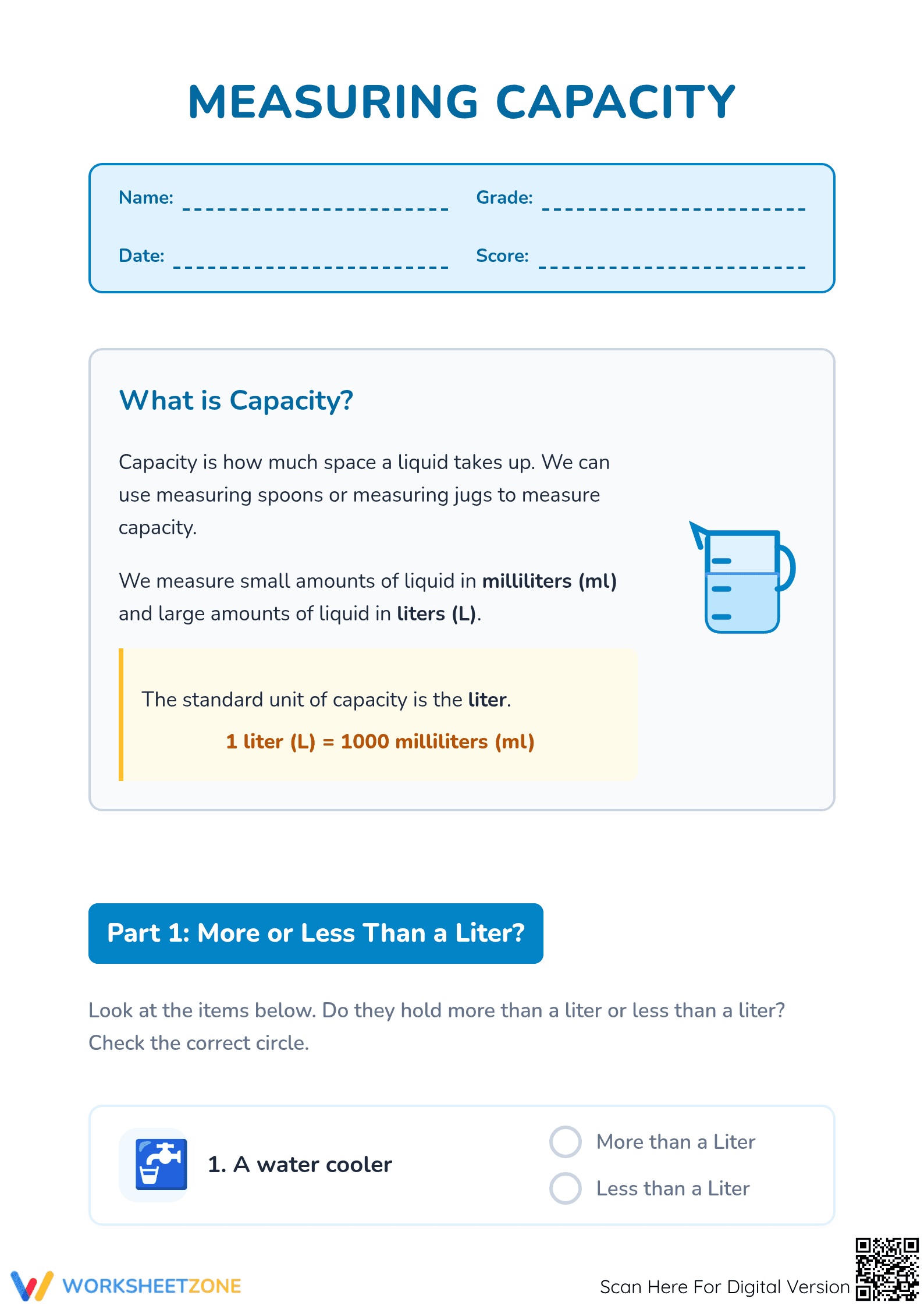
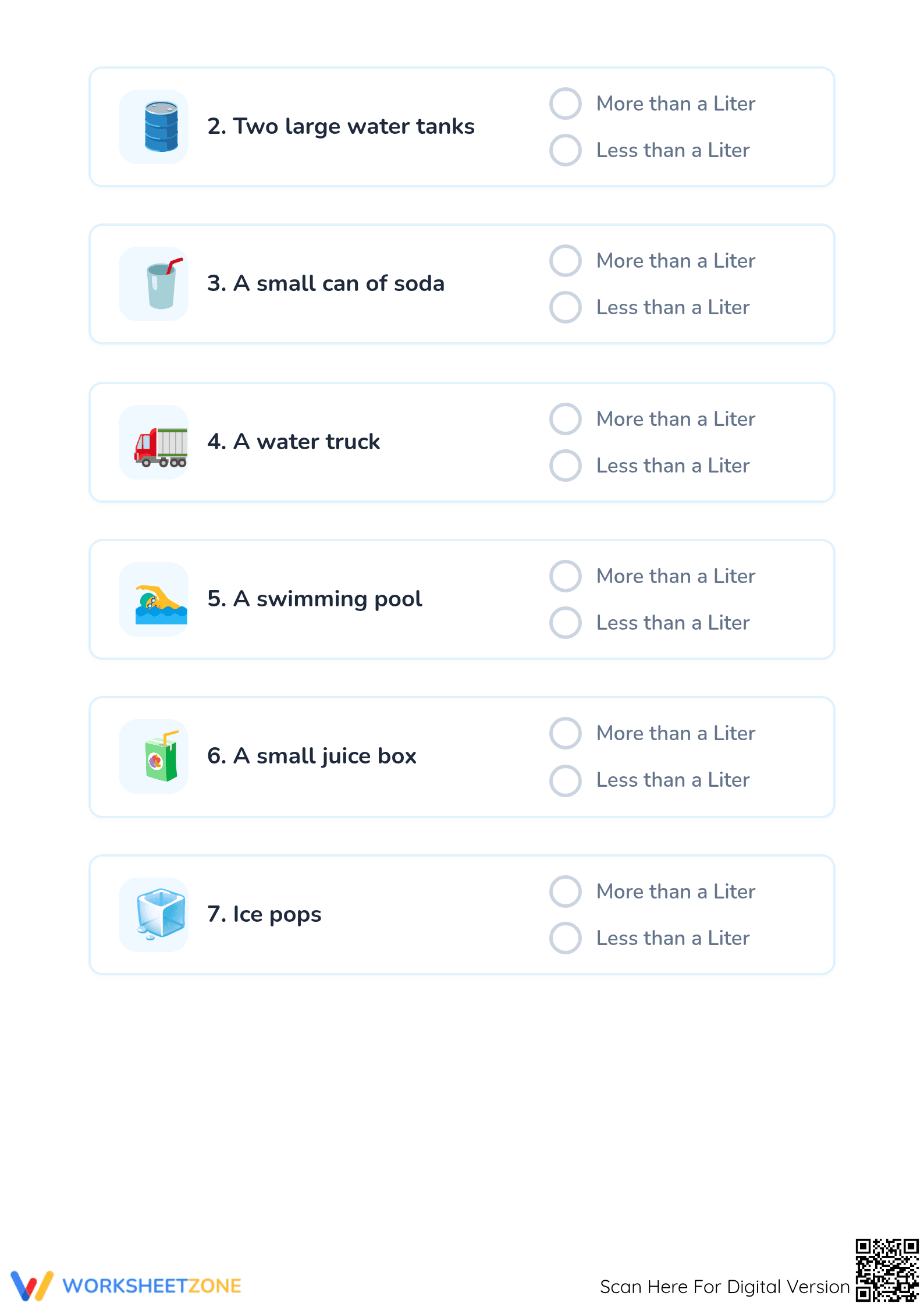
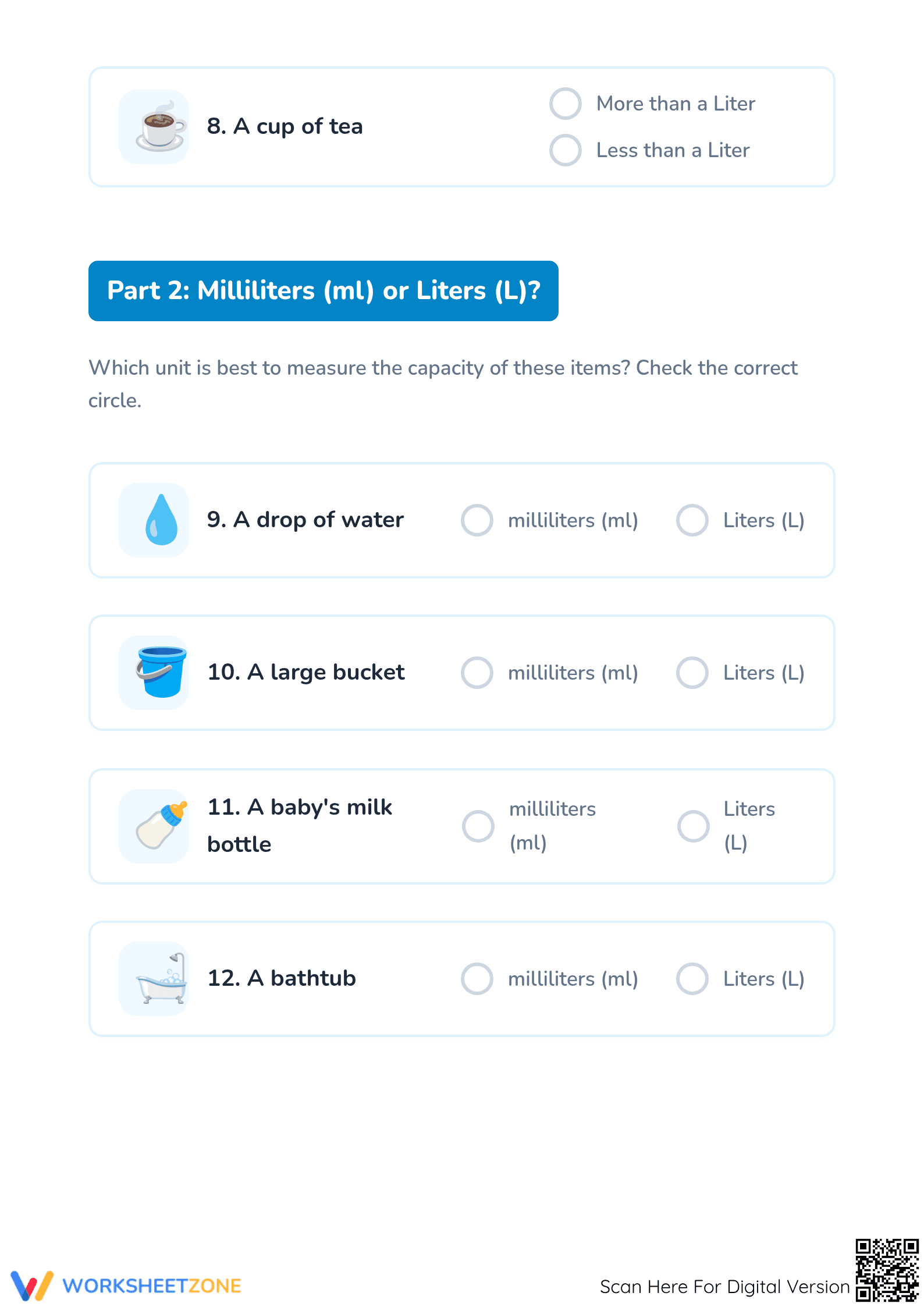
The resource contains three pages of structured practice. Page one introduces the definition of capacity and the relationship between liters and milliliters (1L = 1000mL). Part 1 features 8 problems where students compare objects to a one-liter benchmark. Part 2 includes 4 problems focused on choosing the most logical unit (mL or L) for specific containers. A full answer key is provided for quick grading.
This resource follows a zero-prep workflow designed for busy educators. First, print the three-page PDF (30 seconds). Second, distribute the worksheets to students for independent or guided practice (1 minute). Third, review the answers using the included key or have students self-correct (5 minutes). Total teacher preparation time is under 2 minutes, making it an ideal sub plan or morning work activity.
Primary alignment is to `CCSS.MATH.CONTENT.3.MD.A.2`, which requires students to measure and estimate liquid volumes using standard units. By asking students to choose between liters and milliliters for items like bathtubs and drops of water, the worksheet directly supports the estimation component of the standard. Both standard codes can be copied directly into lesson plans, IEP goals, or district curriculum mapping tools.
Use this worksheet during the "Guided Practice" phase of a measurement unit. After demonstrating the physical size of a liter bottle, assign Part 1 to check for understanding. It also serves as an effective formative assessment at the end of a lesson. Expect students to complete the 12 tasks in approximately 15 to 20 minutes depending on their familiarity with metric units.
This resource is designed for third-grade students but is also suitable for second-grade enrichment or fourth-grade review. It supports English Language Learners with clear visual icons for every problem. Pair this worksheet with a physical liter container and a small medicine dropper to provide a concrete anchor for the abstract concepts of volume.
According to the RAND AIRS 2024 report, high-quality instructional materials that emphasize estimation help bridge the gap between abstract mathematical concepts and real-world application. This worksheet targets CCSS.MATH.CONTENT.3.MD.A.2 by requiring students to evaluate the capacity of diverse objects, from a small juice box to a swimming pool. By focusing on the distinction between milliliters and liters, the 12 tasks reinforce the base-ten nature of the metric system while building the spatial reasoning necessary for advanced geometry and science. Research from Fisher & Frey (2014) suggests that providing clear definitions alongside scaffolded practice—as seen in the introductory block—supports the gradual release of responsibility. This resource ensures students develop a reliable internal benchmark for liquid volume, which is a critical precursor to performing precise measurements in laboratory settings or complex word problems.


