


























Views
Downloads




Printable Measuring Capacity Worksheet | Grade 2-3 Math
Paste this activity's link or code into your existing LMS (Google Classroom, Canvas, Teams, Schoology, Moodle, etc.).
Students can open and work on the activity right away, with no student login required.
You'll still be able to track student progress and results from your teacher account.
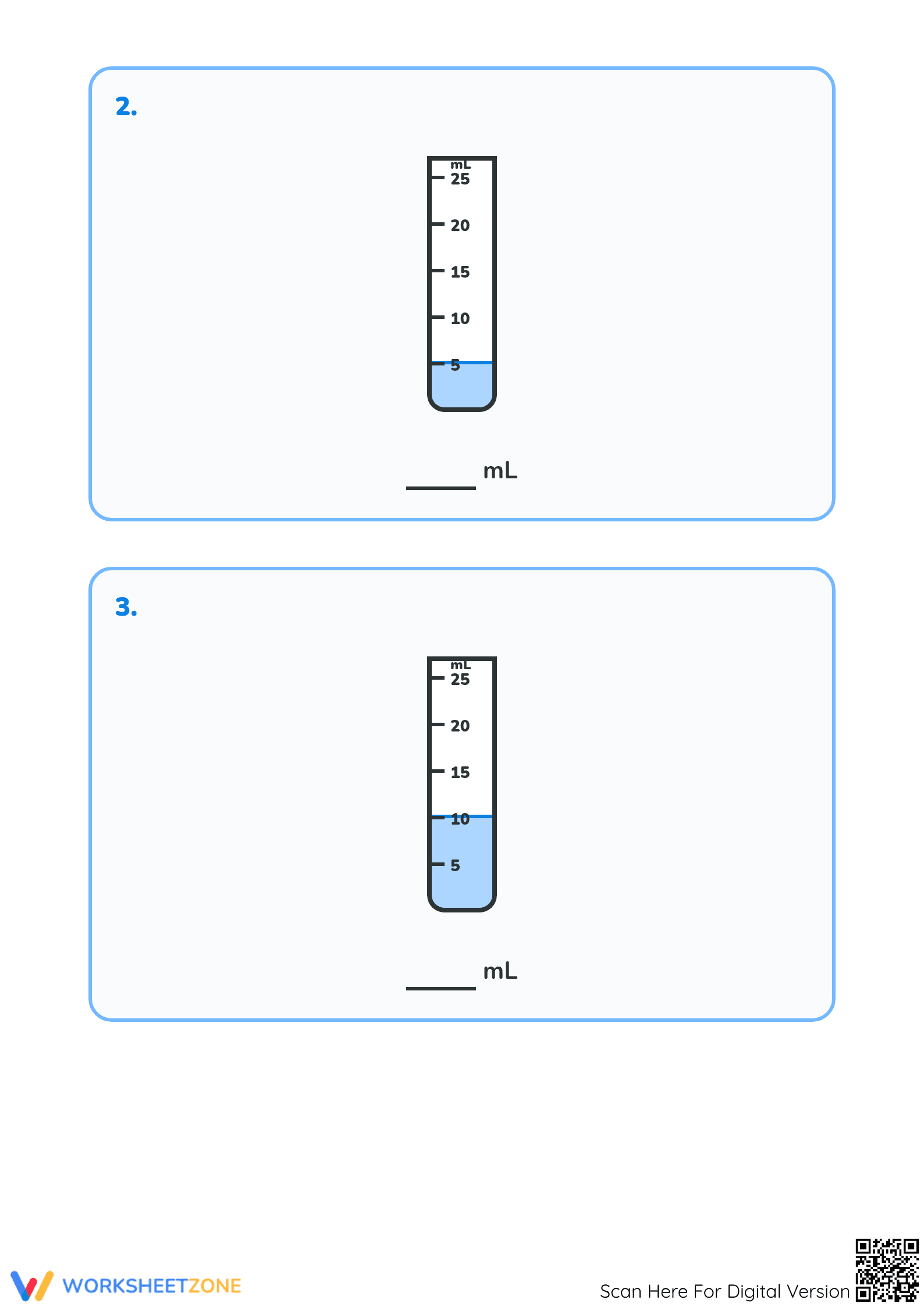
Measure liquid volume with confidence using this comprehensive printable resource. This Measuring Capacity worksheet provides students with a structured environment to practice reading graduated cylinders and visualizing milliliters. By completing these activities, learners bridge the gap between abstract numbers and physical volume units.
At a Glance
- Grade: 2–3 · Subject: Math
- Standard:
CCSS.3.MD.A.2— Measure and estimate liquid volumes using standard units like liters and milliliters.- Skill Focus: Graduated Cylinder Reading
- Format: 5 pages · 9 problems · Answer key included · PDF
- Best For: Independent practice or formative assessment
- Time: 15–20 minutes
Inside this 5-page PDF, teachers will find a clear set of exercises focused on metric volume. The first four pages contain 8 problems featuring graduated cylinders filled with blue liquid at various levels. The final page includes a "Bonus" section where students must color a cylinder to represent exactly 10 mL.
Skill Progression
- Guided Practice: The first tasks utilize whole-number markings (5, 10, 15, 20, 25 mL) to help students orient themselves to the scale.
- Supported Practice: Middle tasks require students to observe liquid levels that fall between increments, encouraging careful counting.
- Independent Application: The final task asks students to translate a numerical value back into a visual representation.
This sequential approach ensures students develop a robust mental model of capacity using a gradual-release framework.
Standards Alignment
This resource is specifically aligned to `CCSS.3.MD.A.2`. The standard requires that students "measure and estimate liquid volumes and masses of objects using standard units of grams (g), kilograms (kg), and liters (l)." While these cylinders use milliliters, they serve as the foundational prerequisite for understanding the metric system. This standard code can be copied directly into lesson plans or curriculum mapping tools.
How to Use It
Integrate this worksheet during the elaborate phase of a lesson on measurement. Teachers can use the first page as a whole-class activity before assigning the rest for independent work. For a formative assessment, observe if students are reading the liquid level at eye level. Total completion time is approximately 20 minutes.
Who It's For
This activity is designed for second and third-grade students introduced to the metric system. It also works as a refresher for fourth graders. Pair this worksheet with physical graduated cylinders and colored water for tactile verification of these paper-based exercises.
The CCSS.3.MD.A.2 standard is a critical benchmark in the transition from concrete counting to abstract measurement. According to the EdReports 2024 analysis of mathematical materials, the ability to visualize volume through graduated scales is a high-leverage skill that supports later success in physical science and higher-order mathematics. This worksheet addresses that need by providing nine targeted tasks that require both receptive reading and expressive drawing of milliliters. By mastering the 25 mL scale presented here, students develop the precision required for complex laboratory work and everyday estimations. The inclusion of a reverse-application task—coloring the cylinder—aligns with research suggesting that dual-encoding (interpreting and creating) leads to higher retention rates. This printable resource serves as a reliable bridge between introductory number sense and formal scientific measurement, ensuring that students meet grade-level expectations for volume estimation and accurate data recording.


