


























0
Views
0
Downloads

0.0
0
Save
0 Likes
Share
Choose the Unit for Volume
0 Views
0 Downloads
Paste this activity's link or code into your existing LMS (Google Classroom, Canvas, Teams, Schoology, Moodle, etc.).
Students can open and work on the activity right away, with no student login required.
You'll still be able to track student progress and results from your teacher account.
Information
Description
What It Is:
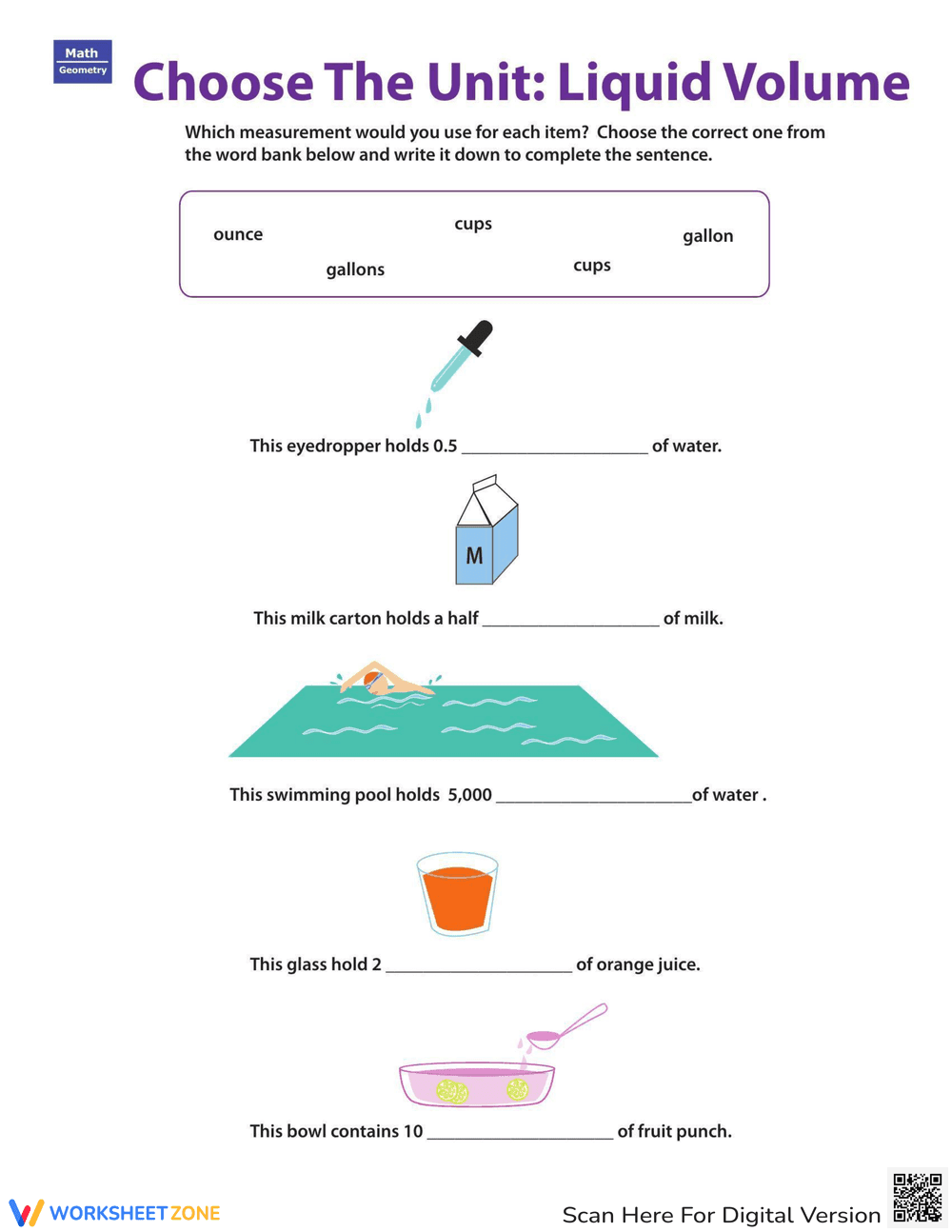
This is a math worksheet titled 'Choose The Unit: Liquid Volume'. It presents a series of fill-in-the-blank sentences where students must select the appropriate unit of measurement (ounce, gallons, cups, or gallon) to describe the liquid volume of various items. The items include an eyedropper, a milk carton, a swimming pool, a glass of orange juice, and a bowl of fruit punch. A word bank with the units of measurement is provided at the top of the worksheet.
Grade Level Suitability:
This worksheet is suitable for grades 2-4. It reinforces basic measurement concepts and helps students understand the relative sizes of different units of liquid volume. The scenarios are relatable and the language is simple enough for this age range.
Why Use It:
This worksheet helps students develop their understanding of liquid volume and measurement units. It encourages them to apply their knowledge to real-world scenarios and choose the most appropriate unit for measuring different quantities. It also reinforces vocabulary related to measurement.
How to Use It:
Students should read each sentence carefully and consider the item being described. They should then select the most appropriate unit of measurement from the word bank and write it in the blank space to complete the sentence. Encourage students to think about the relative sizes of the units to make their selections.
Target Users:
This worksheet is ideal for elementary school students learning about liquid volume and measurement. It can be used as a classroom activity, homework assignment, or review exercise. It is also suitable for students who need extra practice with measurement concepts.
This is a math worksheet titled 'Choose The Unit: Liquid Volume'. It presents a series of fill-in-the-blank sentences where students must select the appropriate unit of measurement (ounce, gallons, cups, or gallon) to describe the liquid volume of various items. The items include an eyedropper, a milk carton, a swimming pool, a glass of orange juice, and a bowl of fruit punch. A word bank with the units of measurement is provided at the top of the worksheet.
Grade Level Suitability:
This worksheet is suitable for grades 2-4. It reinforces basic measurement concepts and helps students understand the relative sizes of different units of liquid volume. The scenarios are relatable and the language is simple enough for this age range.
Why Use It:
This worksheet helps students develop their understanding of liquid volume and measurement units. It encourages them to apply their knowledge to real-world scenarios and choose the most appropriate unit for measuring different quantities. It also reinforces vocabulary related to measurement.
How to Use It:
Students should read each sentence carefully and consider the item being described. They should then select the most appropriate unit of measurement from the word bank and write it in the blank space to complete the sentence. Encourage students to think about the relative sizes of the units to make their selections.
Target Users:
This worksheet is ideal for elementary school students learning about liquid volume and measurement. It can be used as a classroom activity, homework assignment, or review exercise. It is also suitable for students who need extra practice with measurement concepts.


