These 3rd grade measurement and capacity pdf worksheets give teachers a direct path from the introductory idea that containers hold different amounts to the calculating, estimating, and comparing work the Common Core expects from eight- and nine-year-olds. The set spans metric units (liters and milliliters), U.S. customary units (cups, pints, quarts, and gallons), graduated-scale reading, and one-step word problems — all as standalone, printable resources. Each worksheet targets a specific skill cluster so teachers can assign selectively rather than working through the entire collection in one stretch.
The Specific Skills Targeted
Students work across five skill areas as they move through the collection:
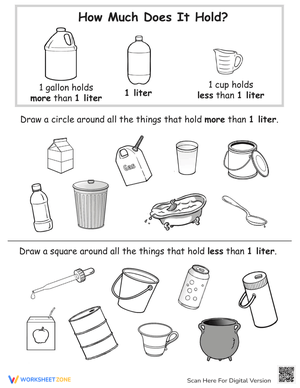
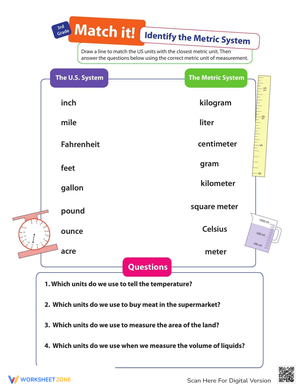
- Unit identification: Deciding whether a container — a soup pot, a medicine dropper, a fish tank — is best measured in milliliters or liters, or in cups versus gallons. Students circle, match, or sort items into unit categories.
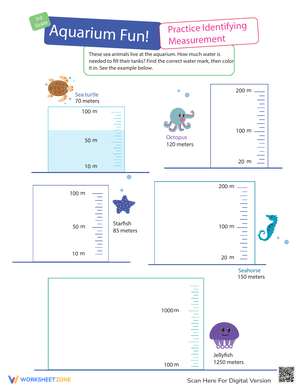
- Scale reading: Interpreting graduated cylinders, measuring cups, and beakers drawn to scale. Markings are not always labeled — students must calculate the interval value before reading the liquid level.
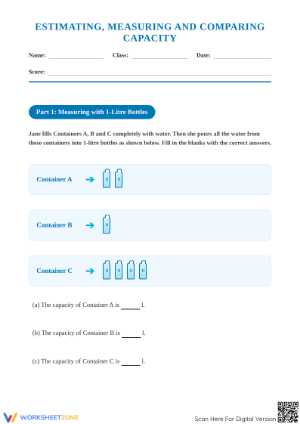
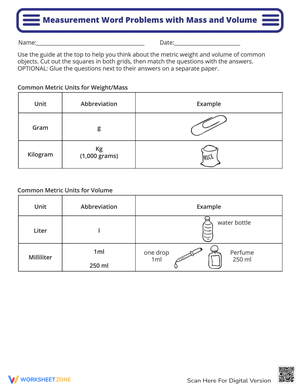
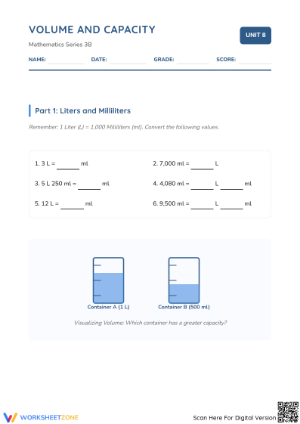
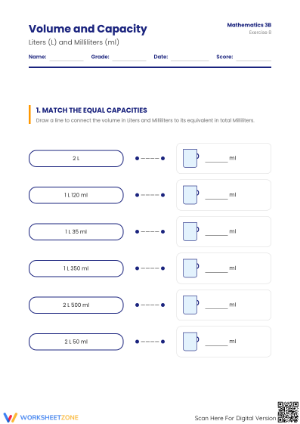
- Metric comparison and basic conversion: Ordering containers by volume, identifying which holds more or less than another, and anchoring the relationship that 1,000 mL equals 1 L. Formal multi-step conversion belongs in later grades, but the 1,000 mL benchmark appears consistently across the metric worksheets.
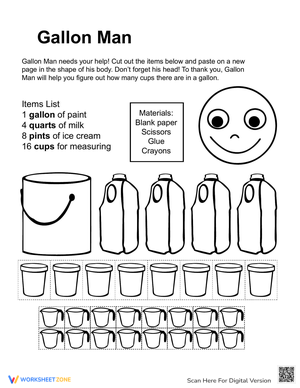
- U.S. customary relationships: Working with the cup–pint–quart–gallon sequence through diagrams, fill-in tables, and the Gallon Man visual model that third graders consistently find useful for recall.
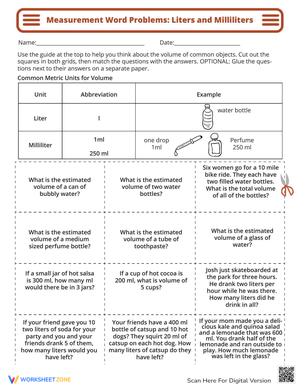
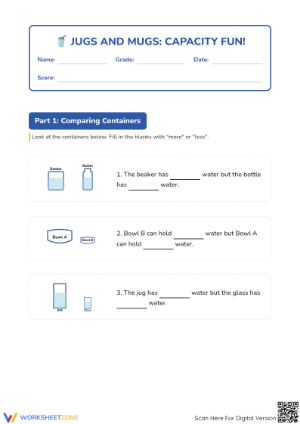
- Word problems: Solving one-step problems that require adding, subtracting, or comparing volumes in context — recipes, fish tanks, rain gauges, and similar situations third graders can actually picture.
Mistakes Students Make That These Worksheets Help You Catch
The volume-versus-capacity distinction sounds simple in a lesson introduction, but in actual student work it collapses fast. Ask a student what volume of water is in a pitcher drawn half full, and a significant portion will write the capacity — the total the container holds — because that is the labeled number they can find on the diagram. The worksheets deliberately present partially-filled containers without a labeled maximum so students have to read the scale rather than copy the top line.
Scale reading produces its own category of errors. When a graduated cylinder has markings every 20 mL, many students assume each interval is 10 mL — they see lines and divide by two without checking. A reliable checkpoint is to have students write the value of one interval in the margin before they record the liquid level. The 3rd grade measurement and capacity pdf worksheets in the scale-reading section include a prompt for exactly this step, which catches the miscounting before it becomes a wrong answer on an assessment.
In customary units, the quart-gallon relationship holds up better in student memory than the cup-pint relationship. Students who correctly know that four quarts make a gallon will still write that four cups make a gallon, skipping pints entirely. That confusion is predictable, not random, and it warrants a direct class discussion before assigning the customary-unit worksheets rather than waiting to see the error appear in completed work.
How to Build These Worksheets Into Your Lesson Plans
The strongest placement for the unit-identification and scale-reading worksheets is the day after a hands-on measurement station, not before. When students have already poured colored water into cylinders and called out the readings aloud, the worksheet becomes a record of something they experienced rather than an abstract exercise. That sequence — physical manipulation first, then paper — makes a visible difference in how accurately students mark the scales and how quickly they move past the interval-counting errors described above.
For teachers running math centers, one station with real measuring cups and containers pairs naturally with an adjacent station where students complete the corresponding worksheet. The tactile station builds the mental image; the worksheet forces them to translate that image into numbers and units. Ten to fifteen minutes at each station is enough for most classes without losing the lesson thread.
The word problem worksheets work well as Wednesday warm-ups once unit identification and scale reading are in place. Spreading them across the week rather than front-loading all the word problem practice gives students time to consolidate each relationship — the kind of spaced retrieval that shows up on end-of-unit assessments in a way that massed practice does not. These 3rd grade measurement and capacity pdf worksheets are also readable and navigable at home, which matters when homework is the only mid-unit practice some students get.
Standard Alignment
CCSS.MATH.CONTENT.3.MD.A.2 requires third graders to measure and estimate liquid volumes using standard units, solve one-step word problems involving those volumes, and represent measurement data appropriately. In most pacing guides, this standard lands in the second half of the year — after students have solid footing with multiplication and division, since several of the word problems at this level require those operations to solve. The worksheets in this set address the full range of 3.MD.A.2 expectations: unit fluency, estimation, scale reading, and written computation set in a measurement context.
Adjusting the Worksheets for a Range of Learners
For students still building number sense around large quantities, the unit-identification worksheets are the right entry point. Matching containers to units requires reasoning about relative size rather than calculation, and it gives struggling learners early success before the scale-reading and computation work begins. Providing a visual reference card — a water bottle image for 1 L, a raindrop for 1 mL — keeps the focus on measurement reasoning rather than memorization of isolated facts.
Advanced students move quickly past the labeled-scale worksheets and benefit most from the unlabeled-interval exercises and the multi-context word problems. A useful extension is to have them write their own word problem using a container they measured in class, then swap with a partner. Constructing a problem from a known answer is harder than solving a given one, and it reveals whether students actually understand the units or are just performing operations. For English learners, the visual-heavy worksheets — especially the container diagrams and matching tasks — reduce language demand without reducing mathematical rigor. Pairing one of these 3rd grade measurement and capacity pdf worksheets with a brief vocabulary anchor chart covering volume, capacity, liter, and milliliter supports language acquisition and math comprehension simultaneously, rather than asking students to sort out both at once.
Frequently Asked Questions
My students keep confusing volume and capacity even after direct instruction. What actually helps?
The clearest fix is to practice consistently with containers that are not full. When a container is full, its volume and capacity are the same number, which reinforces the confusion rather than resolving it. Present a worksheet showing a beaker filled to the halfway mark and ask both questions in sequence: "What is the capacity of this beaker?" and "What is the volume of water right now?" The gap between the two answers is where the understanding lives. Students who answer correctly on a full container will often still get the partially-filled version wrong on the first try — expect that, and use it as the teaching moment rather than treating it as a failure to learn.
How do I explain the meniscus to third graders without making it more confusing than the measurement itself?
Tell them the liquid "dips in the middle" and to read from the bottom of that dip, not from the edges. That is all they need. Avoid introducing the word meniscus until students are reading scales reliably — the terminology is not the skill, and adding a new vocabulary word while students are still working out the technique splits their attention. Once they can consistently find the bottom of the curve, introduce the term as a name for something they already know how to locate.
Should I teach metric and customary units at the same time or separately?
Separately, at least in the initial instruction. Teaching both simultaneously creates a unit-sorting problem on top of the measurement problem — students who are still anchoring what a liter looks like do not need to simultaneously anchor what a quart looks like. Build metric fluency first, including scale reading in milliliters and liters, then introduce customary units as a distinct focus. The worksheets in this set are organized to support that sequence, with metric work preceding the customary-unit exercises so each system gets the attention it needs before students compare across them.













 Interactive Worksheet Maker
 Quiz Maker
 Word Search Maker
 Crossword Puzzle Maker
 Word Scramble Generator
 Sentence Scramble Generator
 Handwriting Worksheet Generator
 Name Tracing Generator
 Fill In The Blank Generator