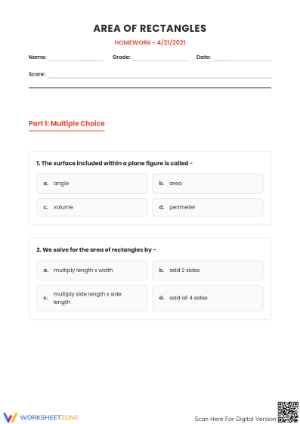
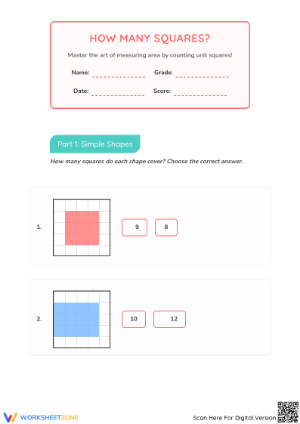
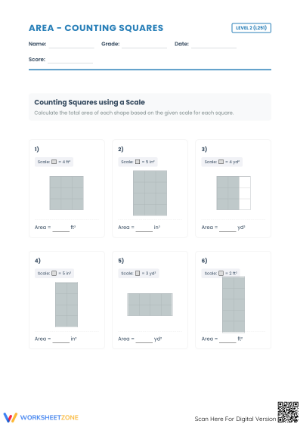
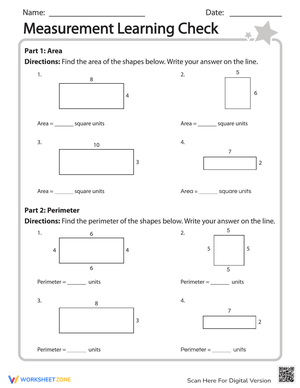
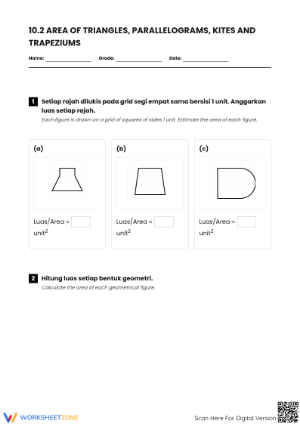
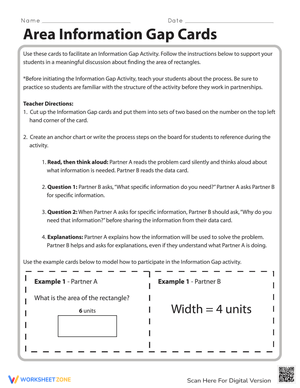
These 3rd grade area worksheets move students from counting unit squares inside hand-drawn grids all the way to multiplying side lengths without any visual support — a progression that takes real instructional sequencing to execute well. The set addresses rectangular area, the tiling-to-multiplication transition, and rectilinear figures that require decomposition before any calculating begins. What teachers get is a matched sequence of worksheets that aligns with where students actually are in building their understanding of square units.
What the Set Covers
Each worksheet targets a specific point on the area learning progression rather than treating all area problems as interchangeable. The skills addressed include:
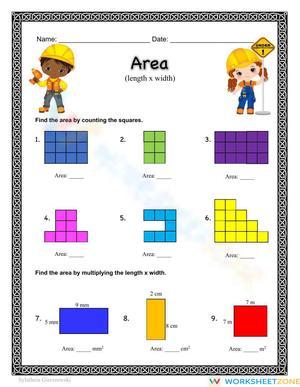
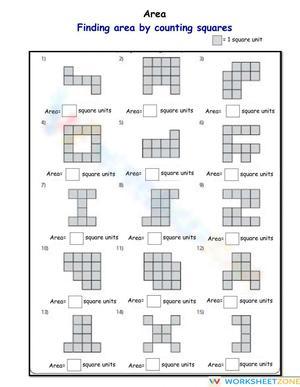
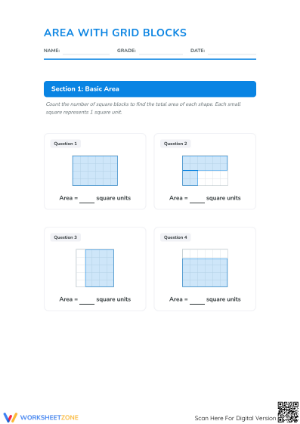
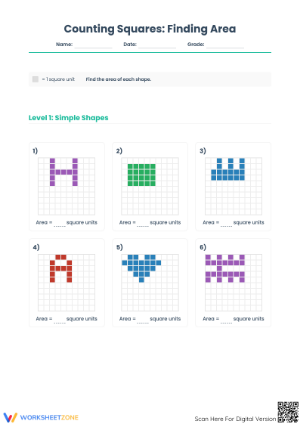
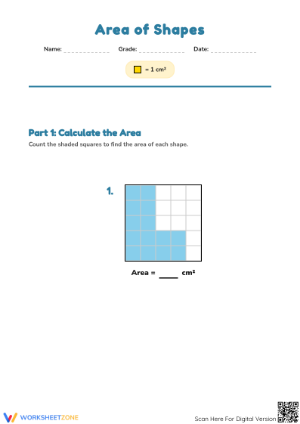
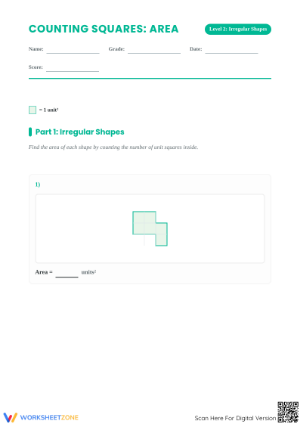
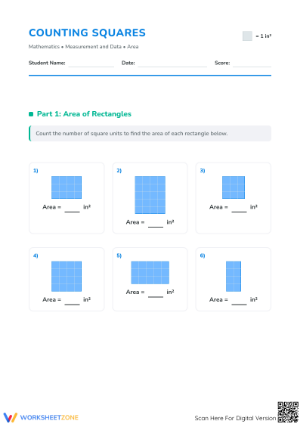
- Counting unit squares inside fully tiled rectangles
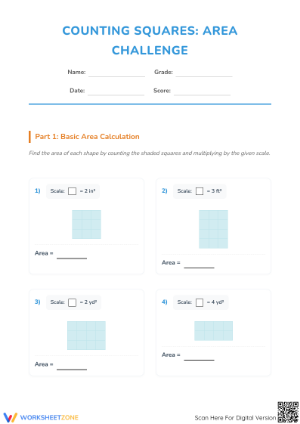
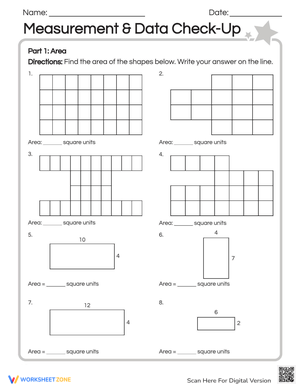
- Completing a partial grid to determine area
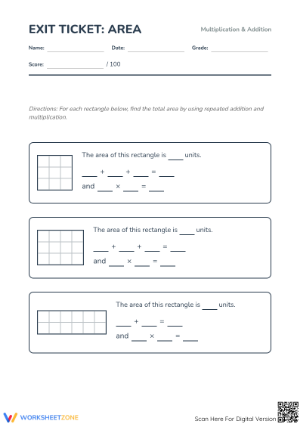
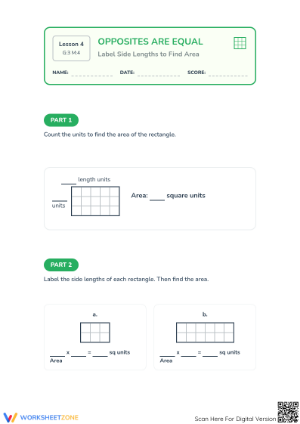
- Writing and solving a multiplication equation based on row-and-column structure
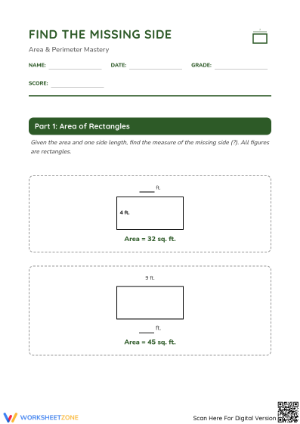
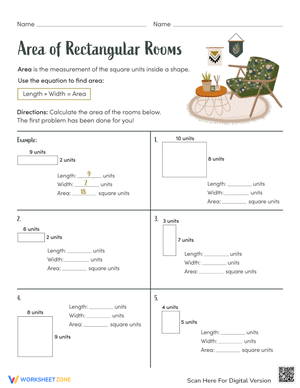
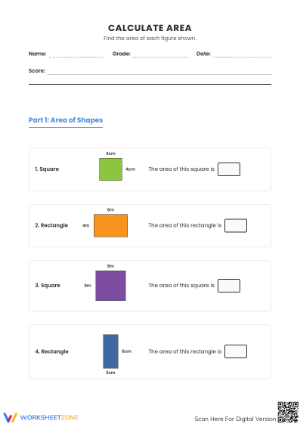
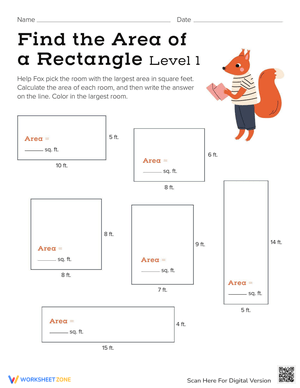
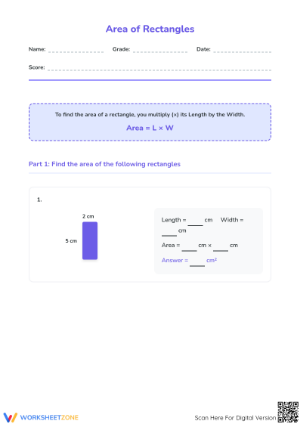
- Finding the area of labeled rectangles with no grid provided
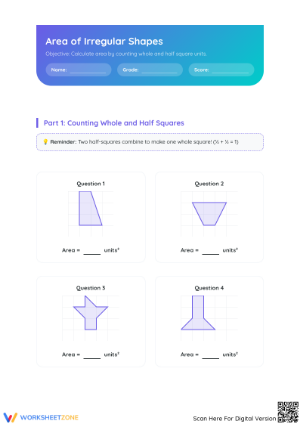
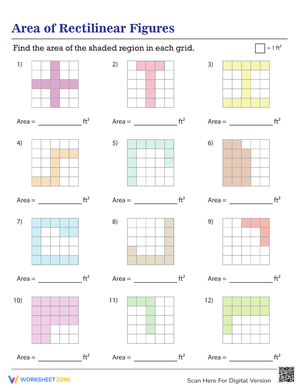
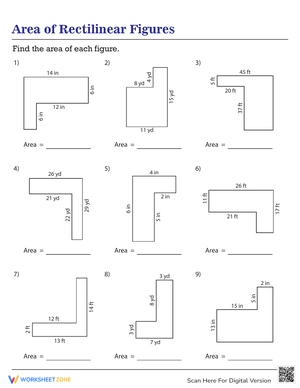
- Decomposing L-shaped rectilinear figures into two rectangles and adding the partial areas
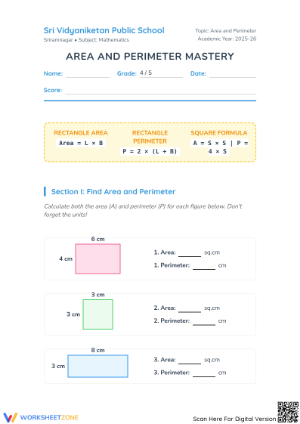
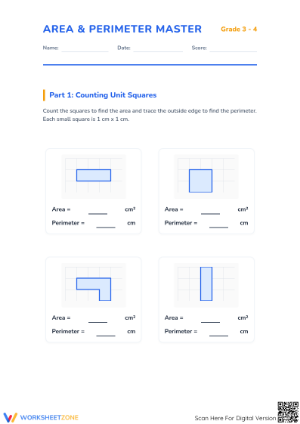
- Distinguishing area from perimeter when both measurements appear in the same problem
From Tiling to Multiplication: The Bridge That Actually Matters
The tiling-to-multiplication connection is the central instructional challenge of this unit. When students tile a rectangle with unit squares, they are building an array — the same structure they already use for multiplication. A 4-by-6 rectangle filled with unit squares is also 4 groups of 6, and recognizing that overlap is what allows students to stop counting individual squares and start multiplying. Worksheets that remove grid lines incrementally — showing full tiling first, then edge squares only, then a bare labeled rectangle — require students to reconstruct the array mentally rather than depend on the visual permanently. That gradual reduction of support is what converts procedural counting into flexible reasoning, and it is genuinely a moment teachers can watch happen in real time.
Mistakes Students Make That These Worksheets Help You Catch
The most persistent error at this grade level is not area-perimeter confusion — that one gets plenty of instructional attention. The subtler problem is students who tile correctly but record the wrong unit. A student fills a 3-by-5 rectangle, counts 15 squares accurately, and writes "15 cm" instead of "15 sq cm" or "15 cm²." They have the count right; they have not yet internalized that the unit changes dimension when you move from length to area. This shows up most clearly on the bare labeled-rectangle problems, where there is no grid to remind them they are counting squares rather than measuring a side.
A second predictable error appears on rectilinear figures. Students who decompose an L-shape correctly will sometimes treat the dividing line they drew as an additional dimension to account for — essentially adding the length of the interior segment to one of their partial area calculations. If completed worksheets show totals that are consistently a few square units too high on the rectilinear problems, that is almost certainly what is happening. A quick whole-class correction before students repeat the process is worth the five minutes.
How to Build These Worksheets Into Your Lesson Plans
The counting worksheets work best as Monday warm-ups the week after students have handled physical square tiles in class. Spacing the representational practice across a weekend from the concrete manipulation strengthens retention in a way that back-to-back lessons do not — students who tile on Friday and then see a grid worksheet on Monday are more likely to make the connection independently rather than mirroring what they watched the teacher do. The multiplication-based worksheets fit better mid-unit, after the array connection has been made explicitly in whole-group instruction. Saving the rectilinear problems for the last portion of a lesson where students have just decomposed shapes with manipulatives gives those worksheets real instructional context rather than dropping a new skill without grounding.
The area-perimeter comparison problems are most useful in the six or seven days immediately after perimeter is introduced. At that point, students need repeated low-stakes practice distinguishing the two — not a formal assessment, just enough exposure to prevent the concepts from fusing together. Reviewing a completed worksheet using a document camera and asking students to explain in one sentence what they measured, not how they measured it, surfaces the conceptual distinction efficiently. These 3rd grade area worksheets also hold up well as small-group formative tools during math rotations, where you can observe three or four students work in real time and catch unit-labeling errors before they solidify into habits.
Standard Alignment
CCSS.MATH.CONTENT.3.MD.C.5 defines area as an attribute of plane figures and establishes the unit square as the standard measuring tool. CCSS.MATH.CONTENT.3.MD.C.6 requires students to measure area by counting unit squares, including both standard and non-standard units. CCSS.MATH.CONTENT.3.MD.C.7 connects area to multiplication and addition, including the expectation that students decompose rectilinear figures into non-overlapping rectangles and add the partial areas to find a total.
In classroom terms, these three standards represent an eight-to-ten week arc that most Grade 3 programs place in the second semester. The .C.5 and .C.6 work lands after multiplication fact fluency is underway — not before — because the area-as-array insight requires students to already have working familiarity with equal groups. Rectilinear decomposition under .C.7 is typically among the last geometry standards formally assessed before end-of-year review, making the rectilinear worksheets particularly useful for targeted practice in the final trimester.
Adapting the Set for Mixed-Ability Classrooms
Students still working on multiplication fact fluency can use the fully tiled worksheets longer than grade-level peers — counting squares is a valid, standards-aligned method under 3.MD.C.6, and moving those students onto bare labeled rectangles before the multiplication foundation is solid creates frustration without adding conceptual understanding. Placing a multiplication reference chart alongside the labeled-rectangle worksheets lets those students focus on the area reasoning without fact retrieval blocking the whole task.
For students ready to move beyond grade-level expectations, the rectilinear worksheets extend naturally by asking them to find two different valid decompositions of the same figure and verify that both methods produce identical totals. That self-checking task builds early algebraic reasoning alongside the geometry. These 3rd grade area worksheets can also support enrichment by presenting figures with one missing side length and a known total area, asking students to work backward — a meaningful challenge that draws on division concepts without requiring a completely separate resource.
Frequently Asked Questions
When should students move from counting squares to using multiplication?
As soon as students recognize that a rectangle's rows and columns form an array, they are ready to multiply — and that recognition often comes earlier in the unit than teachers anticipate. The partial-grid worksheets accelerate this shift because students who try to count the missing interior squares quickly realize multiplication is more reliable. Most students make the transition somewhere in the middle of the tiling unit, not at the end.
How do these worksheets address the area-perimeter mix-up?
Several worksheets present both measurements for the same figure and ask students to label each answer with the correct unit. That side-by-side format forces students to actively distinguish between the two concepts in a way that teaching them weeks apart does not. If a class has already started conflating area and perimeter, these 3rd grade area worksheets work well as a targeted correction tool — a few minutes of whole-class comparison, identifying which unit belongs to which measurement, goes further than re-explaining the definitions from scratch.
Are the rectilinear figure worksheets appropriate for all 3rd graders at the same time?
No. Rectilinear decomposition belongs after students are confident with rectangular area and can add two-digit numbers reliably, since the final step requires combining two partial areas. Introducing these worksheets too early adds cognitive load at the wrong moment — students still sorting out unit squares cannot simultaneously manage figure decomposition. Waiting until rectangular area feels automatic before moving the class to L-shaped figures makes the transition smoother and keeps the rectilinear problems from registering as an entirely new concept rather than an extension of what students already know.













 Interactive Worksheet Maker
 Quiz Maker
 Word Search Maker
 Crossword Puzzle Maker
 Word Scramble Generator
 Sentence Scramble Generator
 Handwriting Worksheet Generator
 Name Tracing Generator
 Fill In The Blank Generator