


























Views
Downloads
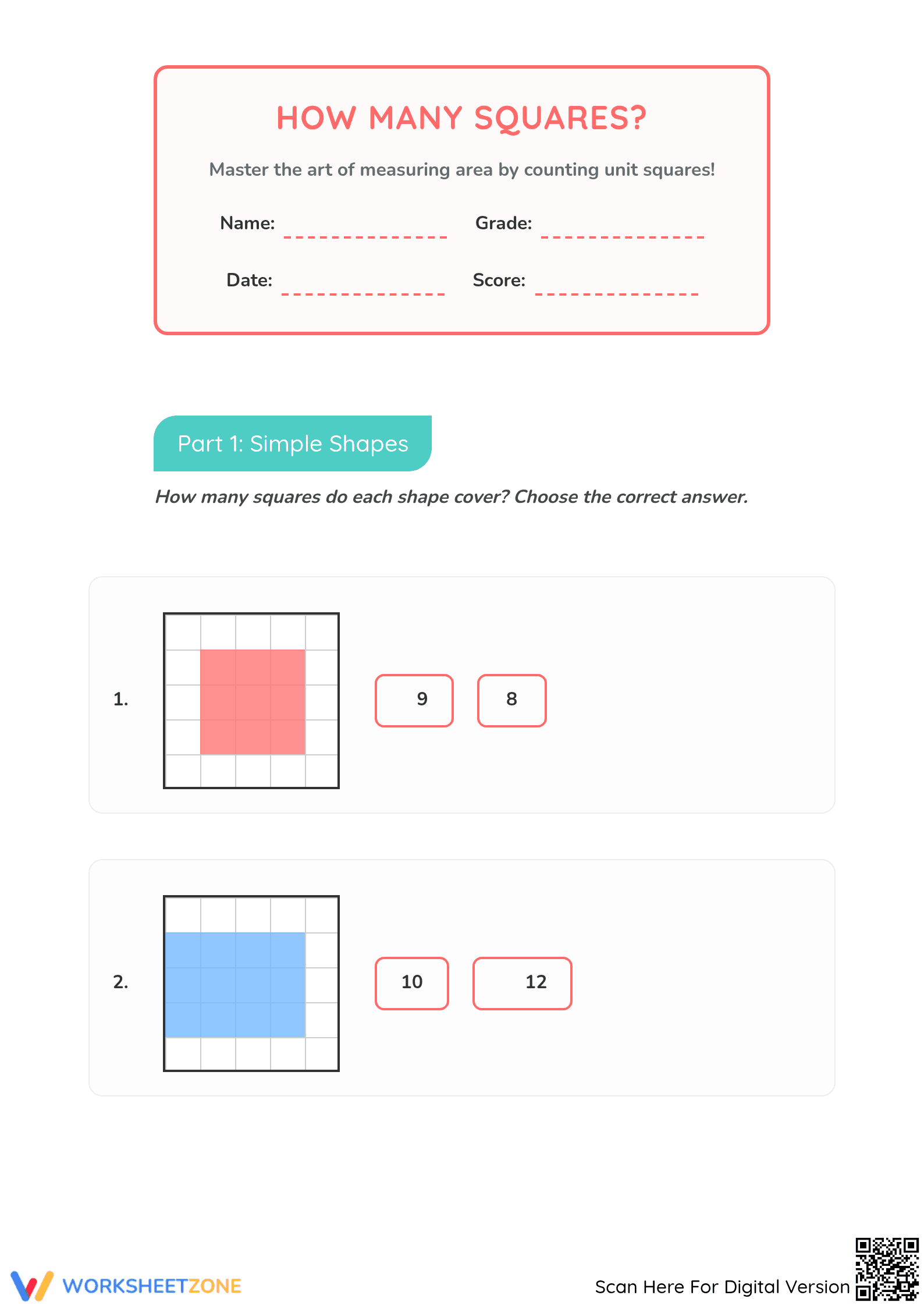
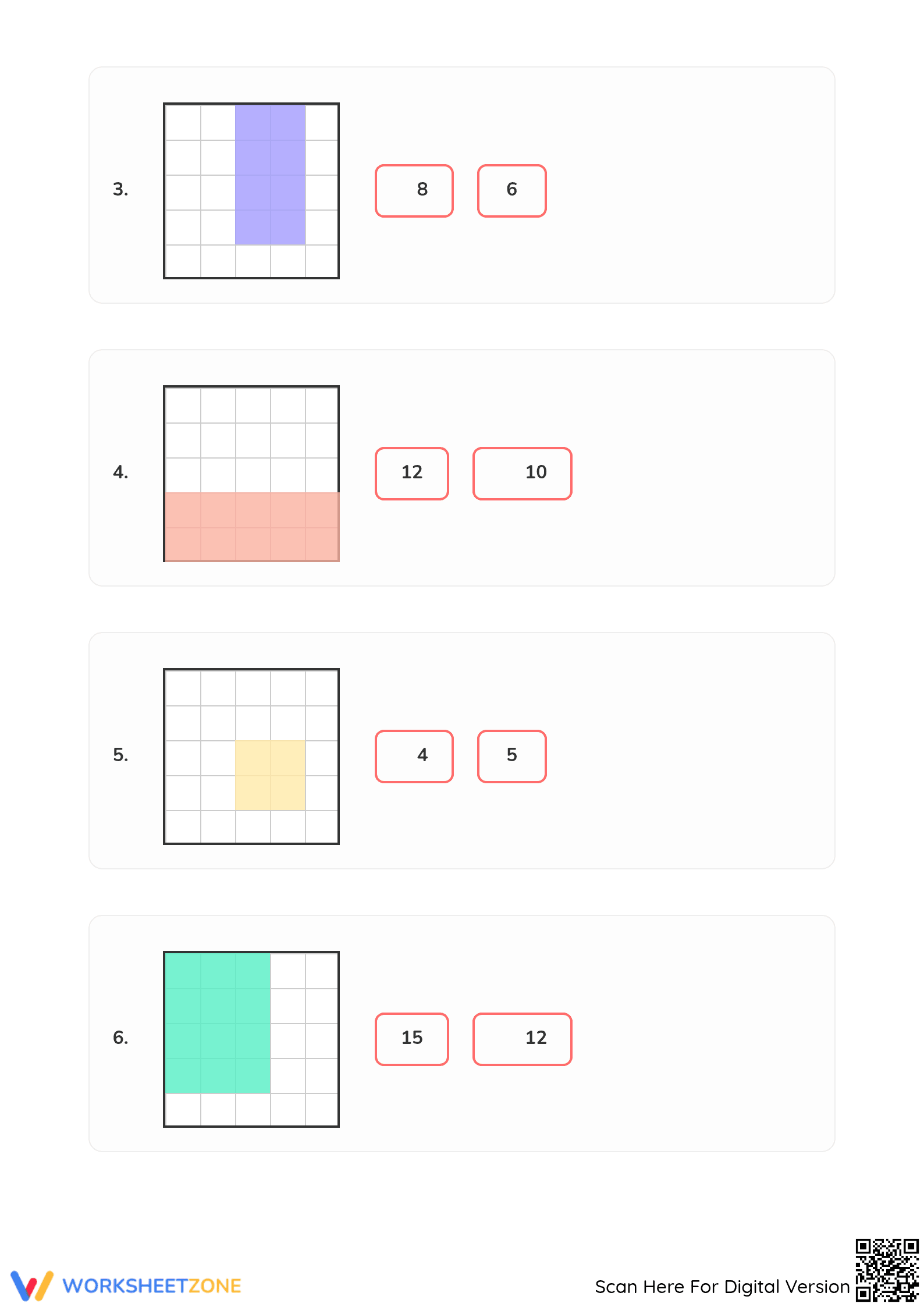
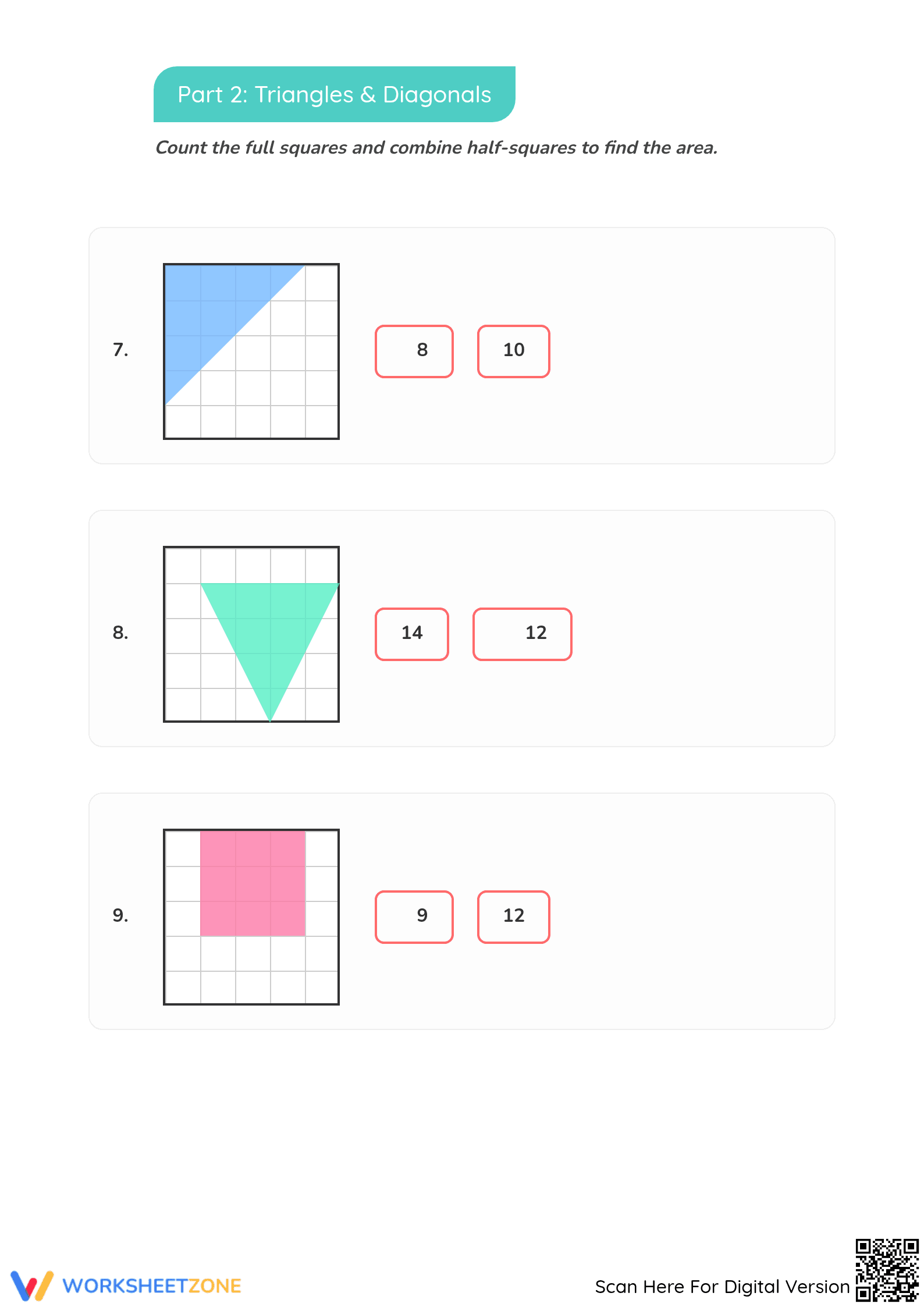
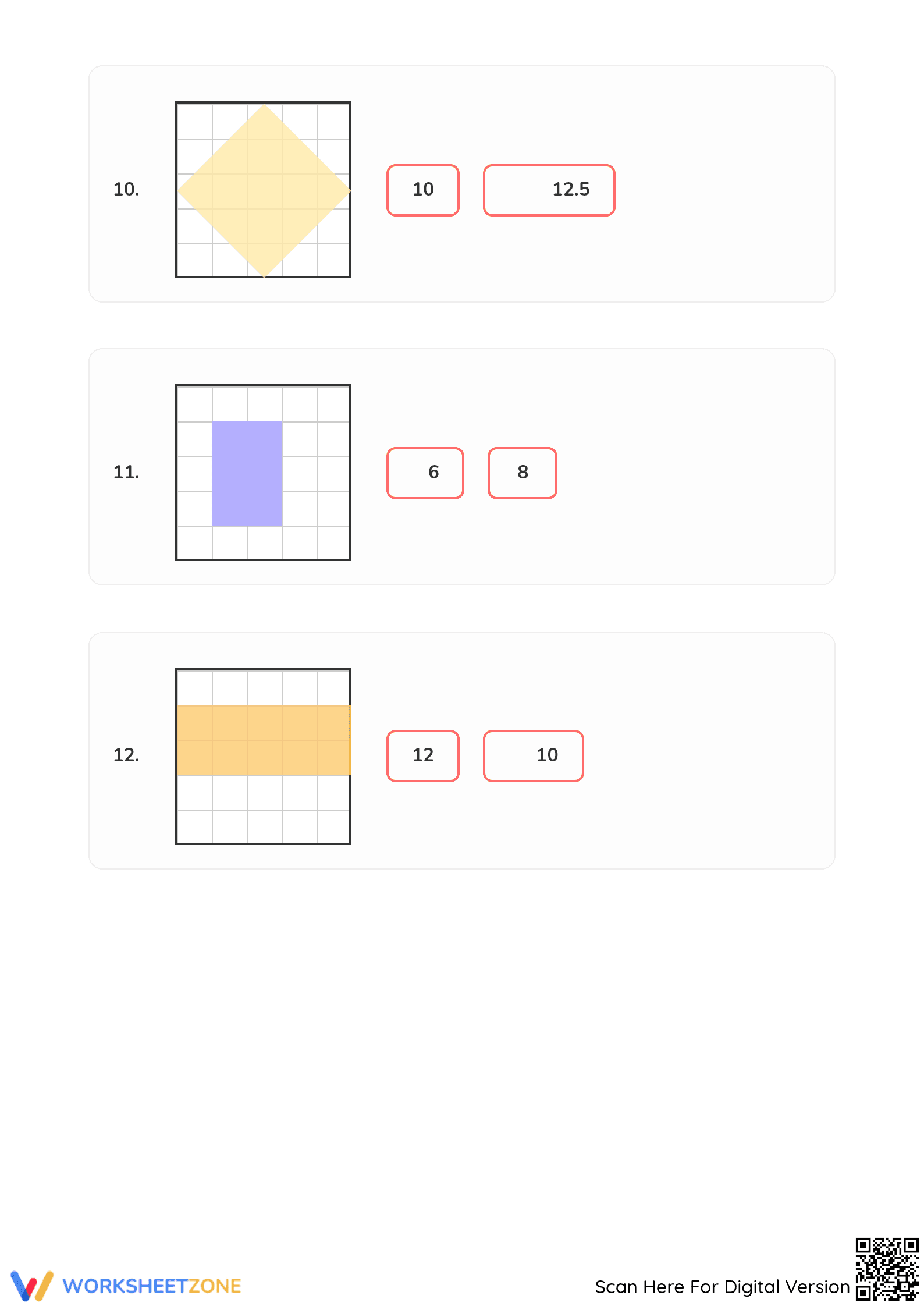

Counting Unit Squares Area Worksheet | Printable Grade 3
Paste this activity's link or code into your existing LMS (Google Classroom, Canvas, Teams, Schoology, Moodle, etc.).
Students can open and work on the activity right away, with no student login required.
You'll still be able to track student progress and results from your teacher account.
This comprehensive Grade 3 area worksheet helps students master the fundamental concept of measurement by counting unit squares to determine the total area of various figures. By working through sixteen structured problems, learners transition from simple rectangles to complex composite shapes, building a solid foundation for more advanced geometric calculations and spatial reasoning skills.
At a Glance
- Grade: 3 · Subject: Math
- Standard:
CCSS.MATH.CONTENT.3.MD.C.6— Measure area by counting unit squares such as square cm or square inches- Skill Focus: Area of simple and composite figures
- Format: 5 pages · 16 problems · Answer key included · PDF
- Best For: Independent practice and formative assessment
- Time: 25–35 minutes
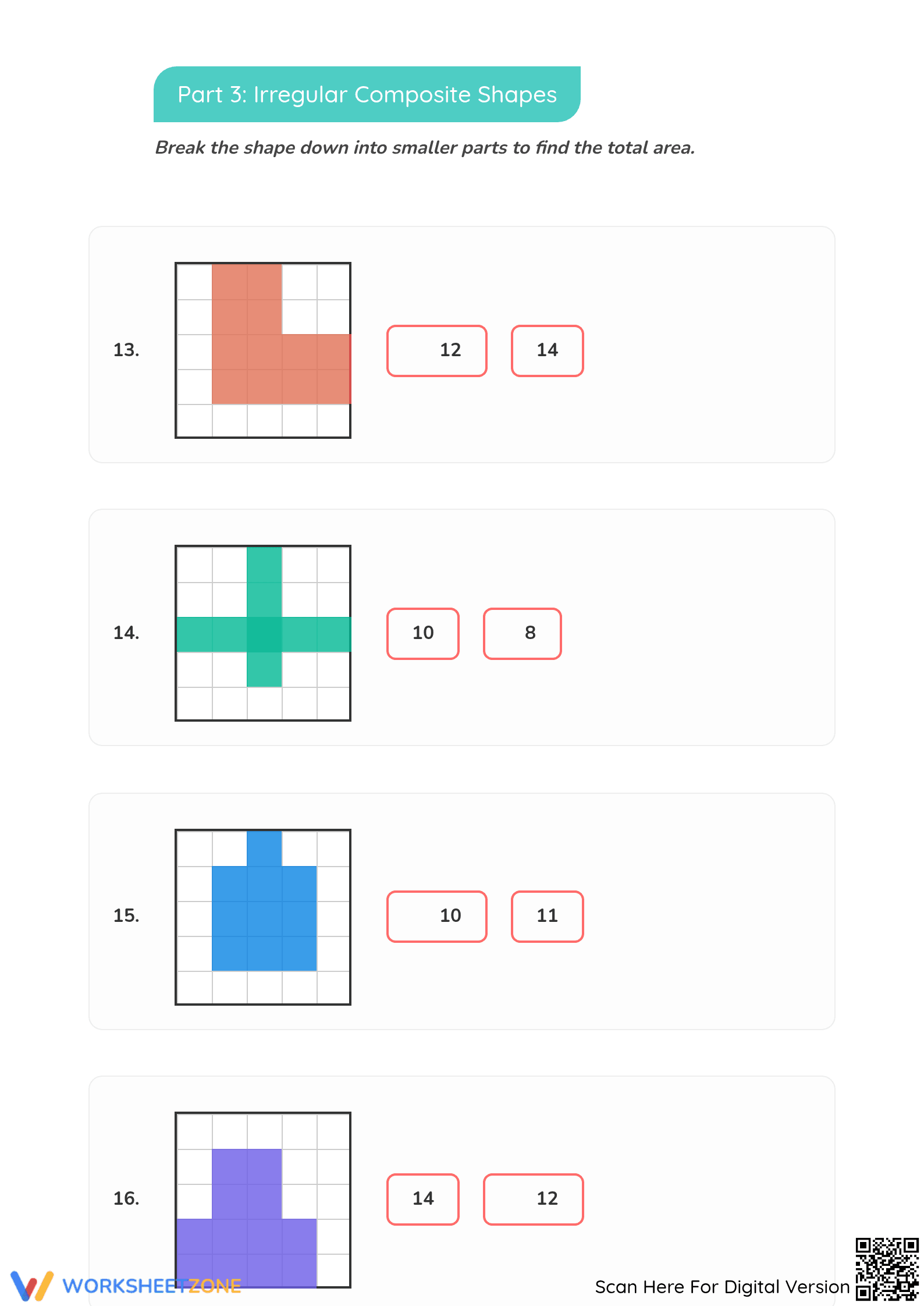
The packet consists of five detailed pages containing sixteen unique tasks designed to scaffold student learning. The problems are divided into three distinct parts: simple shapes, triangles and diagonals, and irregular composite shapes. Each task features a clear grid background where students select the correct area from multiple-choice options. A full answer key is included for rapid grading or self-correction.
Skill Progression
- Guided Practice: The first six problems focus on standard rectangular shapes, providing clear visual cues for counting full unit squares.
- Supported Practice: Problems 7 through 12 introduce diagonal lines and triangles, challenging students to combine half-squares to find a whole unit.
- Independent Practice: The final four tasks require students to decompose complex, irregular composite figures into smaller manageable parts to calculate the total area.
This progression follows a gradual-release model, moving from concrete counting to more abstract spatial decomposition.
Standards Alignment
This resource is directly aligned with CCSS.MATH.CONTENT.3.MD.C.6, which requires students to measure area by counting unit squares. It also supports standard 3.MD.C.7b by having students represent the area of rectangles in mathematical problems. Both standard codes can be copied directly into lesson plans, IEP goals, or district curriculum mapping tools.
How to Use It
Incorporate this worksheet during the independent practice phase of a measurement lesson. Teachers can use the first page as a whole-class guided activity to model counting strategies, then assign the remaining pages. During completion, observe students as they tackle the diagonal shapes; this serves as a critical formative-assessment point. Expect a 30-minute completion time for most third-grade learners.
Who It's For
This resource is ideal for Grade 3 students beginning their area unit, as well as Grade 4 learners needing a refresher on decomposition. The multiple-choice format provides scaffolding for English Language Learners and students with IEP accommodations, while the composite section offers extension for advanced learners. It pairs perfectly with physical square tile manipulatives.
The conceptual framework of this area worksheet is rooted in the "Area and Perimeter" research module from RAND AIRS 2024, which emphasizes that early mastery of unit square counting is a prerequisite for understanding the multiplicative nature of the area formula. By providing sixteen distinct opportunities to interact with unit squares, this resource reduces cognitive load through visual scaffolding, allowing students to focus on the spatial relationships within a grid. Research from NAEP indicates that students who can successfully decompose composite figures into smaller units demonstrate higher proficiency in middle-school geometry. This worksheet specifically targets that developmental bridge by transitioning learners from simple counting to strategic decomposition. The inclusion of diagonal lines further pushes students to conceptualize units as flexible entities that can be partitioned and recombined, a key skill for later work with non-rectangular polygons. This evidence-based approach ensures that Grade 3 learners develop a robust, transferable understanding of area.


