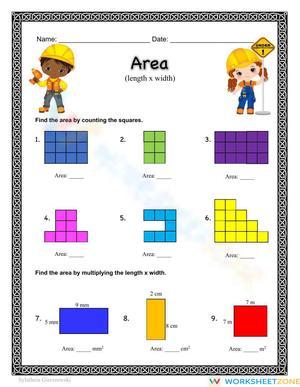
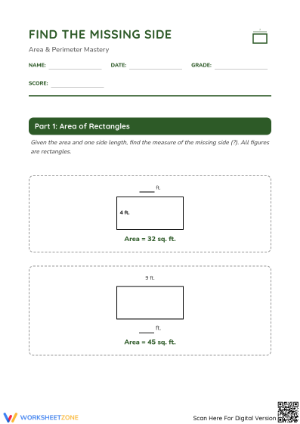
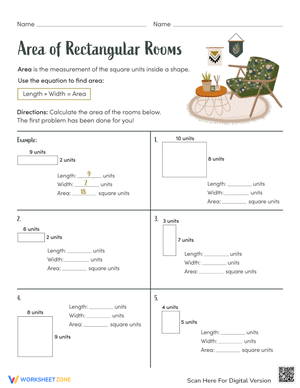
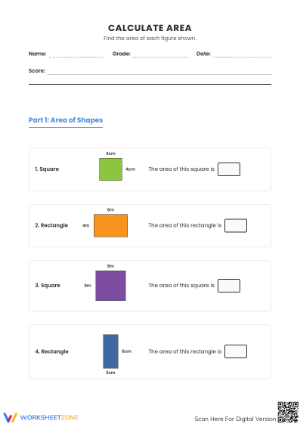
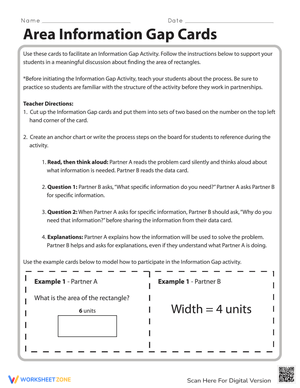
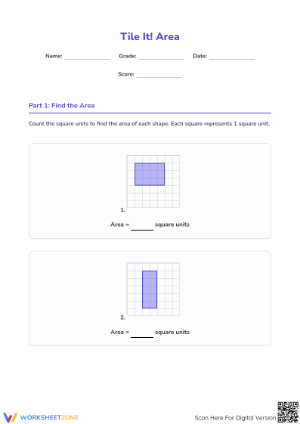
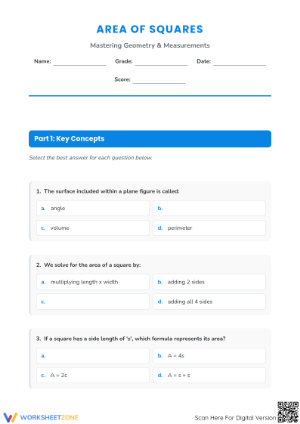
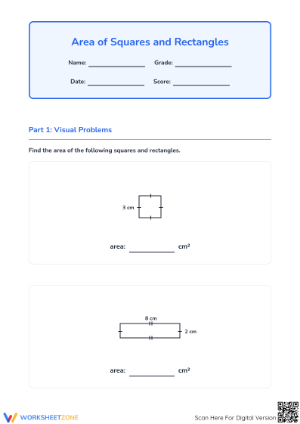
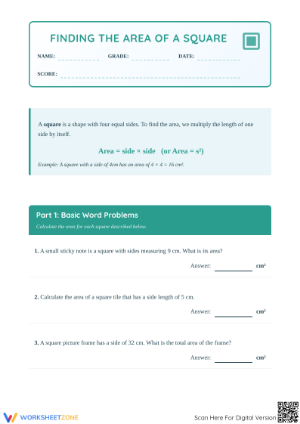
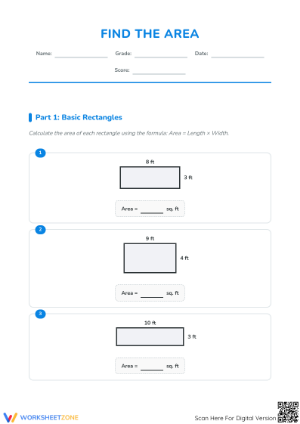
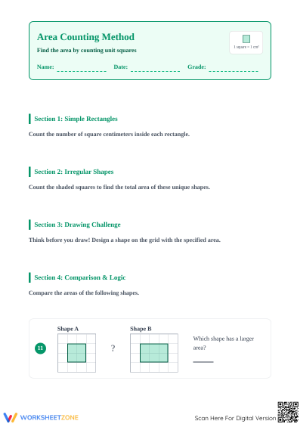
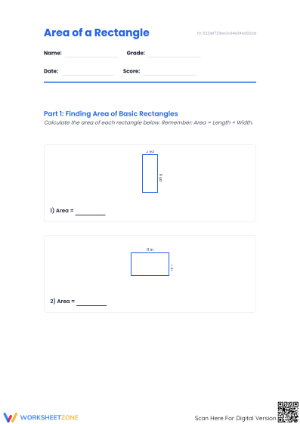
These area of a rectangle printable worksheets for 3rd grade give teachers a ready-made sequence for moving students from counting individual unit squares on a grid to applying the length times width formula — covering the full arc of what 3rd grade geometry standards require. The set spans four distinct problem types, from fully gridded rectangles to labeled-side formula problems to missing-dimension challenges and word problems. Each worksheet targets a specific stage in that progression, so teachers reach for the right resource depending on where their class stands in the unit.
The Specific Skills Covered Across the Set
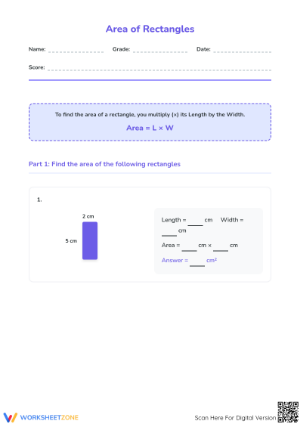
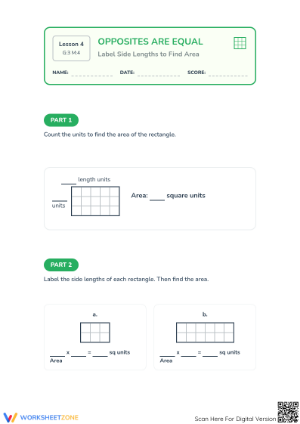
The earliest worksheets present rectangles drawn on a complete square grid; students count every interior square and record the total with a unit label. The next tier removes the interior grid lines and shows only tick marks along each side, nudging students to see rows and columns rather than count square by square. Later worksheets show blank rectangles with side lengths labeled in centimeters or inches, and students write the multiplication sentence and solve. The set also includes problems where the area and one side length are provided and students find the missing dimension — work that directly ties area to division and missing-factor reasoning before those ideas appear in isolation.
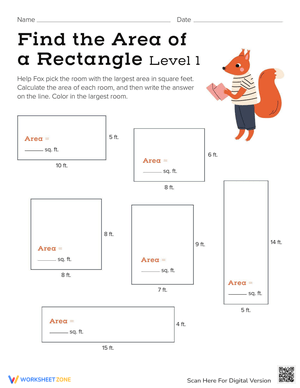
Word problems are distributed across the set rather than saved for the final worksheet. Students calculate the area of a garden plot, a section of floor tile, a painted classroom tabletop. These contexts require students to extract relevant dimensions from a written description — a reading-in-math demand that slows many third graders down well before the multiplication itself does.
Why This Skill Lives in Third Grade
Area shows up in 3rd grade specifically because it is the geometric application of the multiplication arrays students are learning at the same time. A rectangle that is 4 units wide and 3 units tall is structurally identical to a 4×3 array diagram. Teachers who frame the tiling work that way — explicitly pointing out that the rows of unit squares are the same rows students draw in array practice — see students reach the formula faster and hold onto it longer. The standards place these two topics together because they are the same mathematical idea wearing two different outfits, and worksheets that surface that connection reinforce both simultaneously.
Mistakes Students Make That These Worksheets Help You Catch
The most dependable error is adding the side lengths rather than multiplying them. A student who writes "4 + 3 = 7 square units" for a 4-by-3 rectangle is almost always conflating area with perimeter — treating the numbers on the sides as the answer rather than as dimensions that define an interior space. That student needs to return to the full-grid worksheets and physically count or draw unit squares inside the shape before the formula carries any meaning. Repeating "multiply, don't add" without that concrete reset rarely works.
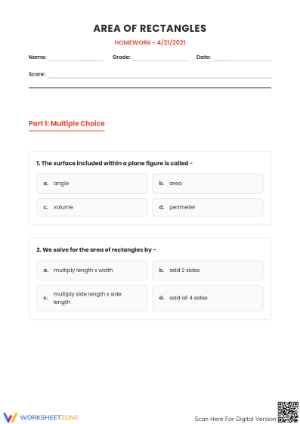
Omitting the square unit label is the second pattern that appears consistently. Students write "12" instead of "12 sq cm" and consider the problem finished. This matters beyond neatness: a student who cannot distinguish between 12 cm and 12 sq cm does not yet understand what they calculated. The area of a rectangle printable worksheets for 3rd grade in this set include a unit label prompt in every answer line, which prevents students from bypassing that step without even noticing.
A third error — less frequent but worth catching early — is grid miscounting. When students rush, they skip a row or recount the same row twice. Asking them to cross off each square as they count, or to write a small number inside each square, surfaces this immediately and also reinforces one-to-one correspondence in a geometric context.
Working These Worksheets Into Your Lesson Planning
The full-grid worksheets work well at the opening of the unit as a whole-class activity projected on the board with a paper copy in each student's hand. Ask students to point to one row and predict how many squares are in it before anyone counts. That prediction step — repeated across two or three different rectangles — builds the row-column mental structure that makes the formula feel like a logical shortcut rather than an arbitrary rule.
For math centers, slide several worksheets into dry-erase sleeves so students can complete and wipe them between rotations. The formula-based worksheets run well this way; the grid-counting worksheets are harder to read through a sleeve and work better as paper copies. During the last ten minutes of a math block — when a multi-step activity is unrealistic — a single area of a rectangle printable worksheets for 3rd grade review sheet covering four to six problems gives enough repetition to consolidate the lesson without pushing students past the point of productive effort.
Near the end of the unit, consider using one worksheet as an open-ended task: give students an area value, such as 24 square units, and ask them to draw every different rectangle they can that has that area. This reversal — from formula to shape rather than from shape to formula — reveals whether students understand that multiple pairs of dimensions share the same product. It also produces quick informal evidence of where each student stands on factor fluency, which is useful data to carry into the next unit.
Standard Alignment
CCSS.MATH.CONTENT.3.MD.C.5 defines area as the number of unit squares needed to cover a plane figure, and CCSS.MATH.CONTENT.3.MD.C.6 specifically requires students to measure area by counting unit squares — both the foundation for the tiling worksheets in this set. CCSS.MATH.CONTENT.3.MD.C.7 formalizes the relationship between area and multiplication, requiring students to apply the formula and solve real-world problems, which is the territory the labeled-side and word-problem worksheets address. All three codes sit inside the 3rd grade Measurement and Data domain, and the placement is deliberate: the standard treats area as the unifying context for multiplication practice across the year, not a standalone geometry topic dropped into the calendar.
Differentiating the Set Across Ability Levels
Students who are still uncertain about what area means benefit most from pairing the full-grid worksheets with physical color tiles. Placing tiles directly onto the printed rectangle before writing any numbers gives them a tactile check — if their tile count and their written answer disagree, the issue is almost always spatial rather than arithmetic. They are not yet seeing the interior of the rectangle as an organized grid of rows.
Students who move quickly through the formula problems have a natural next step in the missing-dimension worksheets, which require division or inverse multiplication thinking rather than a straightforward calculation. Students who have also worked through area of a rectangle printable worksheets for 3rd grade that show both area and perimeter for the same figure can be pushed further by asking them to write — in a sentence — why the two answers are different numbers with different units. That explanation requirement reaches well past the standard while using the exact same worksheet.
For students who struggle to keep their place on fine-line grids, printing the grid-based worksheets at 120% resolves the problem without changing any of the math.
Frequently Asked Questions
Why do some worksheets show tick marks instead of a fully drawn grid?
The tick-mark format is an intermediate step between a complete grid and a blank labeled rectangle. It preserves information about how many unit lengths fit along each side without drawing every interior line. Students have to mentally reconstruct the row-and-column structure — which asks more of them than counting pre-drawn squares — while still giving them enough visual support that they are not working from pure abstraction. Most students need one to two worksheets at this level before the fully labeled format makes sense to them.
When is a student ready for the formula?
The reliable signal is perceptual: a student who looks at a tiled rectangle and immediately says "four rows of six" rather than counting each square individually has developed the array structure needed for the formula to register as a meaningful shortcut. Students who still count square by square are not yet seeing rows — they are still in the tiling stage, and handing them the formula at that point produces memorization without understanding.
How do the worksheets address the area-perimeter confusion?
Several worksheets in the set ask students to calculate both measurements for the same rectangle, recording them in clearly labeled, separate fields on the same worksheet. Seeing both numbers side by side — produced by different operations, labeled in different units — is more effective than teaching the two concepts on entirely separate days. The contrast between the two calculations, right next to each other, is the instructional move.













 Interactive Worksheet Maker
 Quiz Maker
 Word Search Maker
 Crossword Puzzle Maker
 Word Scramble Generator
 Sentence Scramble Generator
 Handwriting Worksheet Generator
 Name Tracing Generator
 Fill In The Blank Generator