


























Views
Downloads
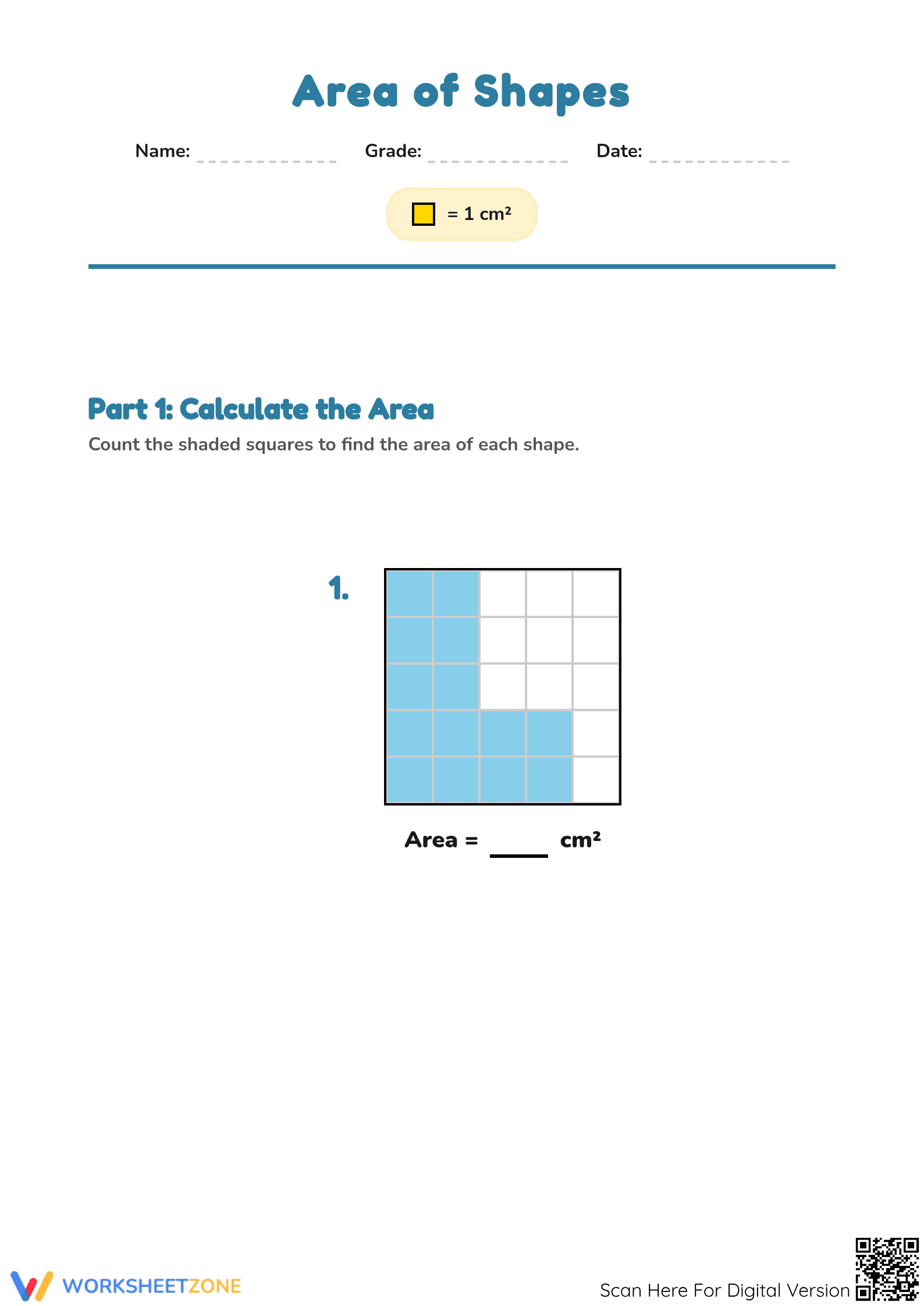



Essential Area Worksheet: Counting Squares — Grade 3 Ready
Paste this activity's link or code into your existing LMS (Google Classroom, Canvas, Teams, Schoology, Moodle, etc.).
Students can open and work on the activity right away, with no student login required.
You'll still be able to track student progress and results from your teacher account.
This essential Grade 3 Math worksheet provides comprehensive practice in calculating the area of irregular and rectilinear shapes. Students develop a foundational understanding of area by counting individual centimetre squares to determine the total space occupied by each figure. This hands-on approach transitions learners from linear measurement to two-dimensional spatial reasoning.
At a Glance
- Grade: 3 · Subject: Math
- Standard:
CCSS.MATH.CONTENT.3.MD.C.6— Measure areas by counting unit squares such as square cm or square inches- Skill Focus: Calculating area via unit square counting
- Format: 5 pages · 12 problems · Answer key included · PDF
- Best For: Independent math center practice or sub plans
- Time: 20–30 minutes
The printable packet contains 12 distinct tasks spread across 5 pages, ensuring students have ample room to work. Each problem features a shape shaded on a grid where one yellow square represents 1 cm². The layout is clean and uncluttered, including a dedicated space for students to write their final calculations. A complete answer key is provided for rapid grading.
Zero-Prep Workflow
Teachers can implement this resource in under two minutes with a simple three-step workflow. First, print the 5-page PDF document or specific pages as needed for your lesson. Next, distribute the worksheets to students, requiring only a pencil for completion. Finally, use the included answer key to review results or facilitate peer-grading, saving significant instructional time. This packet is an ideal choice for emergency substitute plans.
Standards Alignment
This resource is directly aligned to CCSS.MATH.CONTENT.3.MD.C.6: "Measure areas by counting unit squares (square cm, square m, square in, square ft, and improvised units)." It supports the progression toward formulaic area calculation by grounding students in the physical concept of square units. Both standard codes can be copied directly into lesson plans, IEP goals, or district curriculum mapping tools.
How to Use It
Use this worksheet as a formative assessment after introducing the concept of area as "covering a surface." It is particularly effective during the independent practice portion of a guided math workshop. While students work, circulate to observe if they are counting every square or using additive strategies, which provides insight into their mathematical maturity. Expected completion time ranges from 20 to 30 minutes.
Who It's For
Designed primarily for Grade 3 students, this packet also serves as a remediation tool for Grade 4 and 5 learners who struggle with spatial concepts. It pairs perfectly with physical base-ten blocks or plastic centimetre cubes, allowing students to physically build the shapes before counting the shaded representations on the page. It is highly effective for students requiring visual scaffolds in general education or special education settings.
Research from RAND AIRS 2024 highlights that students who master area through unit square counting demonstrate higher proficiency in later geometry and algebra tasks. By explicitly visualizing the square centimetre as a discrete unit of measurement, learners move beyond rote memorization of formulas toward conceptual mastery. This Grade 3 worksheet focuses on CCSS.MATH.CONTENT.3.MD.C.6, enabling students to measure areas by counting unit squares with precision. This methodology aligns with the gradual release of responsibility model, ensuring that the 12 tasks provide sufficient repetition for skill acquisition. Fisher & Frey (2014) argue that providing students with clear visual scaffolds, such as the grids used in these 5 pages, reduces cognitive load and allows for more successful independent practice. This resource ensures that teachers can provide high-quality, standards-aligned geometry instruction without the need for extensive preparation or additional manipulatives, fostering a robust environment for mathematical exploration and surface measurement mastery.


