


























Views
Downloads
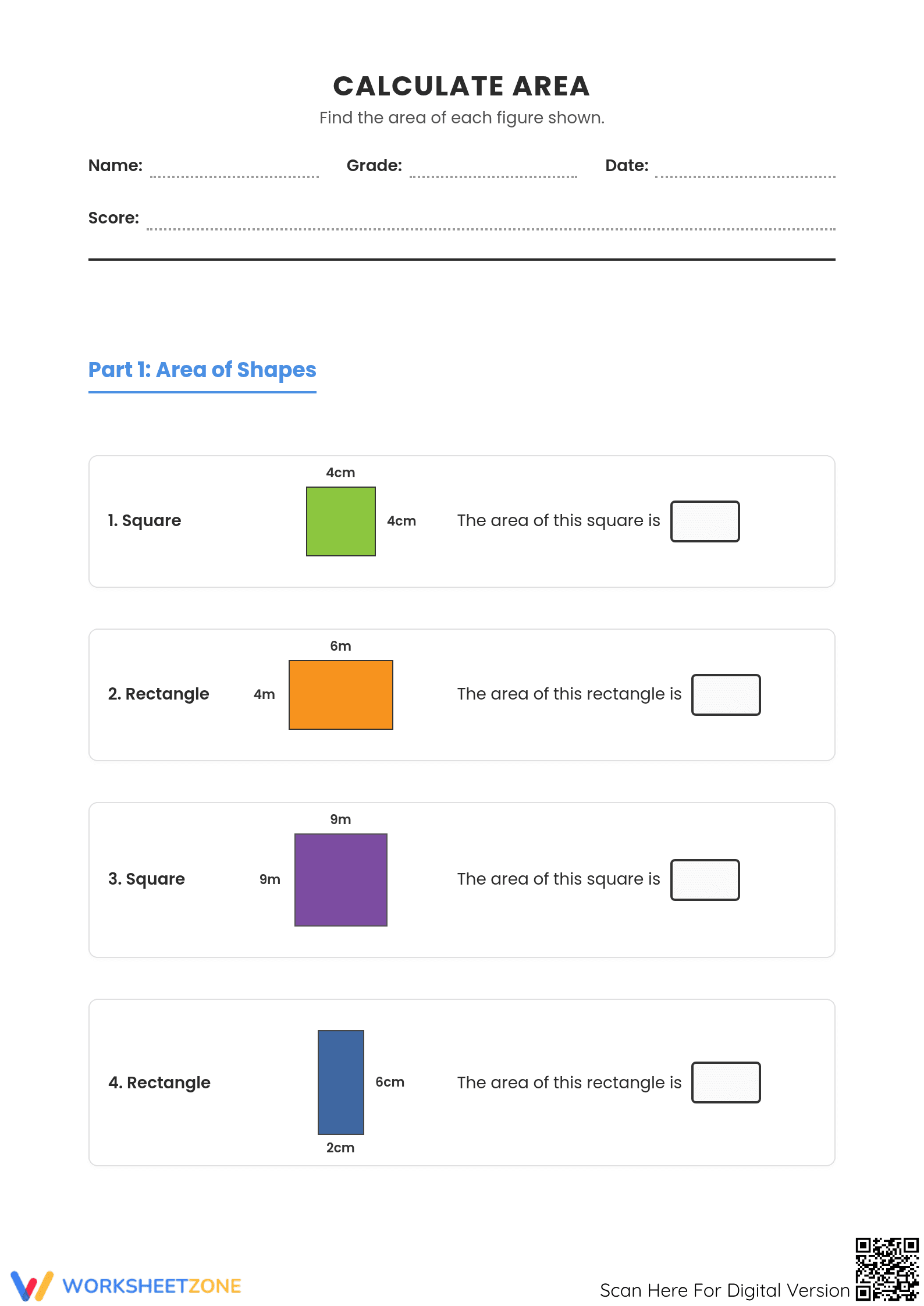



Essential Area of Square and Rectangle Practice Worksheet
Paste this activity's link or code into your existing LMS (Google Classroom, Canvas, Teams, Schoology, Moodle, etc.).
Students can open and work on the activity right away, with no student login required.
You'll still be able to track student progress and results from your teacher account.
Help students master the fundamental skill of calculating the area of squares and rectangles with this comprehensive practice set. This resource transitions from visual shape identification to real-world word problems, ensuring students can apply mathematical formulas with confidence across various contexts.
At a Glance
- Grade: Grade 4 · Subject: Math
- Standard:
CCSS.MATH.CONTENT.4.MD.A.3— Apply the area and perimeter formulas for rectangles in real world and mathematical problems- Skill Focus: Calculating area of squares and rectangles
- Format: 3 pages · 16 problems · Answer key included · PDF
- Best For: Independent practice and formative assessment
- Time: 25–35 minutes
What's Inside
This three-page resource is organized into two sections to facilitate learning. Part 1 features 10 visual problems where students calculate the area of shapes using provided dimensions. Part 2 contains 6 word problems that apply knowledge to scenarios like gardening and carpeting. A full answer key is included for efficient grading and immediate student feedback.
Zero-Prep Workflow
- Print (1 minute): Select the number of copies and print the PDF directly.
- Distribute (1 minute): Hand out the worksheets for independent practice or homework.
- Review (5 minutes): Use the answer key to conduct a quick whole-class check.
This workflow requires under two minutes of preparation, making it ideal for sub plans or busy classroom schedules.
Standards Alignment
This worksheet is aligned with `CCSS.MATH.CONTENT.4.MD.A.3`, which requires students to apply area formulas for rectangles in mathematical problems. Students demonstrate their ability to manipulate the A = L x W formula effectively. This standard code can be copied directly into lesson plans, IEP goals, or district curriculum mapping tools to document student progress.
How to Use It
Use this resource during independent practice after modeling the area formula. To use as a formative assessment, observe students as they complete the first few problems to identify misconceptions regarding units. Most students complete the 16 tasks within 30 minutes, allowing time for a closing discussion on the word problem solutions and real-world applications.
Who It's For
This practice set is designed for fourth-grade students, though it serves as an excellent review for fifth-grade learners. It is effective for students who benefit from clear transitions between visual and abstract problems. Pair this worksheet with a physical anchor chart displaying the area formula to provide a supportive multi-modal learning experience for all students.
According to the RAND AIRS 2024 analysis of instructional materials, the use of structured worksheets significantly improves retention of geometric concepts in elementary learners. This resource specifically addresses the need for standard-aligned practice in calculating the area of squares and rectangles, a foundational skill for spatial reasoning. By providing 16 targeted problems, including 6 real-world scenarios, the resource ensures that students move beyond rote memorization of the area formula toward genuine application. The inclusion of standard CCSS.MATH.CONTENT.4.MD.A.3 provides a clear roadmap for educators to track mastery and identify areas where students may need intervention. This data-driven approach to mathematics instruction is essential for preparing students for the rigors of middle school geometry. The explicit connection between visual shape calculation and abstract word problems fosters a deeper understanding of how mathematical principles apply to everyday objects.


