


























Views
Downloads




Printable Area Worksheet: Count Squares in Irregular Shapes
Paste this activity's link or code into your existing LMS (Google Classroom, Canvas, Teams, Schoology, Moodle, etc.).
Students can open and work on the activity right away, with no student login required.
You'll still be able to track student progress and results from your teacher account.
Strengthen your students' geometric intuition with this focused practice set on finding area through unit square counting. This worksheet moves beyond simple rectangles to challenge students with irregular rectilinear shapes, ensuring they truly understand area as the total number of unit squares required to cover a surface. It is an essential tool for building foundational measurement skills.
At a Glance
- Grade: 3 · Subject: Math
- Standard:
CCSS.MATH.CONTENT.3.MD.C.6— Measure areas by counting unit squares to determine the total space inside a shape- Skill Focus: Counting unit squares in irregular shapes
- Format: 5 pages · 9 problems · Answer key included · PDF
- Best For: Independent practice and geometric measurement mastery
- Time: 15–20 minutes
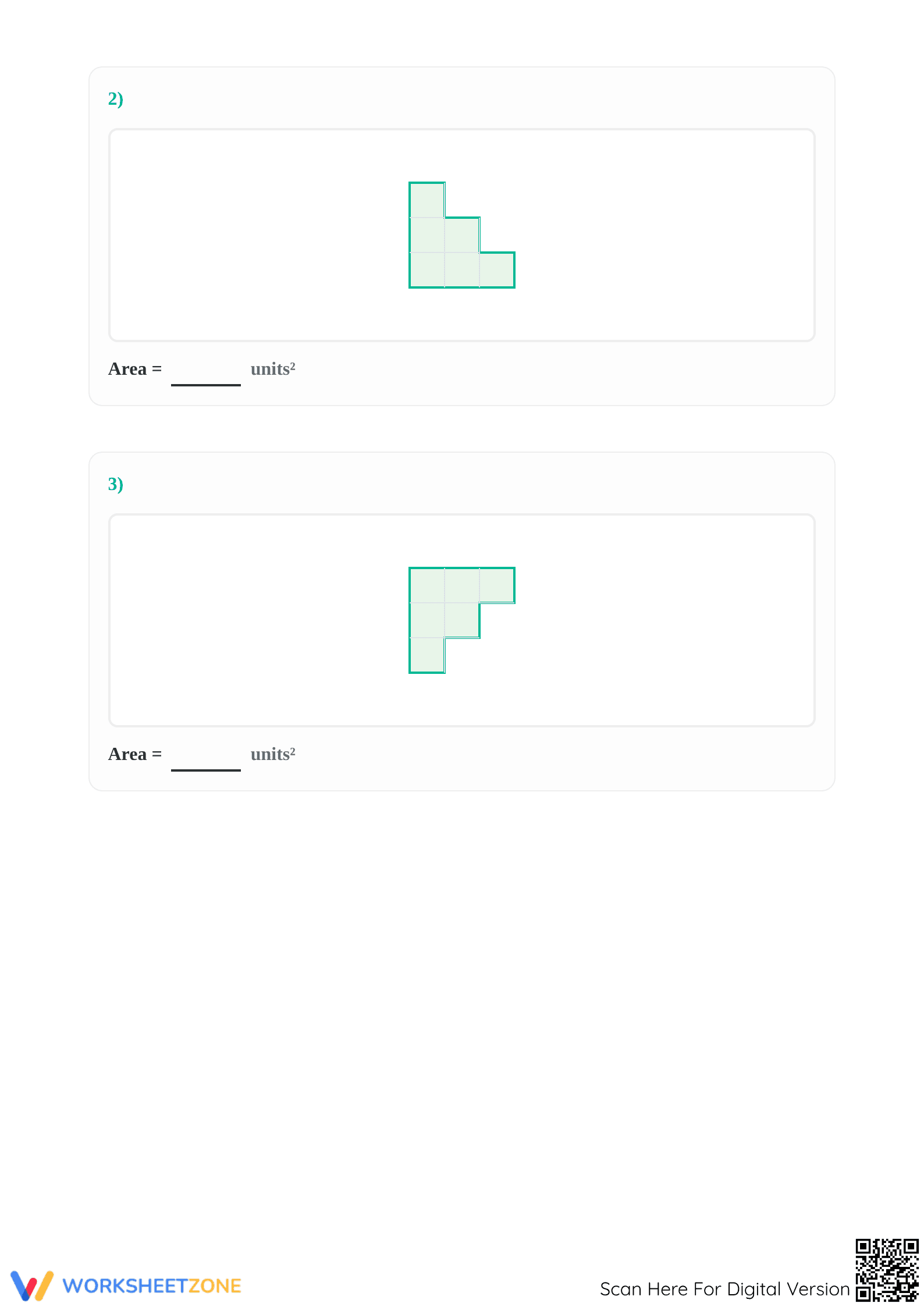
Inside this comprehensive 5-page resource, you will find nine distinct problems featuring unique irregular shapes set against a clear unit grid. Each page provides ample white space for student work, and the final page includes a complete answer key for rapid grading. The worksheet uses a standard 1-unit square key to maintain consistency across all exercises, making it easy for students to transition between different problems.
Zero-Prep Workflow
- Print (1 minute): Select the pages you need and print enough copies for your class or small group.
- Distribute (30 seconds): Hand out the worksheets as a warm-up, independent practice, or a quick homework assignment.
- Review (30 seconds): Use the provided answer key to check for accuracy or allow students to self-correct their work.
This streamlined process ensures that you spend less time preparing and more time teaching, making this resource perfect for last-minute sub plans or unexpected schedule shifts.
This resource is strictly aligned to CCSS.MATH.CONTENT.3.MD.C.6, which requires students to measure areas by counting unit squares (square cm, square m, square in, square ft, and improvised units). By focusing on irregular shapes, it also supports 3.MD.C.7.D, demonstrating that the area of a rectilinear figure can be found by adding the areas of the non-overlapping parts. This standard code can be copied directly into lesson plans, IEP goals, or district curriculum mapping tools.
Use this worksheet as a formative assessment after introducing the concept of area or as a remedial activity for students struggling with the additive nature of measurement. One effective observation tip is to watch for students who skip squares or double-count corners in irregular shapes; this indicates a need for more direct modeling of systematic counting strategies. Expect most students to complete the full set in under 20 minutes.
This worksheet is primarily designed for Grade 3 students but serves as an excellent review for Grade 4 and 5 learners who need to reinforce their conceptual understanding of area. It is particularly useful for English Language Learners and students with IEPs due to its high visual support and low linguistic demand. Pair this with a physical set of unit tiles or an anchor chart on rectilinear area for maximum impact.
According to the RAND AIRS 2024 study on elementary mathematics instruction, the conceptual bridge between simple counting and geometric measurement is most effectively built through visual scaffolds like unit square grids. This Grade 3 worksheet directly addresses CCSS.MATH.CONTENT.3.MD.C.6 by requiring students to count unit squares within irregular rectilinear shapes, reinforcing the understanding that area is additive and measurable. By transitioning from standard rectangles to irregular polygons, students develop higher-order spatial reasoning and a more robust definition of area as the "amount of space covered." Research by Fisher & Frey (2014) suggests that this type of guided practice is essential for mastering the foundational concepts of multiplication as an array-based operation. This 5-page resource provides the necessary repetition to ensure that students move beyond rote memorization toward a functional, visual grasp of two-dimensional space.


