


























Views
Downloads
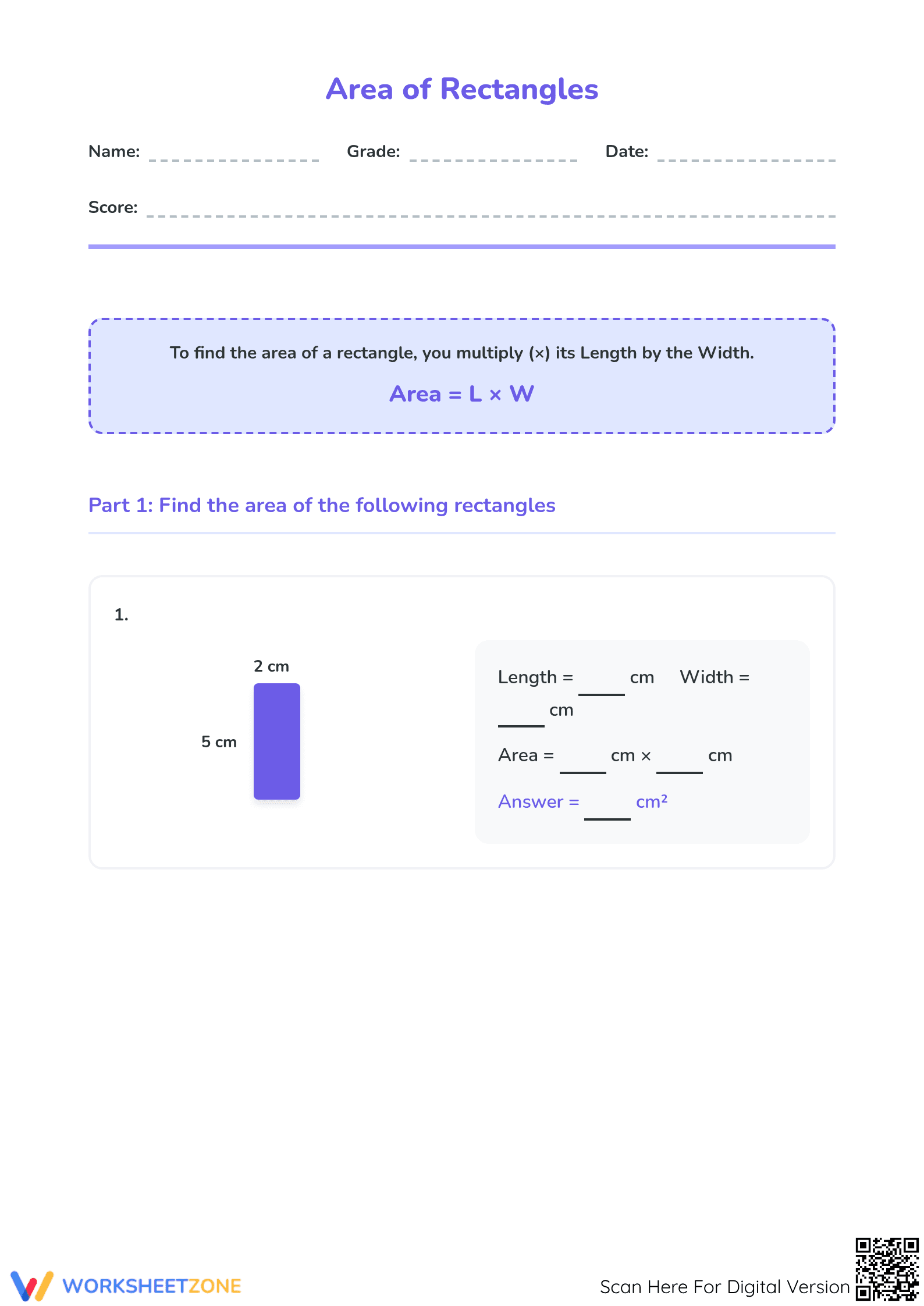



Essential Area of Rectangles Worksheet | Grade 4 Math
Paste this activity's link or code into your existing LMS (Google Classroom, Canvas, Teams, Schoology, Moodle, etc.).
Students can open and work on the activity right away, with no student login required.
You'll still be able to track student progress and results from your teacher account.
This Essential Area of Rectangles worksheet provides students with targeted practice in applying the fundamental geometric formula for area. By working through structured problems, learners transition from simple calculation to algebraic reasoning. Students will demonstrate mastery by calculating total area and solving for unknown side lengths using the inverse of multiplication.
At a Glance
- Grade: 4 · Subject: Math
- Standard:
CCSS.MATH.CONTENT.4.MD.A.3— Apply area and perimeter formulas for rectangles in mathematical problems- Skill Focus: Rectangular area and missing side dimensions
- Format: 5 pages · 14 problems · Answer key included · PDF
- Best For: Independent practice or homework reinforcement
- Time: 20–30 minutes
Inside this 5-page resource, teachers will find a clear and logical progression of tasks designed to build student confidence. The worksheet includes 10 visual problems where students identify the length and width of various rectangles before calculating the final area in square centimeters. The final section introduces four word-problem style challenges that require students to work backward from a known area to find a missing side length, ensuring a deep understanding of the relationship between dimensions.
- Guided Practice: The first few problems provide a visual anchor with labeled dimensions and a scaffolded calculation box to ensure students follow the Area = Length × Width formula correctly.
- Supported Practice: Problems 5 through 10 remove the calculation prompts, requiring students to independently extract the measurements and set up their own multiplication equations.
- Independent Practice: Part 2 shifts to higher-order thinking with 4 problems focused on finding missing side lengths, requiring students to utilize division or inverse multiplication strategies.
This sequence follows a gradual-release model, moving from concrete visual identification to abstract problem-solving.
This resource is specifically aligned to `CCSS.MATH.CONTENT.4.MD.A.3`, which focuses on applying the area formula for rectangles in mathematical problems. The inclusion of missing-side tasks supports the broader understanding of algebraic thinking within geometry. Both standard codes can be copied directly into lesson plans, IEP goals, or district curriculum mapping tools.
For best results, use this worksheet as an independent practice activity following a direct instruction lesson on the area formula. It serves as an excellent formative assessment tool; observe if students struggle more with the direct area calculation or the inverse missing-side problems to target future small-group instruction. Expected completion time is roughly 25 minutes for most Grade 4 students.
This worksheet is ideal for Grade 4 students but remains highly relevant for Grade 3 learners ready for a challenge or Grade 5 students requiring a foundational review. It pairs naturally with graph paper activities or physical area-model manipulatives to help students visualize the space within the boundaries of each rectangle.
According to Fisher & Frey (2014), the gradual release of responsibility is a critical component of successful mathematics instruction, particularly when moving from computational fluency to problem-solving. This worksheet adheres to that framework by providing 14 distinct tasks that increase in cognitive demand. By requiring students to not only multiply dimensions but also divide to find missing sides, the resource ensures they internalize the standard CCSS.MATH.CONTENT.4.MD.A.3. Research from NAEP indicates that students who can fluidly navigate between area and linear dimensions show significantly higher achievement in middle school geometry. This printable PDF provides the structured repetition necessary for that fluid navigation, offering a clear evidence-based path to mastery in elementary measurement and data analysis. The 5-page format ensures ample space for student work without overwhelming the learner with cluttered visuals.


