


























Views
Downloads


Area of Rectangles Worksheet | Grade 4 Printable Math
Paste this activity's link or code into your existing LMS (Google Classroom, Canvas, Teams, Schoology, Moodle, etc.).
Students can open and work on the activity right away, with no student login required.
You'll still be able to track student progress and results from your teacher account.
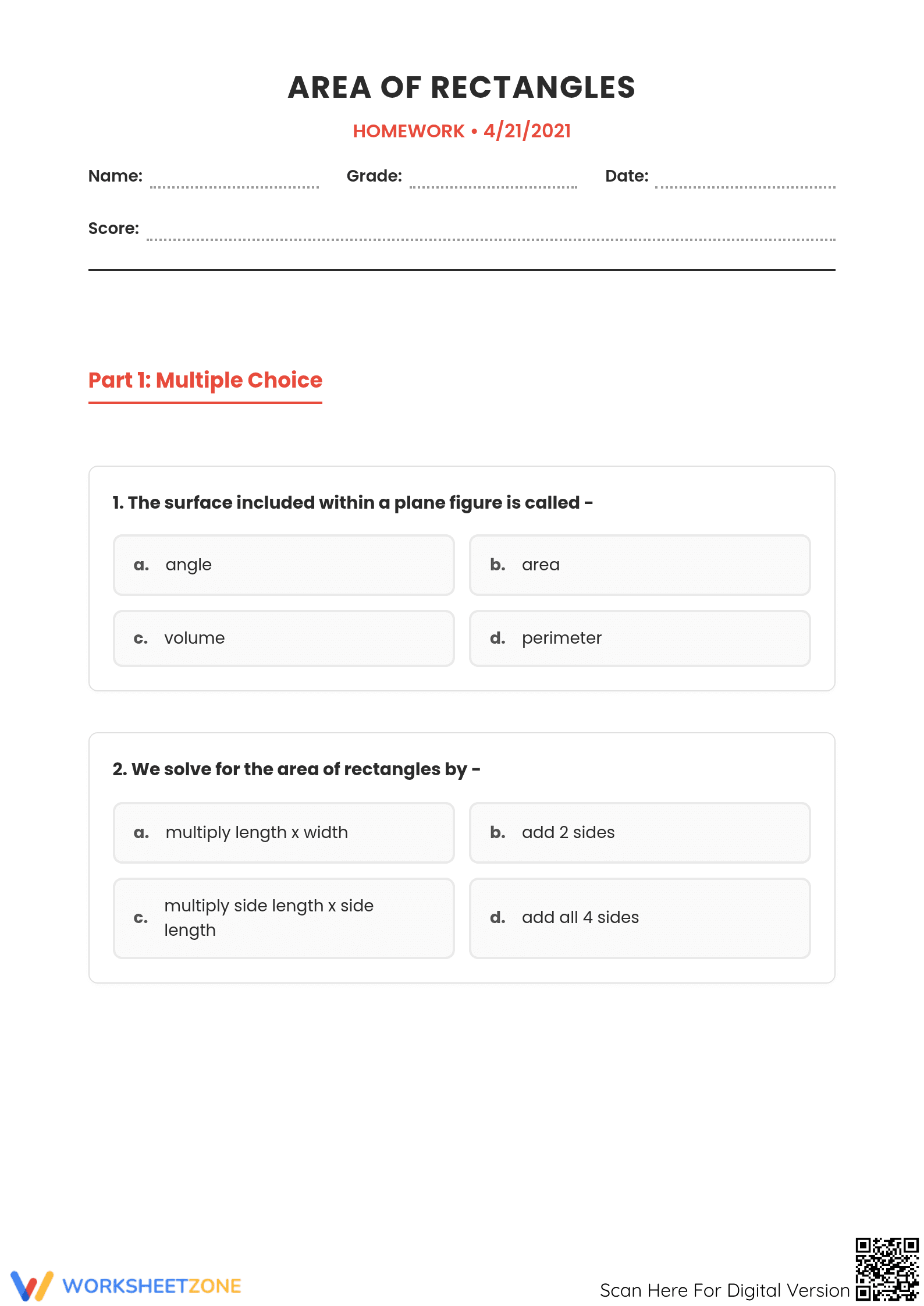
This Grade 4 geometry worksheet provides comprehensive practice in calculating the area of rectangles and squares across twelve targeted problems. Students will learn to apply the formula for area to visual models and complex word problems, ensuring they can reliably determine spatial dimensions in square units. This resource bridges the gap between basic identification and advanced mathematical application.
At a Glance
- Grade: 4 · Subject: Math (Measurement and Data)
- Standard:
CCSS.MATH.CONTENT.4.MD.A.3— Apply the area and perimeter formulas for rectangles in real world and mathematical problems- Skill Focus: Calculating Area of Rectangles and Squares
- Format: 5 pages · 12 Multiple Choice problems · Full Answer key included · Printable PDF
- Best For: Daily homework assignments, independent seatwork practice, or formative geometry assessment
- Time: 20–30 minutes of focused work
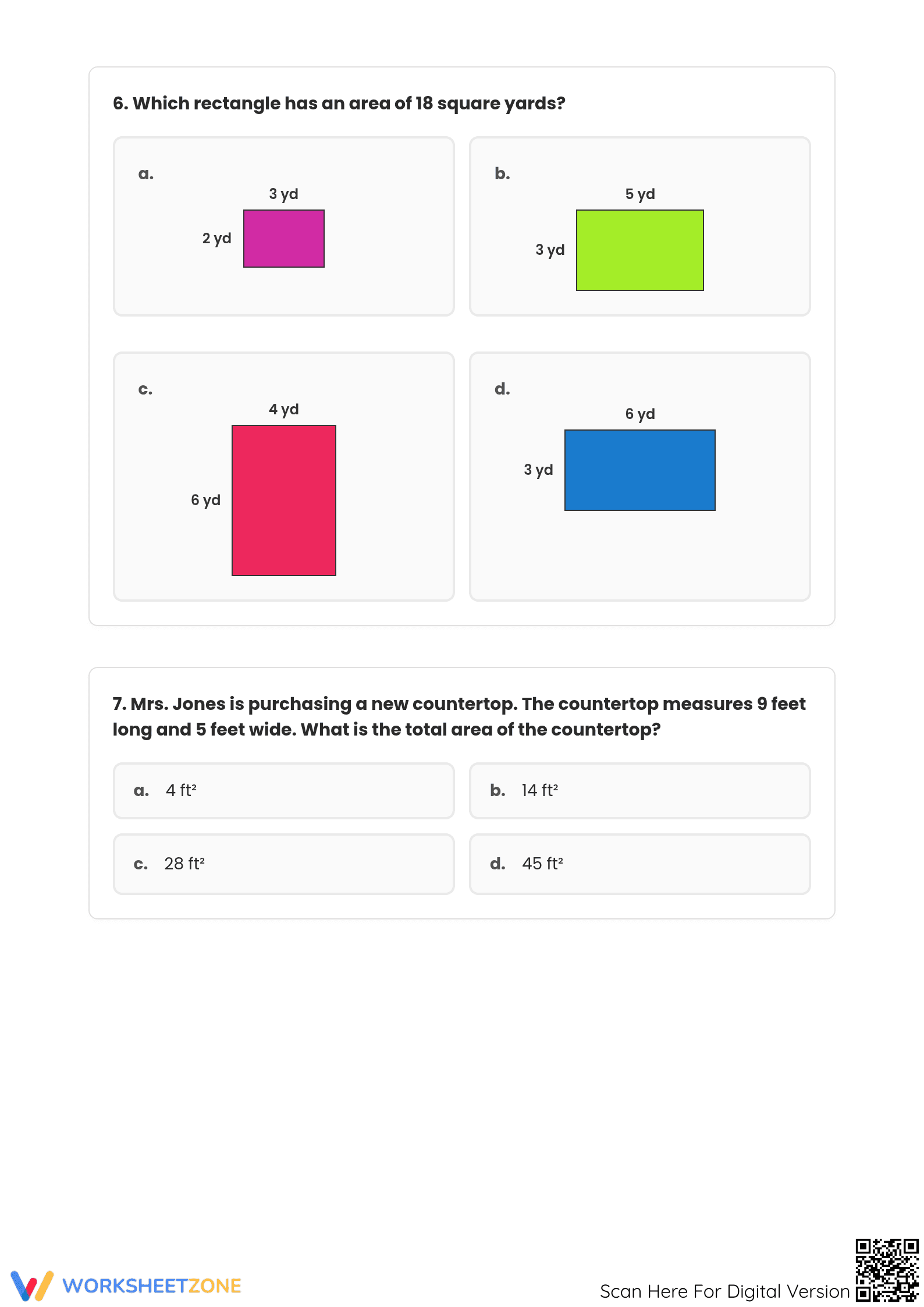
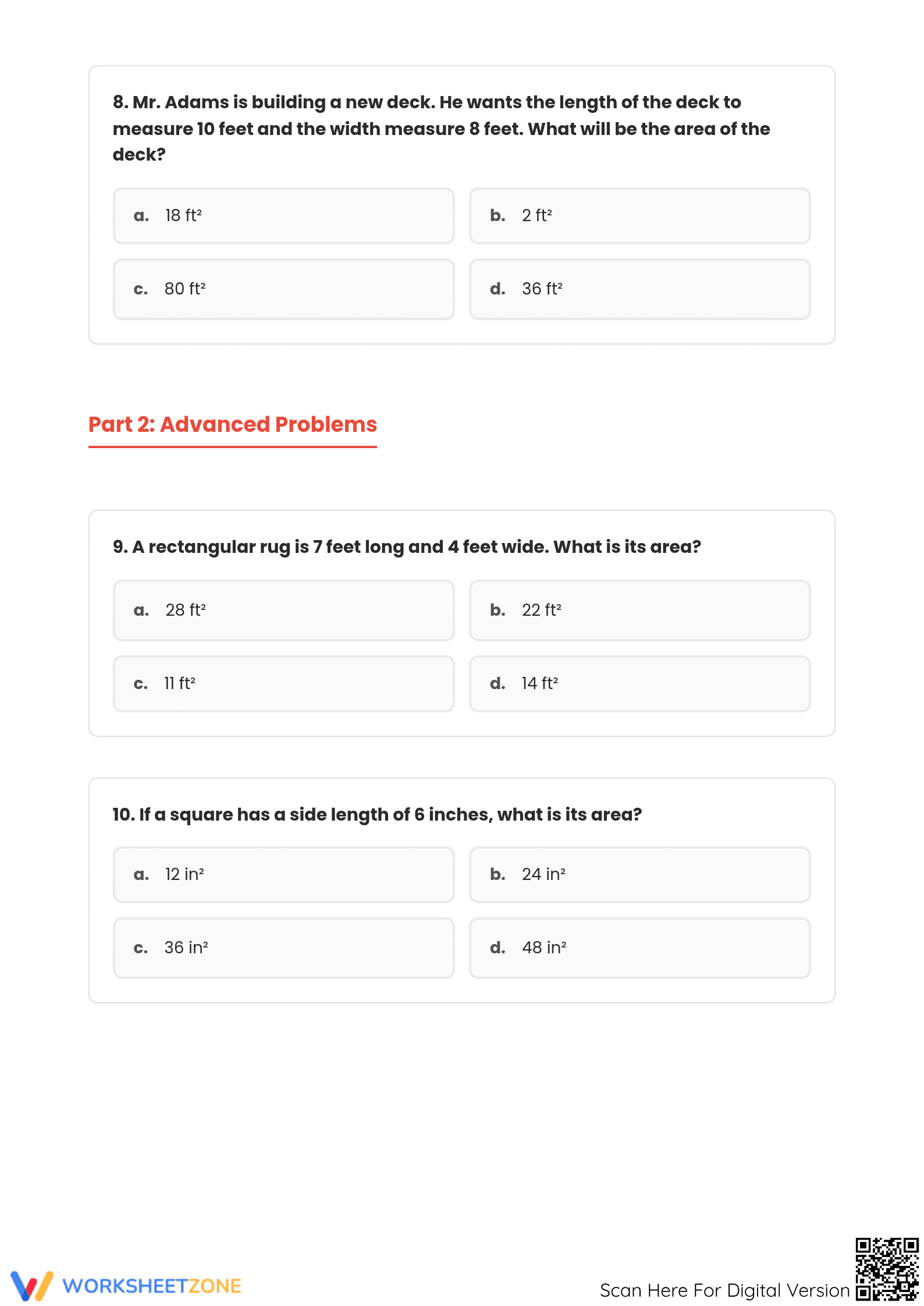
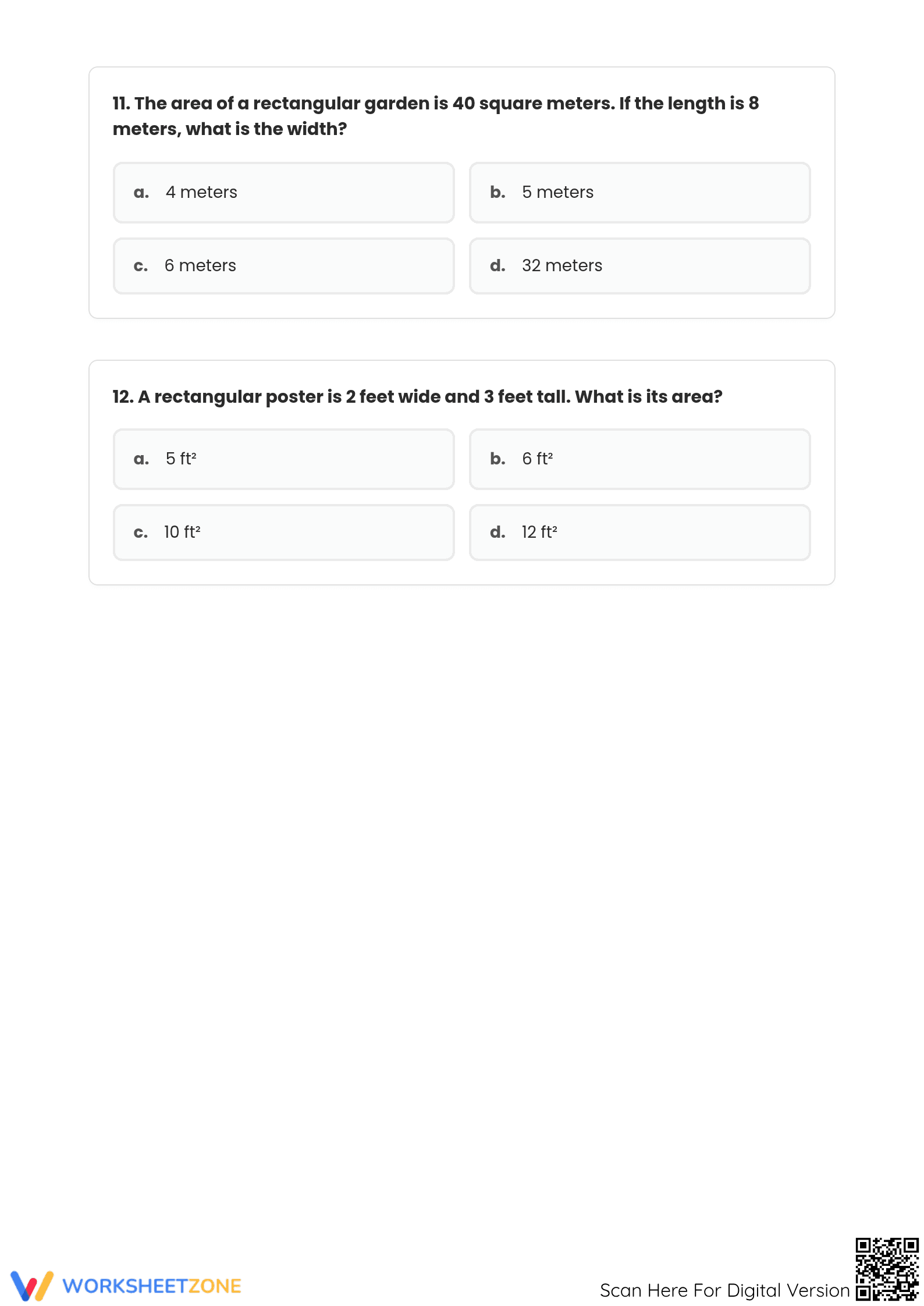
The packet contains five high-quality pages featuring a mix of multiple-choice and open-response questions. Part one includes eight foundational problems with visual models and situational prompts. Part two introduces four "Advanced Problems" that challenge students to find missing dimensions or solve multi-step area puzzles. A complete answer key is provided for immediate grading or self-correction sessions.
Skill Progression
- Guided Practice: Problems 1-2 define area and the essential formula, anchoring the concept through clear definitions and basic recognition tasks (2 tasks).
- Supported Practice: Students calculate area using visual rectangle models with clearly labeled dimensions to build computational fluency and confidence (4 tasks).
- Independent Practice: Learners solve real-world word problems and inverse area challenges requiring higher-order thinking and application of formulas (6 tasks).
This resource utilizes a gradual-release model to move students from basic identification to independent geometric mastery. The structured layout ensures that learners are supported as the cognitive demand increases.
Standards Alignment
This worksheet aligns directly with CCSS.MATH.CONTENT.4.MD.A.3, which requires students to apply the area and perimeter formulas for rectangles in real-world contexts. The problems transition from identifying the definition of area to calculating specific square units for various polygons. Both standard codes can be copied directly into lesson plans, IEP goals, or district curriculum mapping tools.
How to Use It
Use this resource as a summative assessment after a unit on measurement and data. Alternatively, assign it during a math center rotation to observe how students handle the transition from visual rectangles to text-based word problems. For formative assessment, watch for students who confuse addition with multiplication—a common error that this structured layout helps identify early. Expected completion time ranges from 20 to 30 minutes.
Who It's For
This resource is designed for Grade 4 general education students, but the "Advanced Problems" section makes it suitable for Grade 3 acceleration or Grade 5 review. It is particularly effective for students requiring clear visual supports and multiple-choice options before moving to abstract computation. Pair this with a physical tiling activity or a geometric anchor chart for maximum instructional impact.
Effective geometry instruction requires a transition from concrete manipulation to abstract formula application. According to Fisher & Frey (2014), the gradual release of responsibility—moving from definitions to guided visual models and finally to independent word problems—is essential for mathematical mastery. This worksheet facilitates that progression by organizing tasks into foundational and advanced sections. By requiring students to identify the correct formula (length x width) before applying it to varied units like feet, inches, and meters, the resource reinforces conceptual understanding of 2D space. The inclusion of twelve targeted problems provides sufficient repetitions to ensure the procedural fluency required by CCSS.MATH.CONTENT.4.MD.A.3. This design aligns with evidence-based practices for geometric reasoning, ensuring that students can reliably transfer their classroom knowledge to real-world scenarios involving area calculation and spatial measurement.


