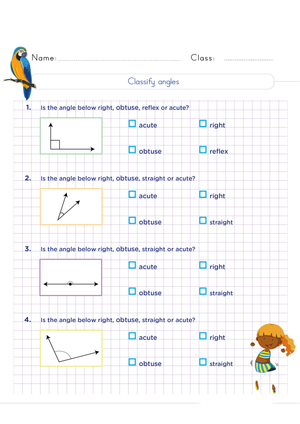
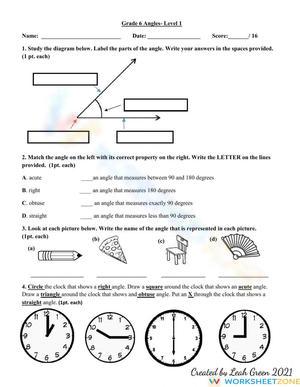
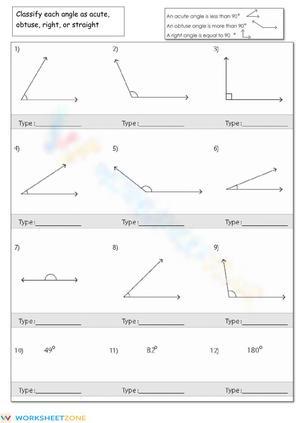
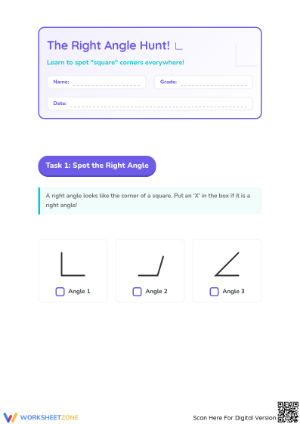
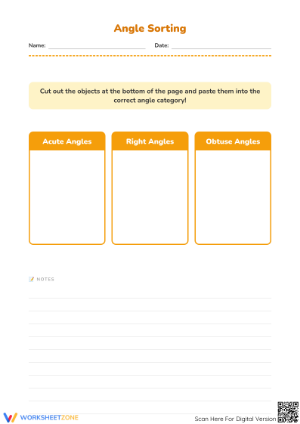
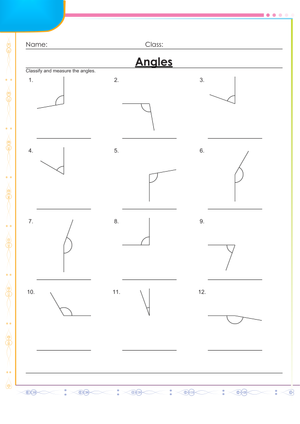
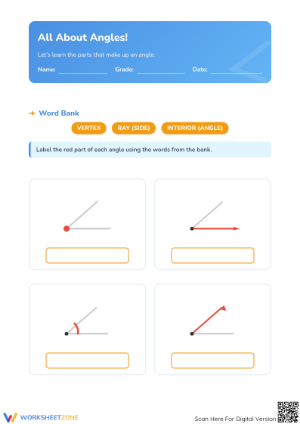
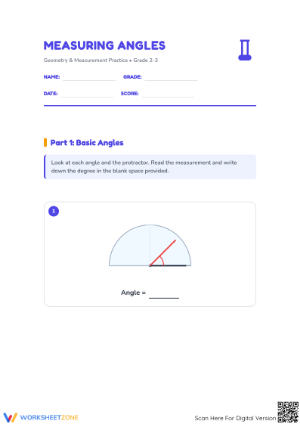
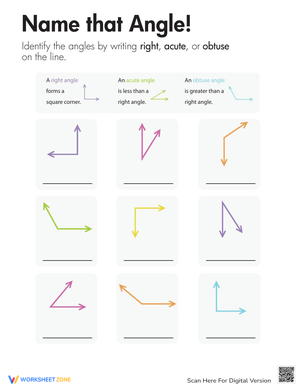
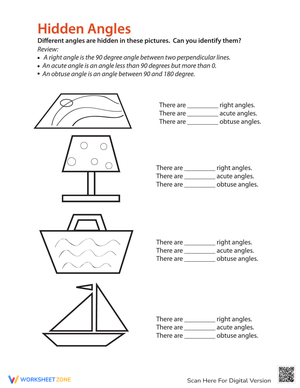
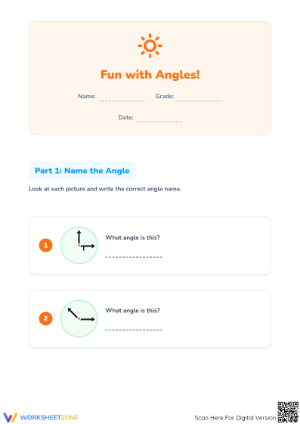
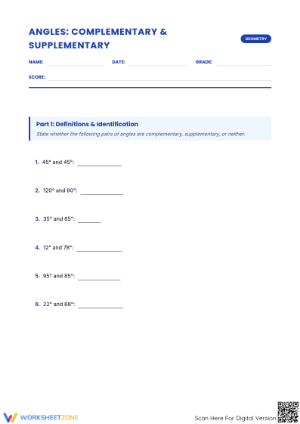
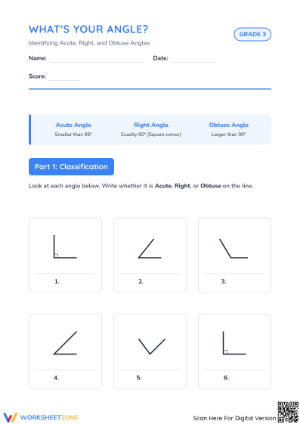
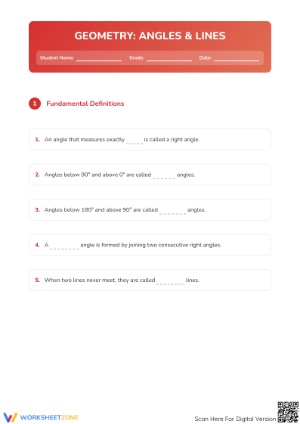
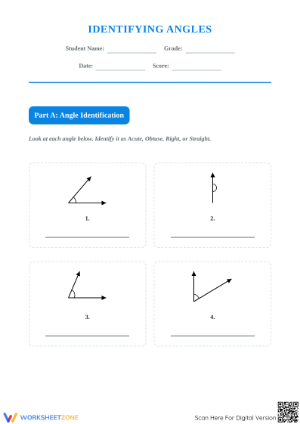
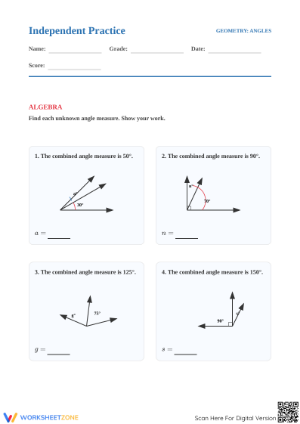
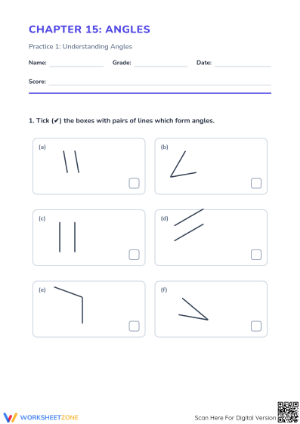
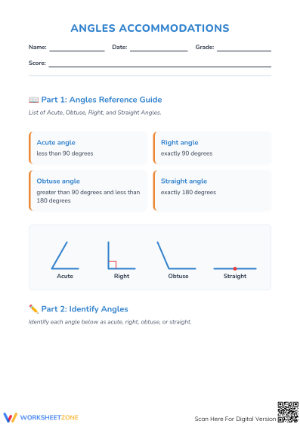
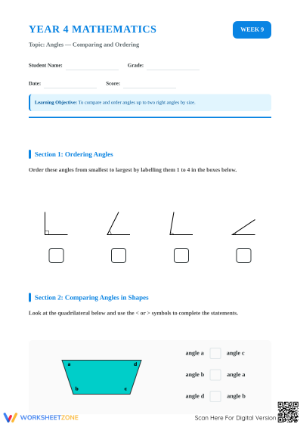
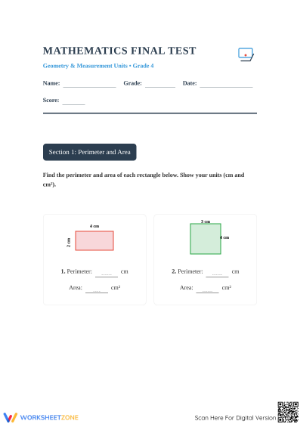
These angles worksheets for 3rd grade make right-angle recognition the organizing concept — not a note at the end of a shapes unit but the specific visual reasoning skill that determines whether students can actually categorize quadrilaterals with any accuracy. Each worksheet puts students in contact with angles inside polygons and asks them to do something precise: identify, mark, compare, or count. The set builds the kind of geometric attention that translates directly into the shape-attribute work CCSS 3.G.A.1 targets.
What Students Practice Across the Set
Each worksheet in this angles worksheets for 3rd grade set addresses one or more of six specific skills:
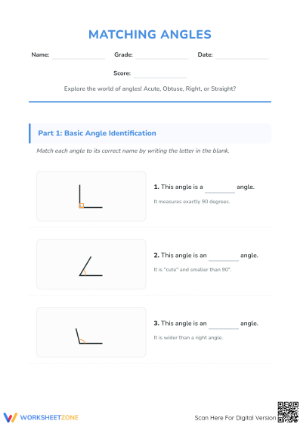
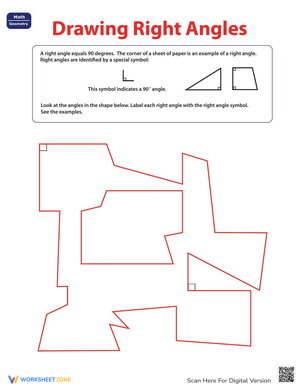
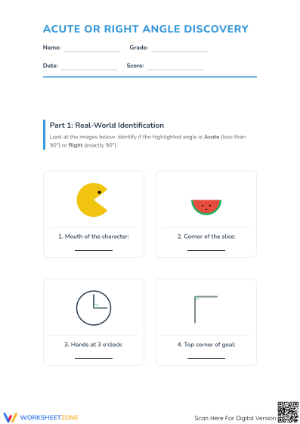
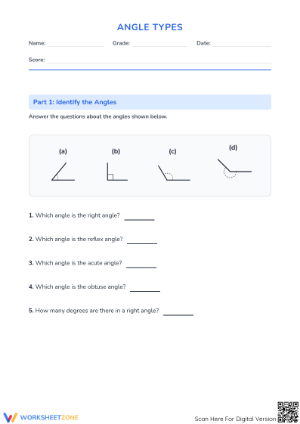
- Identifying right angles — "square corners" — inside familiar polygons, including squares, rectangles, and irregular quadrilaterals
- Marking right angles with the standard small-square notation at the vertex
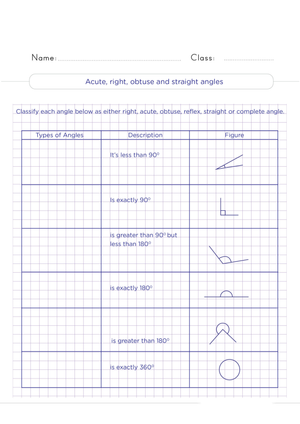
- Comparing unlabeled angles to a right-angle reference and classifying them as less than or greater than a right angle
- Counting angles in polygons from triangles through hexagons, linking angle count directly to side count
- Examining near-right angles and deciding whether a corner is truly a right angle or only close
- Identifying right angles in shapes shown at non-standard orientations — tilted, rotated, or positioned off-axis
That last skill is not extra credit. A significant portion of third graders who can identify a right angle in an upright square will fail to recognize the same angle when the shape is rotated 30 or 45 degrees. The set returns to non-standard orientations throughout rather than confining them to a single worksheet, because distributed exposure is what builds the flexible recognition students actually need.
Mistakes Students Make That These Worksheets Help Teachers Catch
The error that surprises teachers most the first time they encounter it is ray-length confusion. Two angles drawn with identical openings but different ray lengths look different to many third graders — the one with longer lines registers as "bigger." It is not. Angle size is the turn between the rays at the vertex, not how far the rays travel. Students carrying this misconception mark comparison tasks incorrectly in ways that look like carelessness but point to something deeper. Some worksheets in the set show exactly this scenario — two angles with the same measure but different ray lengths — specifically so this error has a place to surface where it can be addressed directly.
A second reliable error is orientation-based identification failure. Students who correctly recognize right angles in standard position — horizontal base, vertical side — will look at a 45-degree-rotated right angle and mark it as not a right angle. They are pattern-matching to a memorized image rather than reasoning about the geometric relationship. This is not laziness; it reflects a genuinely incomplete concept. The fix is fast: place the corner of a sheet of paper into the rotated angle, show that it fits with no gap and no overlap, and ask the student what that means. Most students arrive at the answer themselves.
A smaller but consistent error: students who count polygon sides accurately will still miscount angles, typically by skipping the vertex where they started. Teaching students to mark each vertex with a dot as they count — rather than tracing the perimeter — eliminates most of these errors before they become habitual.
Fitting These Worksheets Into Your Geometry Unit
Three placement points work consistently across classroom structures. Using one worksheet as a warm-up the day after introducing right angles gives students immediate reinforcement before the concept has time to fade. Assigning one during an independent rotation while a small group works with physical shapes keeps students engaged with the concept at different levels of abstraction simultaneously. Using one as a check-in before moving from angle identification into quadrilateral sorting tells you clearly whether the class is ready for that transition — students who cannot reliably identify angles will struggle badly in sorting tasks, and the resulting confusion wastes lesson time.
The paper-corner reference tool belongs alongside the worksheets whenever the concept is still forming. Students place the corner of any sheet of paper at the vertex of an unknown angle and check whether the angle is fully covered (less than a right angle) or extends past the paper's edges (greater than a right angle). This is a precise method, not an estimate, and it helps more than any verbal explanation of angle size. Pairing this tool with angles worksheets for 3rd grade tasks lets students move between the physical reference and the formal representation on the page — until the paper corner becomes unnecessary.
Standard Alignment
These worksheets support CCSS 3.G.A.1, which asks students to understand that shapes in different categories may share attributes, and that specific shared attributes — including angle types — define larger categories of shapes. In classroom terms, this is the standard that asks students to explain why a rectangle is not the same as a general parallelogram. That explanation requires reliable angle identification: the rectangle has four right angles; the parallelogram does not. These worksheets address that prerequisite directly, before classification tasks begin, so students have the visual and verbal vocabulary the sorting work demands.
Adjusting the Set for a Range of Learners
For students still developing the concept, the paper-corner tool is the most useful adjustment. Allow them to use it freely at first, then reduce that support across several sessions as the visual concept stabilizes. Students who also struggle with shape recognition benefit from working with physical cutouts alongside each worksheet — holding a real square up to the drawing while they identify its corners. This concrete-to-representational sequence is temporary; the goal is working from the worksheet independently.
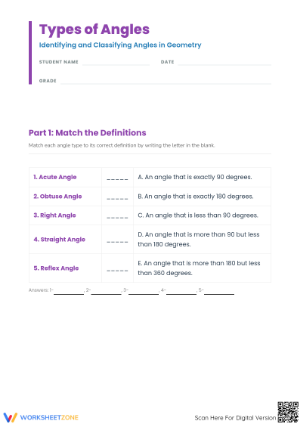
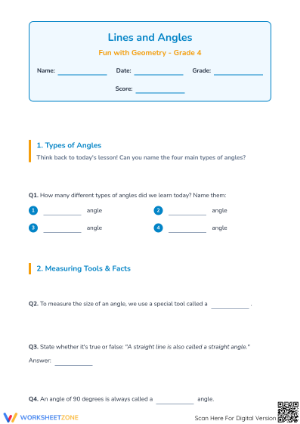
For students ready to go further, introducing acute and obtuse as vocabulary gives them language for what they are already classifying. A short extension that works well: after classifying an angle on the worksheet, those students use a protractor to read the actual degree measure. Extending angles worksheets for 3rd grade practice this way gives advanced students early protractor exposure without shifting the focus of the lesson for everyone else — and students are genuinely interested when they see that their paper-corner estimate matches what the protractor confirms.
Frequently Asked Questions
Do students need to know the words "acute" and "obtuse" to use these worksheets?
No. The worksheets consistently use "less than a right angle" and "greater than a right angle" as the comparison language, which matches the CCSS 3.G.A.1 expectation at this grade level. Acute and obtuse are not required vocabulary and appear only where a teacher chooses to introduce them as additional enrichment.
What if a student insists that a tilted square doesn't have right angles?
Hand the student a sheet of paper and ask them to place the corner inside one of the tilted square's corners. When they see the fit is exact — no gap between the rays and the paper, no overlap — ask what that tells them about the angle. Most students answer correctly from that observation alone. Verbal argument rarely resolves this as quickly as the physical demonstration does.
How do I handle students who say the angle with longer lines is bigger?
Cover the outer sections of both rays — with a finger, a sticky note, or a small card — so only the area near the vertex is visible. Ask whether the angles still look different in size. They usually do not. Then slowly uncover the rays and watch the impression return. That moment, when students notice the ray length creating the illusion, is the actual teaching point, and it tends to stick.
Are these worksheets appropriate for grades other than third?
Second graders who name shapes confidently and are ready to examine attributes can use the simpler identification worksheets as enrichment without modification. Fourth graders beginning angle measurement with protractors can run through one or two worksheets in the opening lesson of that unit as a conceptual anchor — the review takes little time for students who already know the material, and it surfaces quickly any gaps in foundational understanding that need attention before degree measurement begins.













 Interactive Worksheet Maker
 Quiz Maker
 Word Search Maker
 Crossword Puzzle Maker
 Word Scramble Generator
 Sentence Scramble Generator
 Handwriting Worksheet Generator
 Name Tracing Generator
 Fill In The Blank Generator