


























Views
Downloads



Essential Angles Worksheet | Grade 4 Math Practice
Paste this activity's link or code into your existing LMS (Google Classroom, Canvas, Teams, Schoology, Moodle, etc.).
Students can open and work on the activity right away, with no student login required.
You'll still be able to track student progress and results from your teacher account.
This Grade 4 math worksheet focuses on the additive property of angles, requiring students to solve for unknown measures using addition and subtraction. By working through visual diagrams and word problems, learners develop a concrete understanding of how angles decompose into smaller parts. It is an effective tool for building geometric reasoning and algebraic thinking.
At a Glance
- Grade: 4 · Subject: Math
- Standard:
CCSS.MATH.CONTENT.4.MD.C.7— Solve addition and subtraction problems to find unknown angles on a diagram- Skill Focus: Additive Angle Measures
- Format: 3 pages · 10 problems · Answer key included · PDF
- Best For: Independent practice and formative assessment
- Time: 20–30 minutes
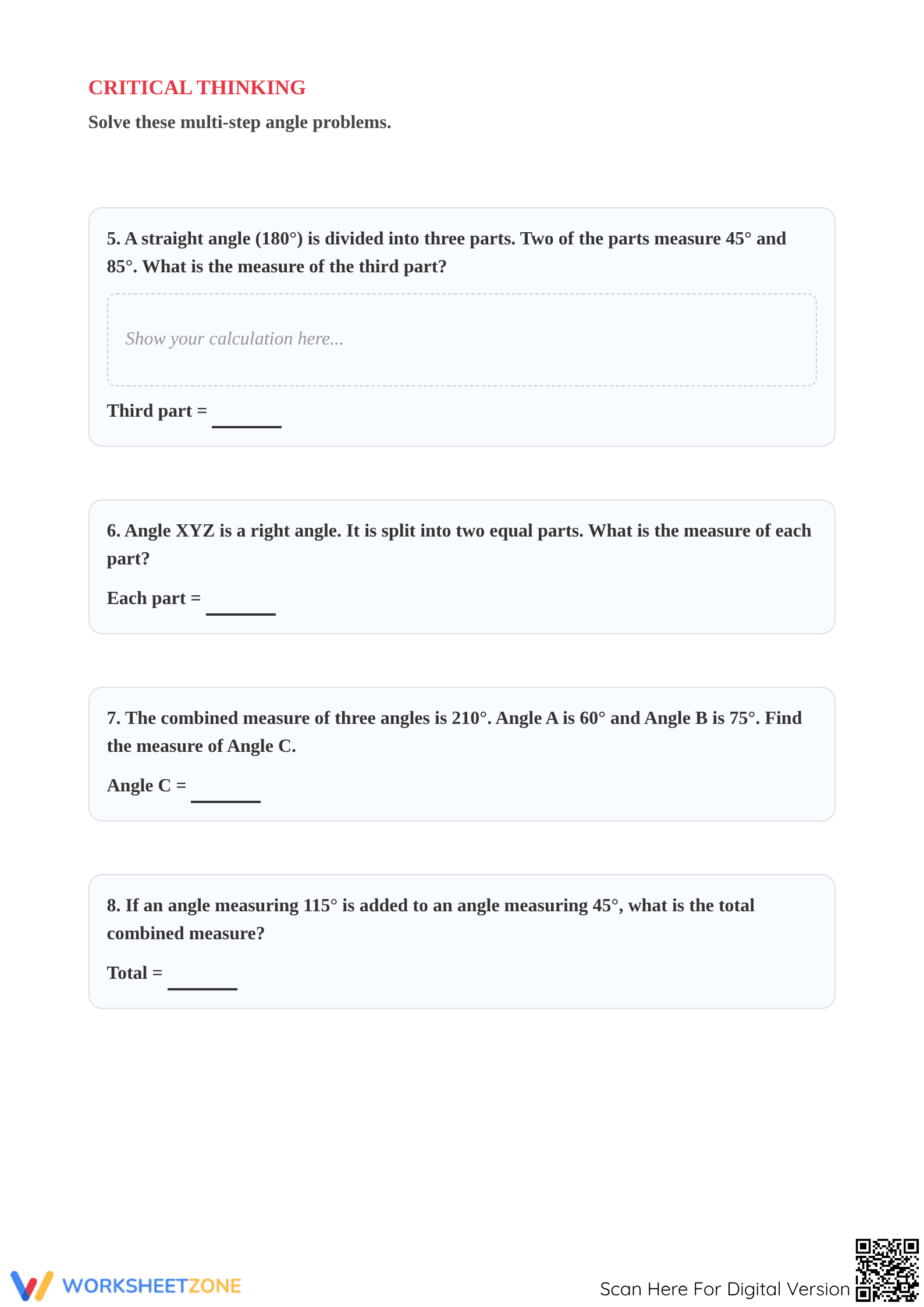
The resource contains three pages of high-quality instructional material. The first page features four visual problems where students must calculate the missing angle 'a', 'n', 'g', or 's' based on a provided total measure. The following two pages transition into critical thinking word problems, covering concepts like straight angles (180 degrees), right angles (90 degrees), and complementary angles. A full answer key is provided for quick grading.
Skill Progression
- Guided practice: The first four problems use clear visual diagrams with labeled arcs to help students visualize the relationship between the whole angle and its parts.
- Supported practice: Problems 5 through 8 introduce multi-step scenarios, such as dividing a straight angle into three distinct parts, requiring students to apply multiple operations.
- Independent practice: The final problems challenge students to apply definitions of complementary and equal-sized angles without visual aids.
This gradual-release model ensures students move from concrete visual identification to abstract mathematical application using the I Do, We Do, You Do framework.
Standards Alignment
The primary focus is `CCSS.MATH.CONTENT.4.MD.C.7`, which states that students should recognize angle measure as additive and solve addition and subtraction problems to find unknown angles on a diagram in real-world and mathematical problems. It also supports 4.MD.C.5 by reinforcing the concept of angle measurement. Both standard codes can be copied directly into lesson plans, IEP goals, or district curriculum mapping tools.
How to Use It
Use this worksheet during the "You Do" phase of a lesson on geometric measurement. It works best after students have practiced using protractors but before they move on to complex polygon properties. For a formative assessment, observe how students handle problem 5; if they struggle to subtract two known parts from 180, they may need additional scaffolding with number bonds. Expect 25 minutes for completion.
Who It's For
This resource is designed for fourth-grade students mastering geometry standards, though it serves as excellent review for fifth graders or enrichment for advanced third graders. It pairs naturally with a classroom anchor chart showing right, straight, and complementary angle definitions and a direct instruction lesson on additive properties.
According to the RAND AIRS 2024 report, structured practice in geometric decomposition is vital for transitioning students from basic shape recognition to formal algebraic reasoning. This worksheet directly addresses this developmental milestone by requiring students to apply CCSS.MATH.CONTENT.4.MD.C.7 through 10 targeted problems. By calculating unknown angle measures in both visual and word-problem formats, learners internalize the additive property of measurement. Research from Fisher & Frey (2014) emphasizes that independent practice should involve tasks that mirror the complexity of the standard while providing enough structure to prevent frustration. This 3-page PDF achieves that balance by scaffolding from labeled diagrams to abstract critical thinking questions. Educators can use the included answer key to provide immediate feedback, a practice shown to significantly improve retention in elementary mathematics. This resource provides a reliable, standards-aligned pathway for students to achieve mastery in angle relationships and geometric problem-solving.


