


























Views
Downloads


Essential Classifying Angles Worksheet | Grade 3 Math
Paste this activity's link or code into your existing LMS (Google Classroom, Canvas, Teams, Schoology, Moodle, etc.).
Students can open and work on the activity right away, with no student login required.
You'll still be able to track student progress and results from your teacher account.
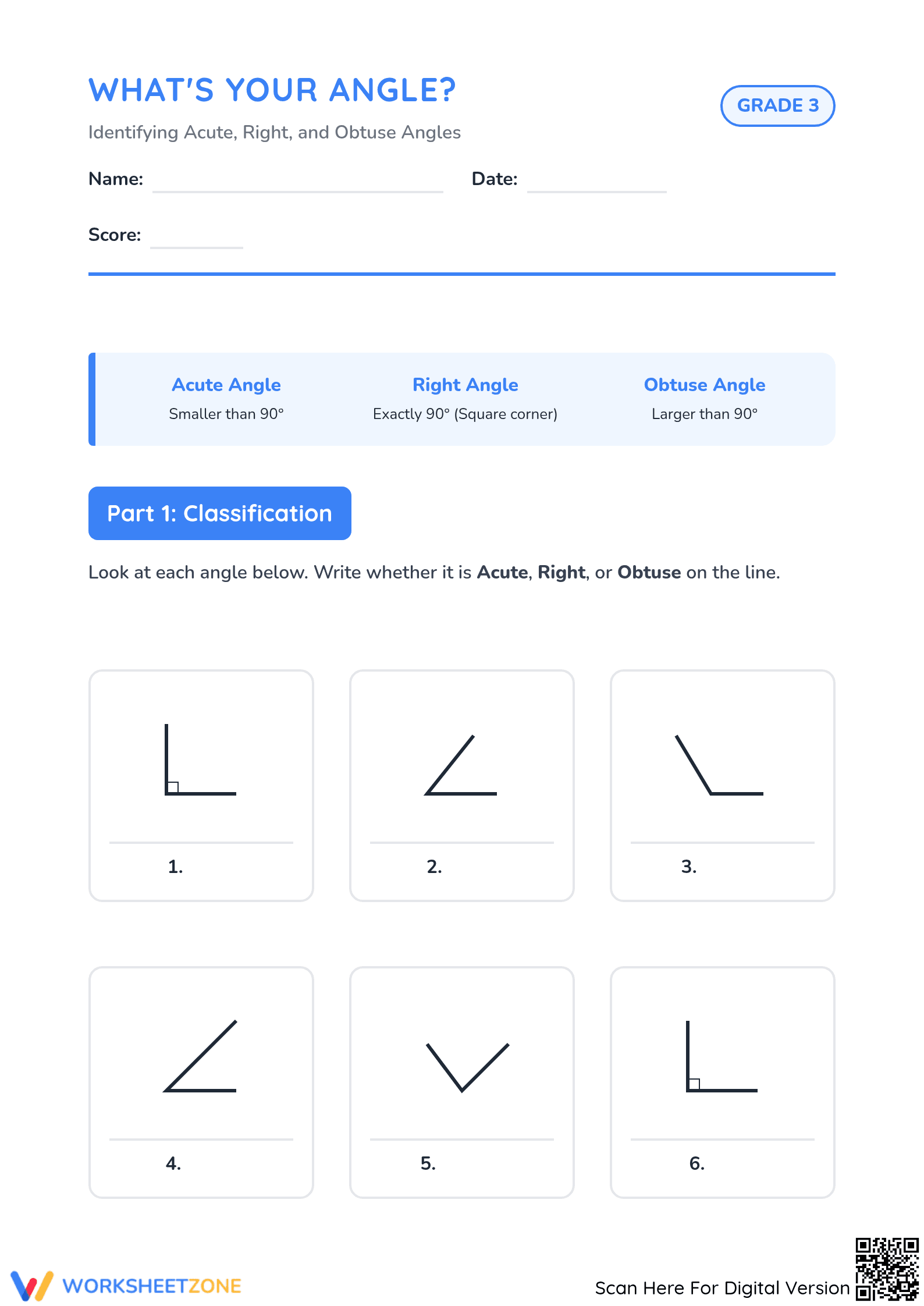
Master basic geometry by identifying and classifying angles with precision. This Grade 3 worksheet provides a structured approach to recognizing acute, right, and obtuse angles through visual identification, real-world application, and creative drawing practice. Students will move from simple recognition to constructing their own geometric representations, ensuring a deep understanding of angular relationships and attributes.
At a Glance
- Grade: 3 · Subject: Mathematics
- Standard:
3.G.A.1— Understand that shapes in different categories may share attributes- Skill Focus: Angle Classification (Acute, Right, and Obtuse)
- Format: 3 pages · 15 high-quality problems · Full answer key included · High-resolution PDF
- Best For: Core geometry unit practice and formative assessment
- Time: 20–30 minutes total instruction
What's Inside
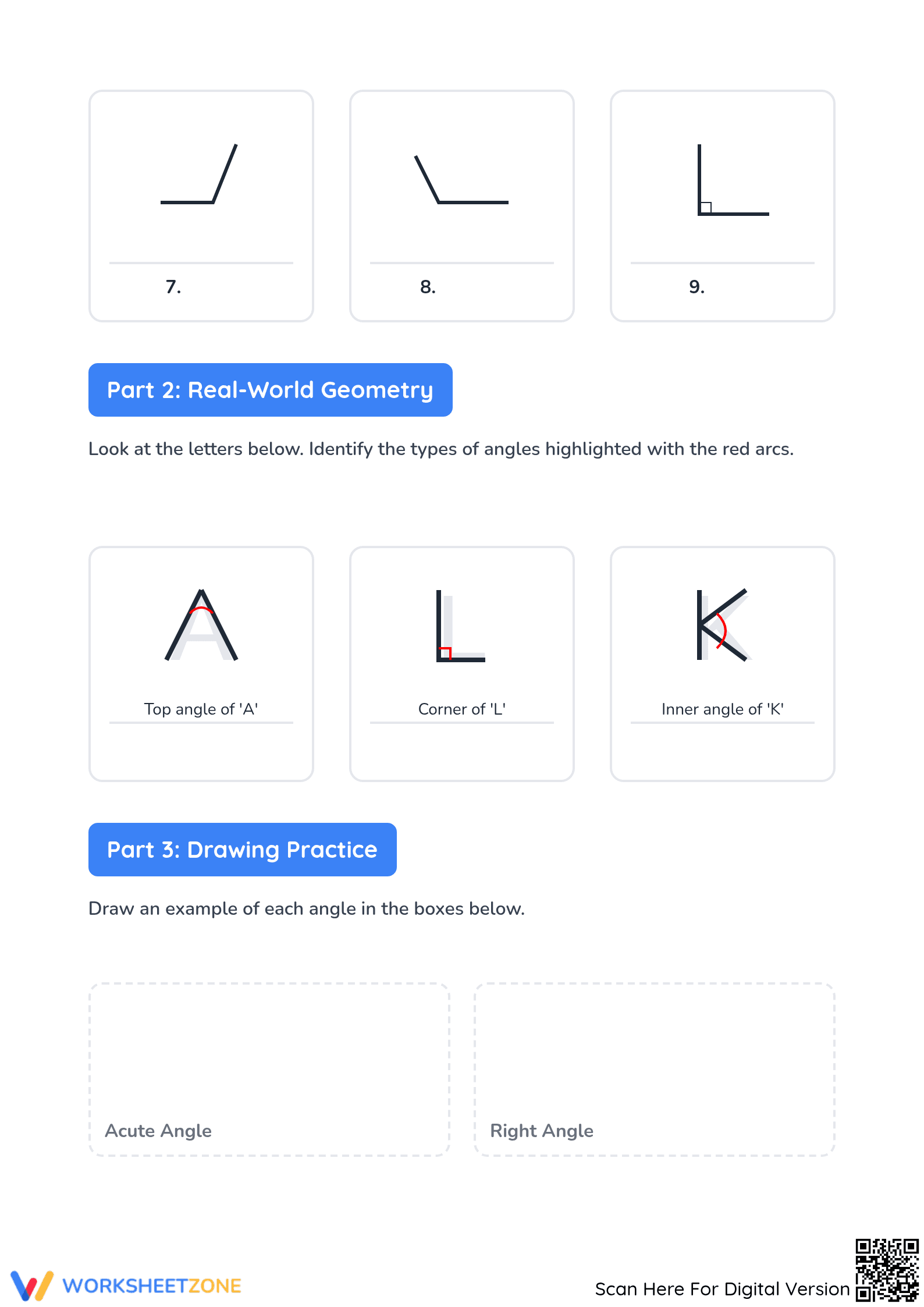
This comprehensive 3-page PDF resource contains three distinct instructional parts designed to build mastery. The first section offers 9 visual classification tasks, the second applies geometry to real-world letters (A, L, K), and the third challenges students to draw their own examples. A clear reference guide at the top of the first page defines each angle type by its degree relative to 90 degrees, while a complete answer key ensures easy grading and immediate student feedback.
Skill Progression
- Guided Practice: Students use a provided reference bank to classify 9 standalone angles, focusing on the distinction between smaller than, exactly, and larger than 90 degrees.
- Supported Practice: The tasks move to real-world geometry, where students identify hidden angles within familiar alphabet characters, bridging abstract shapes and concrete objects.
- Independent Practice: Students finalize their learning by constructing acute, right, and obtuse angles from scratch in dedicated workspace boxes.
This gradual-release model ensures students build the conceptual confidence needed for geometric fluency and future work with quadrilaterals.
Standards Alignment
The primary focus of this activity is 3.G.A.1, which requires students to understand that shapes in different categories may share attributes, and that shared attributes can define a larger category. By identifying right angles and comparing them to acute and obtuse variations, students develop the foundational vocabulary required for advanced quadrilateral classification and spatial reasoning. This standard code can be copied directly into lesson plans, IEP goals, or district curriculum mapping tools.
How to Use It
This resource is ideal for use during the "Guided Practice" phase of a geometry lesson. After introducing the concepts of 90-degree corners, teachers can distribute the worksheet to observe how students apply the definitions to the initial 9 problems. Alternatively, use Part 2 as a quick formative assessment exit ticket to see if students can generalize their knowledge to complex shapes like the letter 'K'. Expect most students to complete the entire set within 25 minutes.
Who It's For
This worksheet is specifically designed for third-grade students beginning their geometry units. It is highly effective for visual learners who benefit from the large, clear diagrams and the alphabet-based application. For students requiring extra support, teachers might pair this resource with a physical "angle finder" tool or a classroom anchor chart displaying real-world examples of right angles found within the school environment.
Identifying angles by their properties is a critical milestone in early geometric reasoning. This worksheet, aligned with the CCSS.MATH.CONTENT.3.G.A.1 standard, ensures Grade 3 students actively analyze attributes that define geometric categories, rather than just memorizing names like acute, right, and obtuse. This approach helps bridge the gap between simple shape recognition and the complex spatial perception required in upper elementary math. Educators can confidently integrate these 15 tasks into their curriculum for developing foundational proficiency in geometry and measurement.


