




























Views
Downloads

Printable Angle Types Worksheet | Grade 4 Math

Paste this activity's link or code into your existing LMS (Google Classroom, Canvas, Teams, Schoology, Moodle, etc.).
Students can open and work on the activity right away, with no student login required.
You'll still be able to track student progress and results from your teacher account.
This Grade 4 math worksheet provides a clear and structured way for students to master angle classification. By identifying visual representations and numerical measurements, learners build a solid foundation in geometry. It focuses on the four primary angle types, ensuring students can distinguish between acute, obtuse, right, and reflex angles with confidence.
At a Glance
- Grade: 4 · Subject: Math
- Standard:
CCSS.MATH.CONTENT.4.G.A.1— Identify and classify acute, obtuse, and right angles in two-dimensional figures.- Skill Focus: Angle Classification
- Format: 2 pages · 8 problems · Answer key included · PDF
- Best For: Independent practice or quick formative assessment
- Time: 15–20 minutes
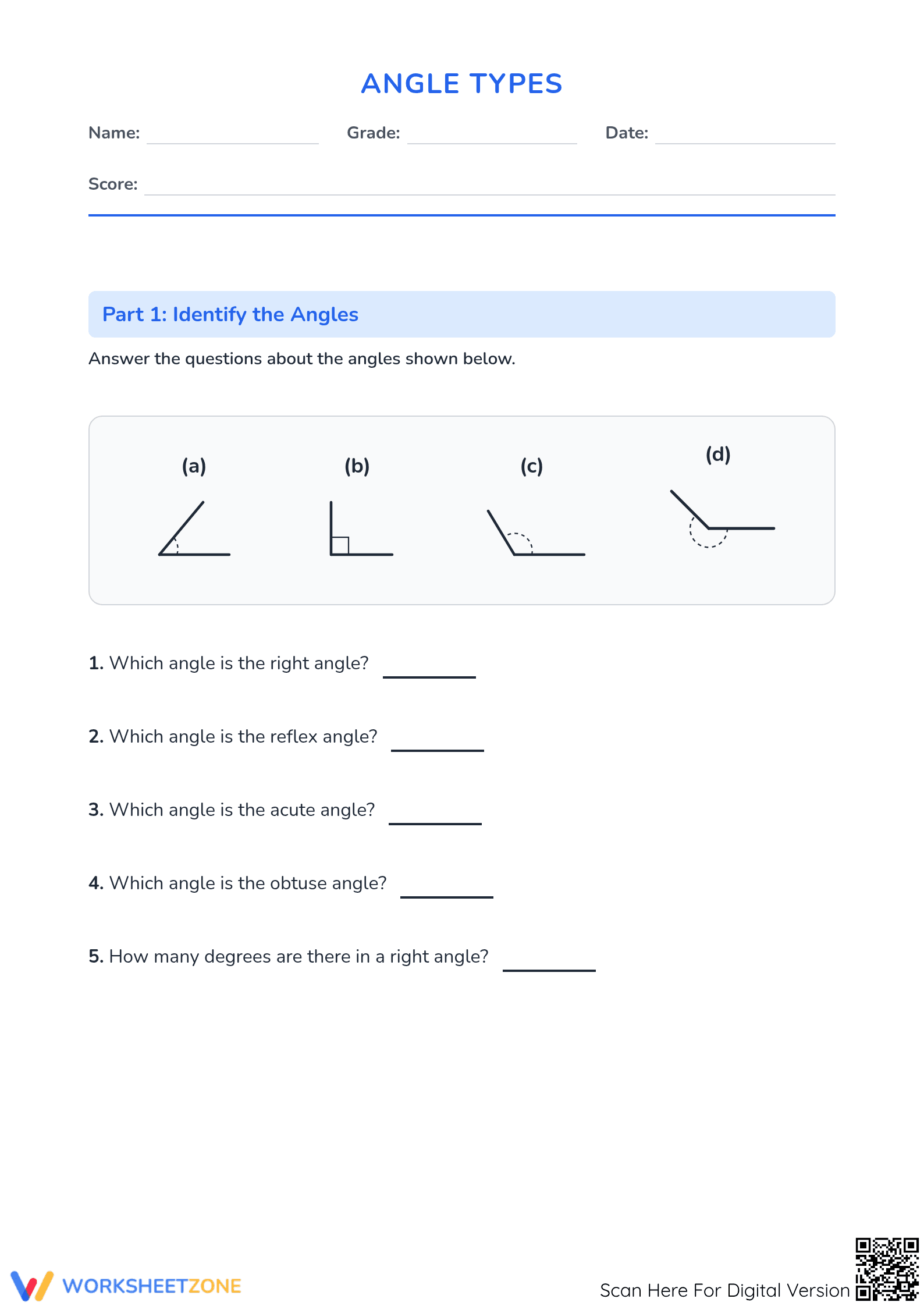
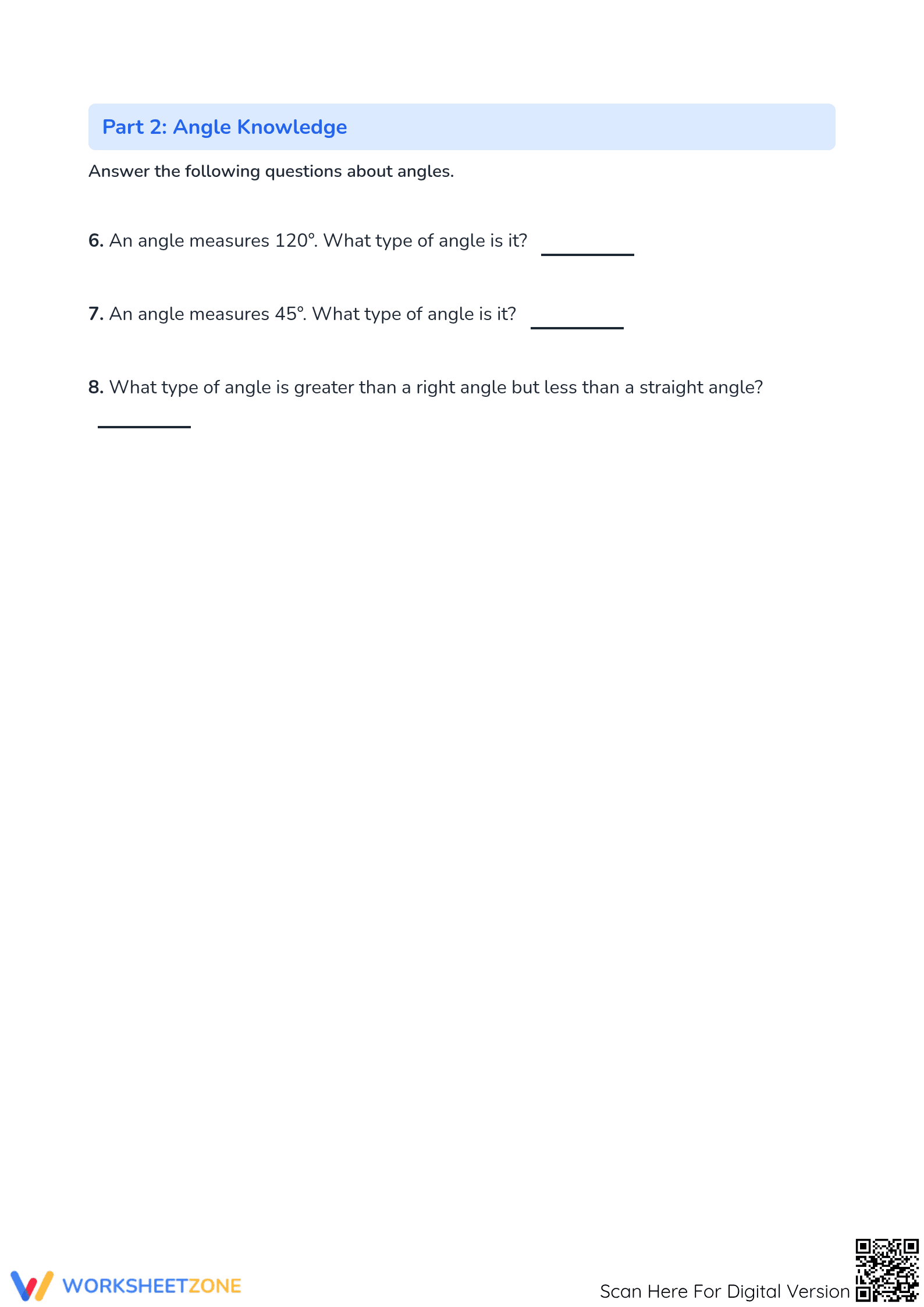
The resource consists of two pages featuring 8 targeted tasks. Part 1 uses visual diagrams to prompt students to identify specific angle types from a provided set. Part 2 transitions to conceptual knowledge, asking students to classify angles based on degree measurements (e.g., 120° and 45°) and definitions. A full answer key is included for rapid grading and immediate student feedback.
This worksheet is designed for immediate classroom use. Teachers can print the two-page PDF in under 1 minute. Distribution takes seconds, and because the instructions are self-explanatory, students can begin working immediately. Reviewing the 8 answers using the provided key takes less than 2 minutes, making this an ideal choice for busy mornings, homework assignments, or emergency sub plans.
The primary focus is `CCSS.MATH.CONTENT.4.G.A.1`, which requires students to "Draw points, lines, line segments, rays, angles (right, acute, obtuse), and perpendicular and parallel lines; identify these in two-dimensional figures." It also supports 4.MD.C.5 regarding angle measurement concepts. Both standard codes can be copied directly into lesson plans, IEP goals, or district curriculum mapping tools.
Use this as a formative assessment after an introductory lesson on protractors and angle types. It works well during the independent practice phase of a gradual release model. Teachers should observe if students can correctly identify the reflex angle, as this often requires more spatial reasoning than right or acute angles. Completion typically takes 15 to 20 minutes for most fourth-grade learners.
This is tailored for Grade 4 students but serves as an excellent review for Grade 5 learners or an extension for advanced Grade 3 students. It pairs naturally with a geometry anchor chart or a hands-on activity using pattern blocks to find angles in real-world shapes. The clear layout is particularly helpful for students who benefit from reduced visual clutter.
According to the RAND AIRS 2024 report, high-quality instructional materials that combine visual identification with numerical classification significantly improve geometric reasoning in upper elementary students. This worksheet aligns with CCSS.MATH.CONTENT.4.G.A.1 by requiring students to recognize and name acute, obtuse, right, and reflex angles. By providing 8 distinct tasks that move from visual recognition to abstract definition, the resource supports the cognitive shift from concrete to representational math. Research from Fisher & Frey (2014) emphasizes that clear, zero-prep scaffolds allow teachers to focus on targeted interventions rather than administrative setup. This resource provides a reliable, evidence-based method for assessing student mastery of angle properties within a standard 20-minute instructional block. It is a practical tool for any Grade 4 math curriculum focused on geometric foundations and measurement accuracy.


