




























Views
Downloads


Printable Types of Angles Worksheet | Grade 3 Math Ready

Paste this activity's link or code into your existing LMS (Google Classroom, Canvas, Teams, Schoology, Moodle, etc.).
Students can open and work on the activity right away, with no student login required.
You'll still be able to track student progress and results from your teacher account.
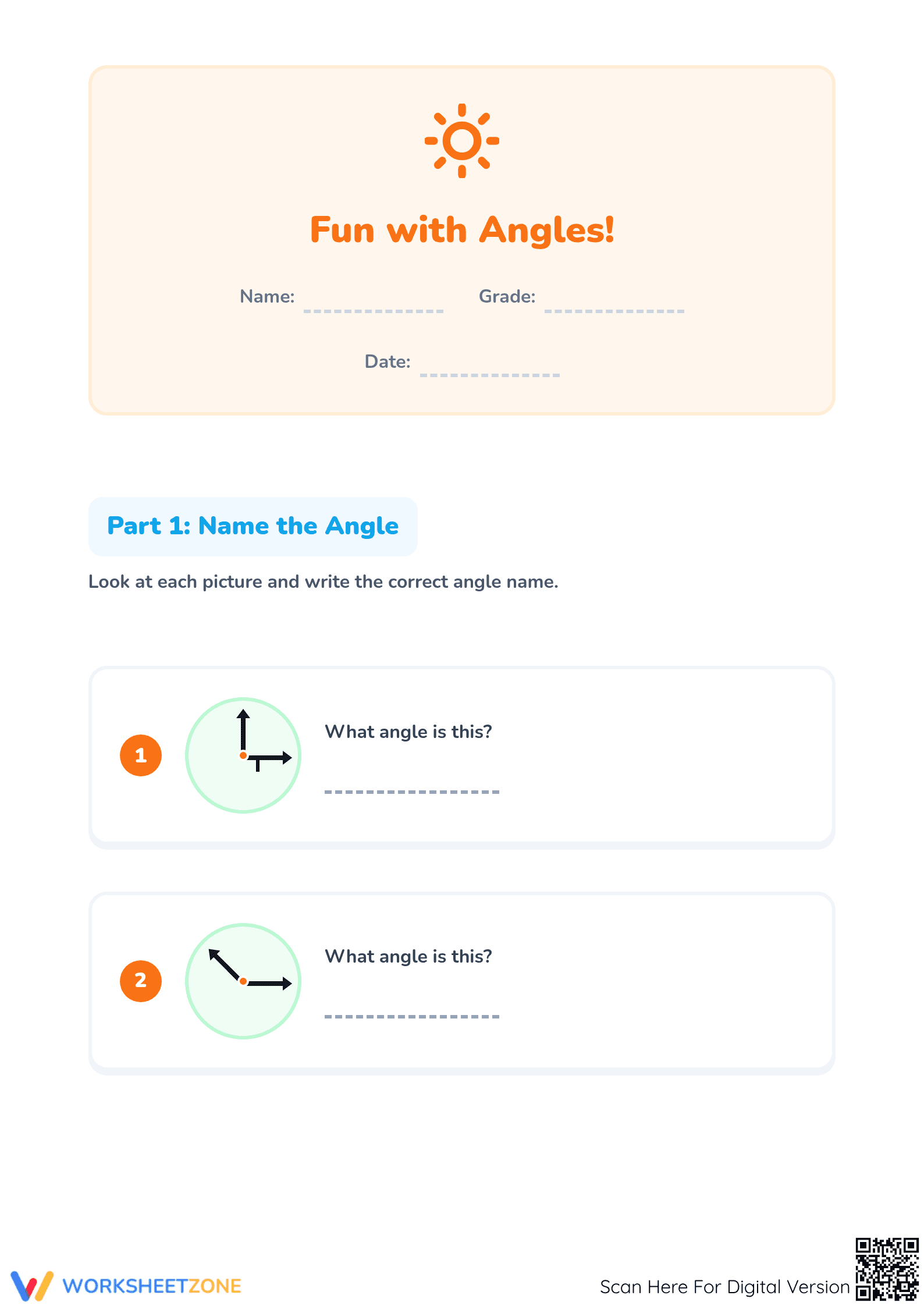
Identify and classify angles with precision using this comprehensive geometry resource. Students will learn to distinguish between acute, obtuse, right, straight, and reflex angles through a variety of engaging formats. This worksheet transforms abstract geometric concepts into concrete identifying tasks, ensuring learners build a strong foundation for advanced spatial reasoning and measurement.
At a Glance
- Grade: 3 · Subject: Math
- Standard:
CCSS.MATH.CONTENT.4.G.A.1— Identify and draw right, acute, and obtuse angles in two-dimensional figures- Skill Focus: Angle Classification
- Format: 5 pages · 17 problems · Answer key included · PDF
- Best For: Geometry unit practice and formative assessment
- Time: 25–35 minutes
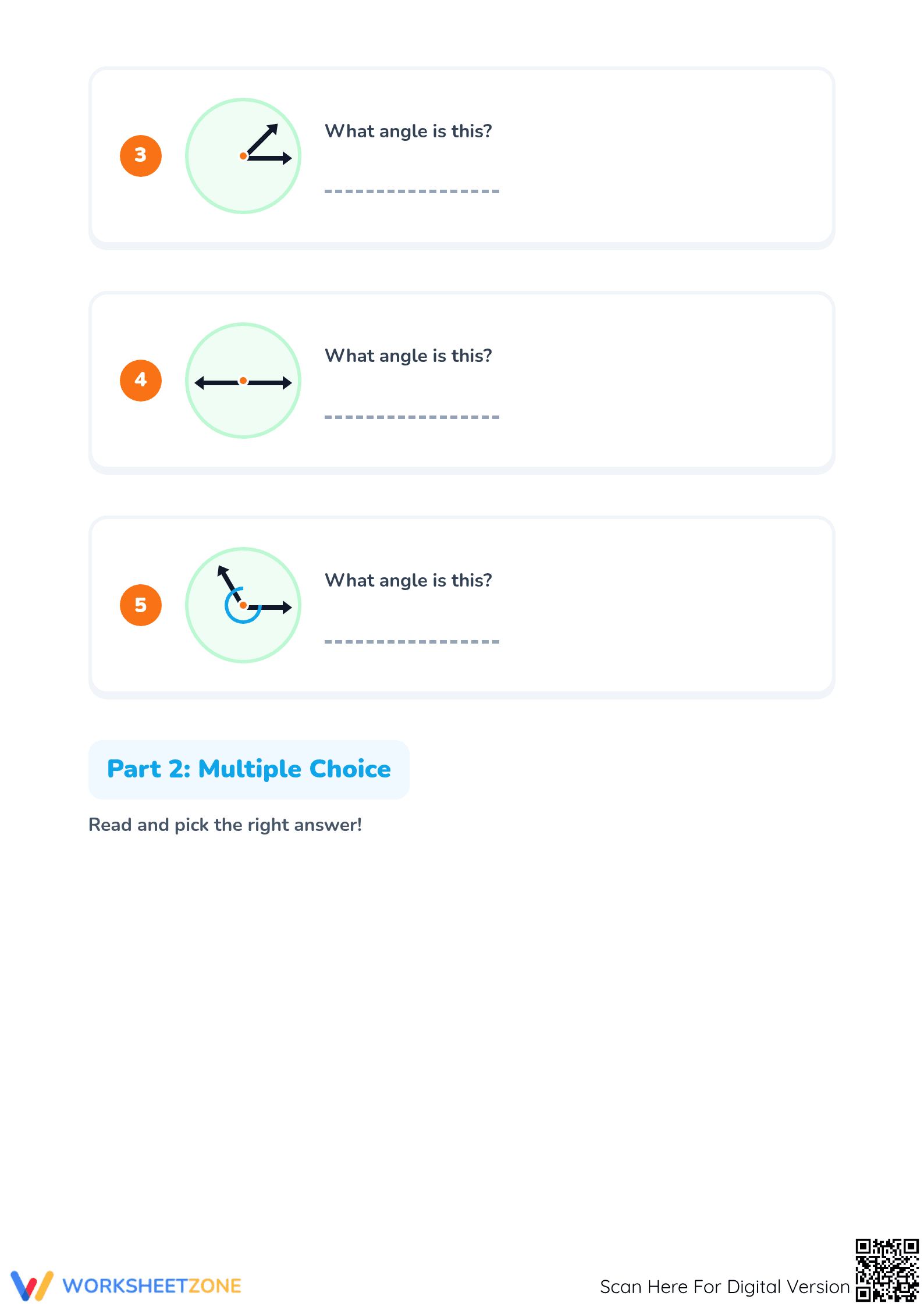
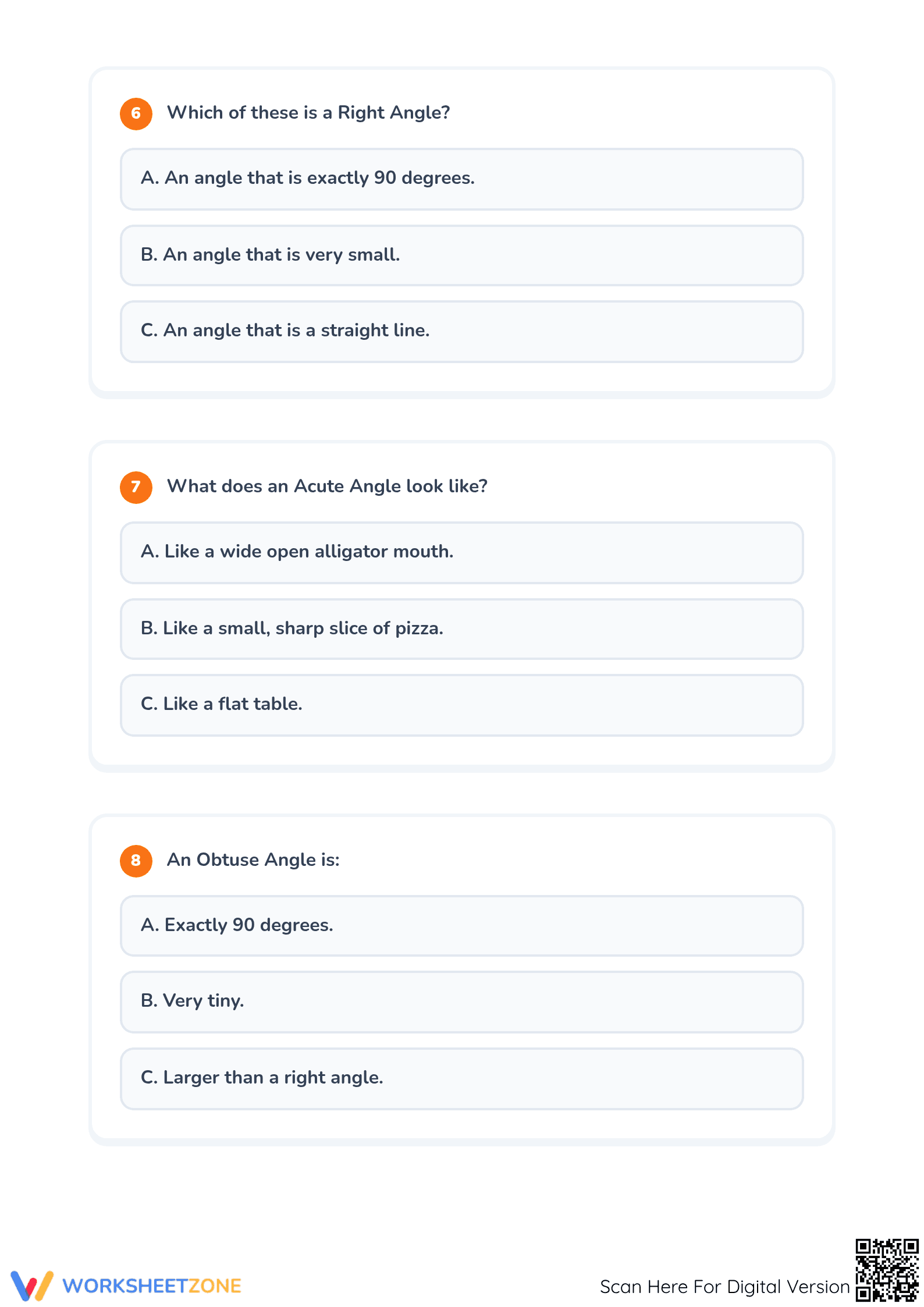
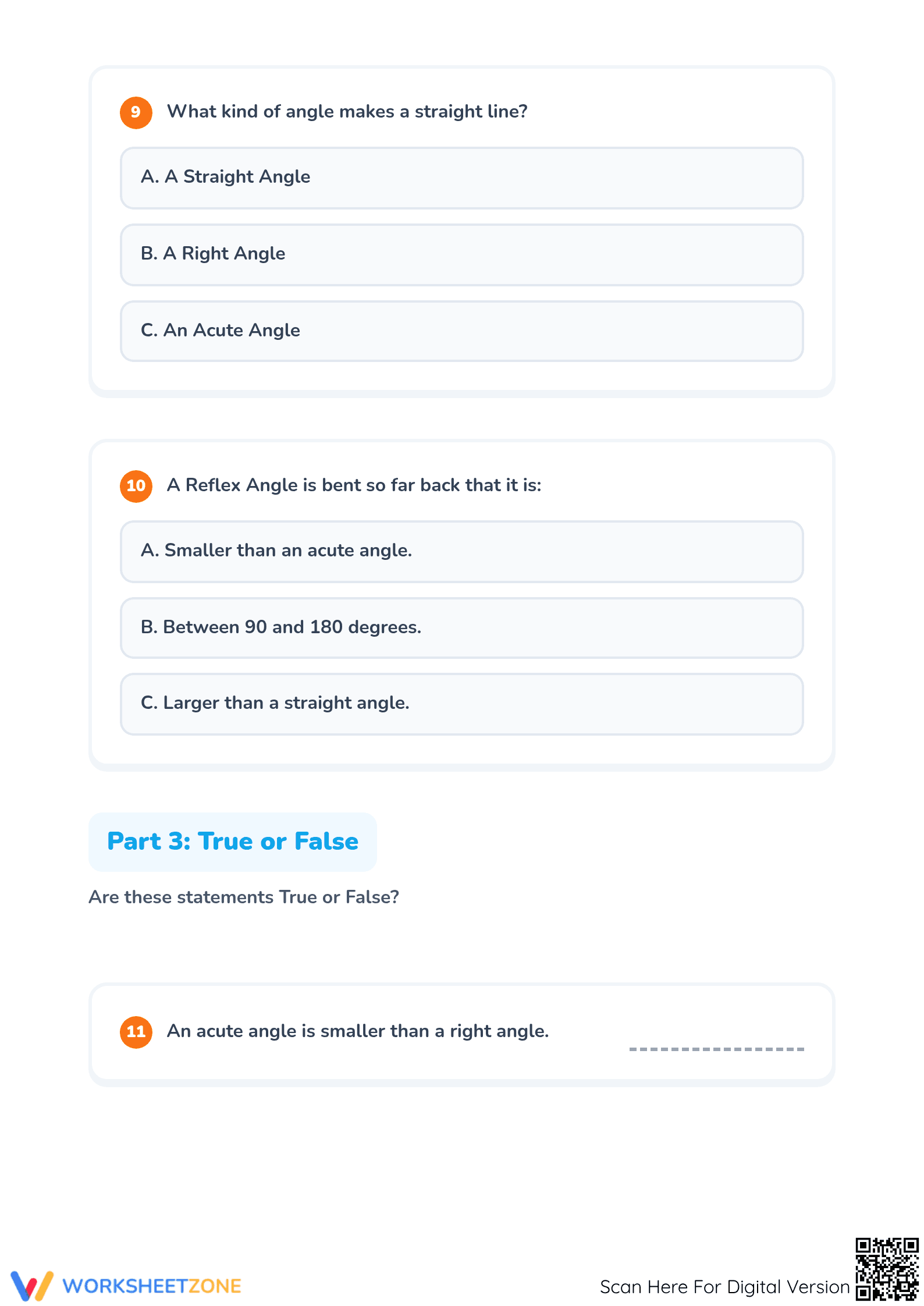
This five-page PDF provides a robust exploration of angle types. It contains 17 distinct problems across four sections: naming visual representations, multiple-choice conceptual questions, true/false logic checks, and fill-in-the-blank terminology reinforcement. The inclusion of reflex and straight angles alongside the standard trio ensures a complete understanding of the 360-degree rotation spectrum. A full answer key is provided for rapid grading.
Skill Progression
- Guided Identification: Part 1 uses clear visual diagrams of clocks and rays to help students name angles based on observable size and orientation.
- Conceptual Logic: Parts 2 and 3 move away from visuals, requiring students to apply definitions of degree ranges to select correct answers and validate geometric statements.
- Independent Mastery: The final section requires students to recall and write specific terminology without prompts, confirming they have internalized the vocabulary.
This scaffolded approach supports the gradual release of responsibility from visual cues to abstract definitions, ensuring students move from basic recognition to conceptual understanding.
Standards Alignment
This resource is primary aligned to CCSS.MATH.CONTENT.4.G.A.1, which requires students to draw and identify points, lines, rays, and angles, specifically right, acute, and obtuse varieties. While reflex and straight angles are extension concepts in many Grade 3 curricula, they provide essential context for understanding how angles function as rotations. This standard code can be copied directly into lesson plans, IEP goals, or district curriculum mapping tools.
How to Use It
Use this worksheet as a mid-unit check for understanding after students have been introduced to the protractor or basic angle definitions. During the independent practice phase, observe students as they complete Part 1; those struggling to distinguish between acute and obtuse angles may need a physical "corner" tool to compare against right angles. The expected completion time for the full 17-item set is approximately 30 minutes.
Who It's For
This practice set is ideal for Grade 3 students ready for geometric extension or Grade 4 learners mastering core standards. The varied question types support diverse learners by providing multiple ways to demonstrate knowledge. Pair this resource with a physical clock face or an angle-sorting anchor chart to provide a visual reference during the multiple-choice and true-false sections.
According to the instructional frameworks established by Fisher & Frey (2014), the classification of geometric attributes is a critical step in developing higher-order spatial reasoning. This worksheet facilitates that development by forcing students to move beyond simple recognition and into the area of categorical definition. By requiring students to identify angles in 17 different scenarios, the resource ensures that the geometric properties of right, acute, and obtuse angles are reinforced through repetitive, high-quality practice. Research in the NAEP mathematics assessments highlights that students who master early geometry vocabulary perform significantly better in middle-school trigonometry. This standards-aligned tool provides the necessary repetition to bridge the gap between basic shape recognition and advanced geometric proofs. The focus on CCSS.MATH.CONTENT.4.G.A.1 ensures that every task contributes to a measurable educational outcome, providing teachers with actionable data on student proficiency.


