


























Views
Downloads




Grade 3 Matching Angles — Printable No-Prep Worksheet
Paste this activity's link or code into your existing LMS (Google Classroom, Canvas, Teams, Schoology, Moodle, etc.).
Students can open and work on the activity right away, with no student login required.
You'll still be able to track student progress and results from your teacher account.
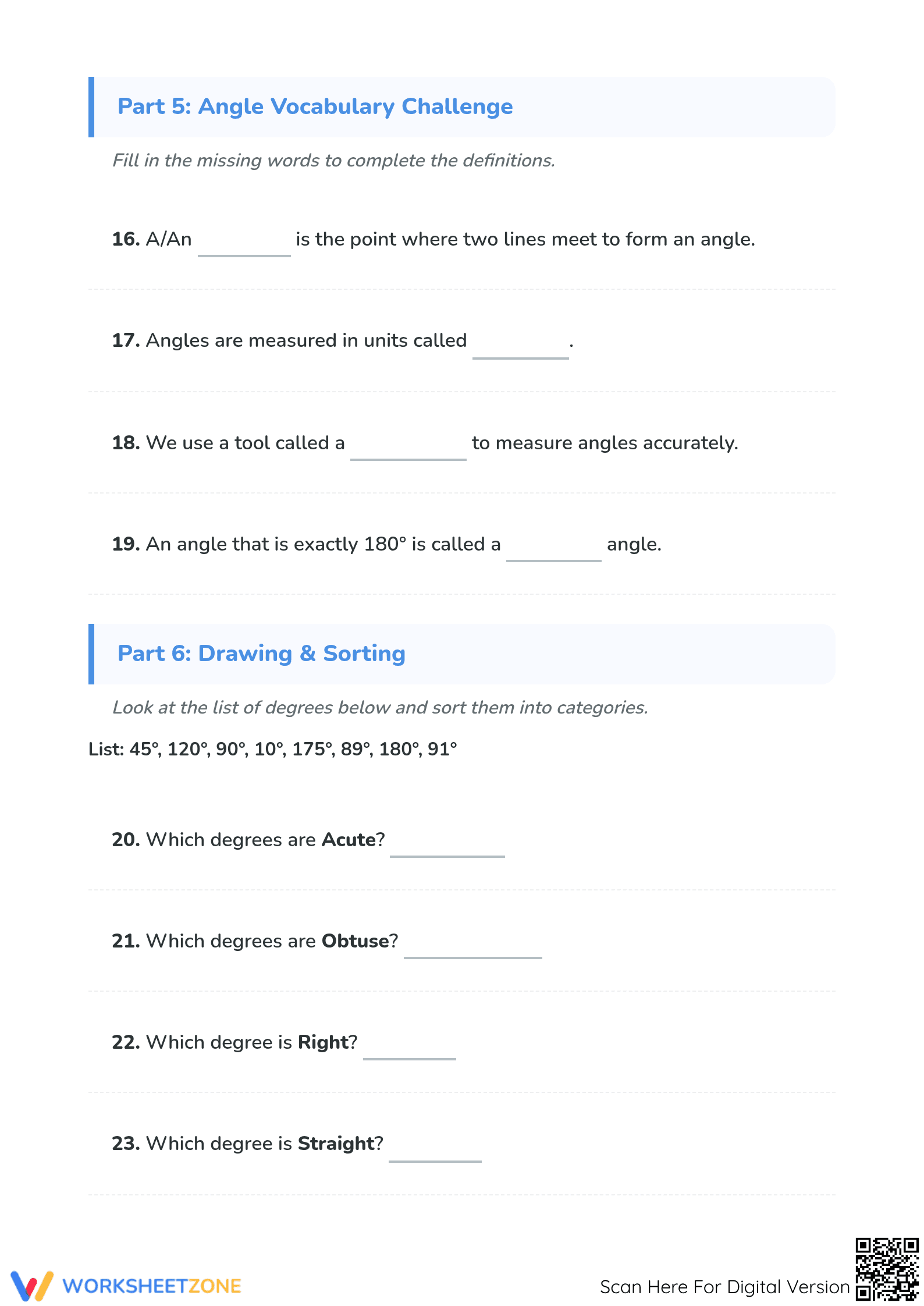
Mastering angle properties is a foundational step in geometric reasoning. This comprehensive five-page worksheet helps students transition from visual recognition to identifying acute, obtuse, and right angles in real-world contexts and shapes. By the end of these 25 exercises, learners will confidently classify angles by their degree measurements and orientation.
At a Glance
- Grade: 3 · Subject: Math
- Standard:
CCSS.MATH.CONTENT.4.G.A.1— Draw and identify right, acute, and obtuse angles in various two-dimensional figures- Skill Focus: Angle Classification and Identification
- Format: 5 pages · 25 problems · Answer key included · PDF
- Best For: Targeted small group instruction and student independent practice
- Time: 30–45 minutes
What's Inside
This 5-page packet features six sections designed for conceptual depth. It includes visual identification with degree hints, real-world application using clock faces, and shape analysis for rectangles and triangles. The worksheet also contains True/False checks, a vocabulary challenge for terms like "vertex," and a data-sorting activity to categorize degrees. A full answer key is provided.
Zero-Prep Workflow
This resource requires exactly zero teacher preparation. Print the five-page packet and distribute it during your geometry unit. Clear sections allow for easy pacing—assign pages as warm-ups or the entire packet as a summative assessment. Reviewing is streamlined by the included answer key, which matches the layout for quick cross-referencing. Total prep time is under 120 seconds.
Standards Alignment
Primary focus is CCSS.MATH.CONTENT.4.G.A.1, requiring students to "draw and identify right, acute, and obtuse angles in two-dimensional figures." This content introduces 4th-grade concepts scaffolded for Grade 3 learners exploring shape properties. This alignment supports the progression of CCSS.MATH.CONTENT.3.G.A.1. Both standard codes can be copied directly into lesson plans or district curriculum mapping tools.
How to Use It
Use this during independent practice after introducing angle types. It is effective as a mid-unit assessment to identify students struggling with acute versus obtuse orientations. For formative observation, watch students during the "Real World" section to see if they visualize rays on clock faces. Expected completion time ranges from 30 to 45 minutes.
Who It's For
This is ideal for Grade 3 extensions or Grade 4 reinforcement. It supports English Language Learners (ELL) through the "Vocabulary Challenge," which explicitly defines geometric parts. It pairs naturally with a digital protractor or pattern blocks to provide a hands-on dimension to these paper-based tasks.
According to the RAND AIRS 2024 study, linking abstract concepts to real-world visuals, like clock faces, improves spatial vocabulary retention. This worksheet implements these findings by requiring students to classify angles within the context of common polygons. By integrating definitions alongside numerical classification, the resource addresses multiple cognitive domains. This dual approach aligns with Fisher & Frey (2014) research on the "Gradual Release of Responsibility," moving students from guided identification to independent sorting and evaluation. The inclusion of the CCSS.MATH.CONTENT.4.G.A.1 standard ensures that the practice remains rigorous and aligned with college-and-career readiness benchmarks, providing measurable data points for student growth in geometry. Furthermore, providing diverse problem sets—from multiple-choice true/false questions to open-ended degree sorting—allows educators to capture a holistic view of student mastery across the instructional cycle.


