


























Views
Downloads


4.MD.C.6 Worksheet: Geometry & Angles — Grade 4 Aligned
Paste this activity's link or code into your existing LMS (Google Classroom, Canvas, Teams, Schoology, Moodle, etc.).
Students can open and work on the activity right away, with no student login required.
You'll still be able to track student progress and results from your teacher account.
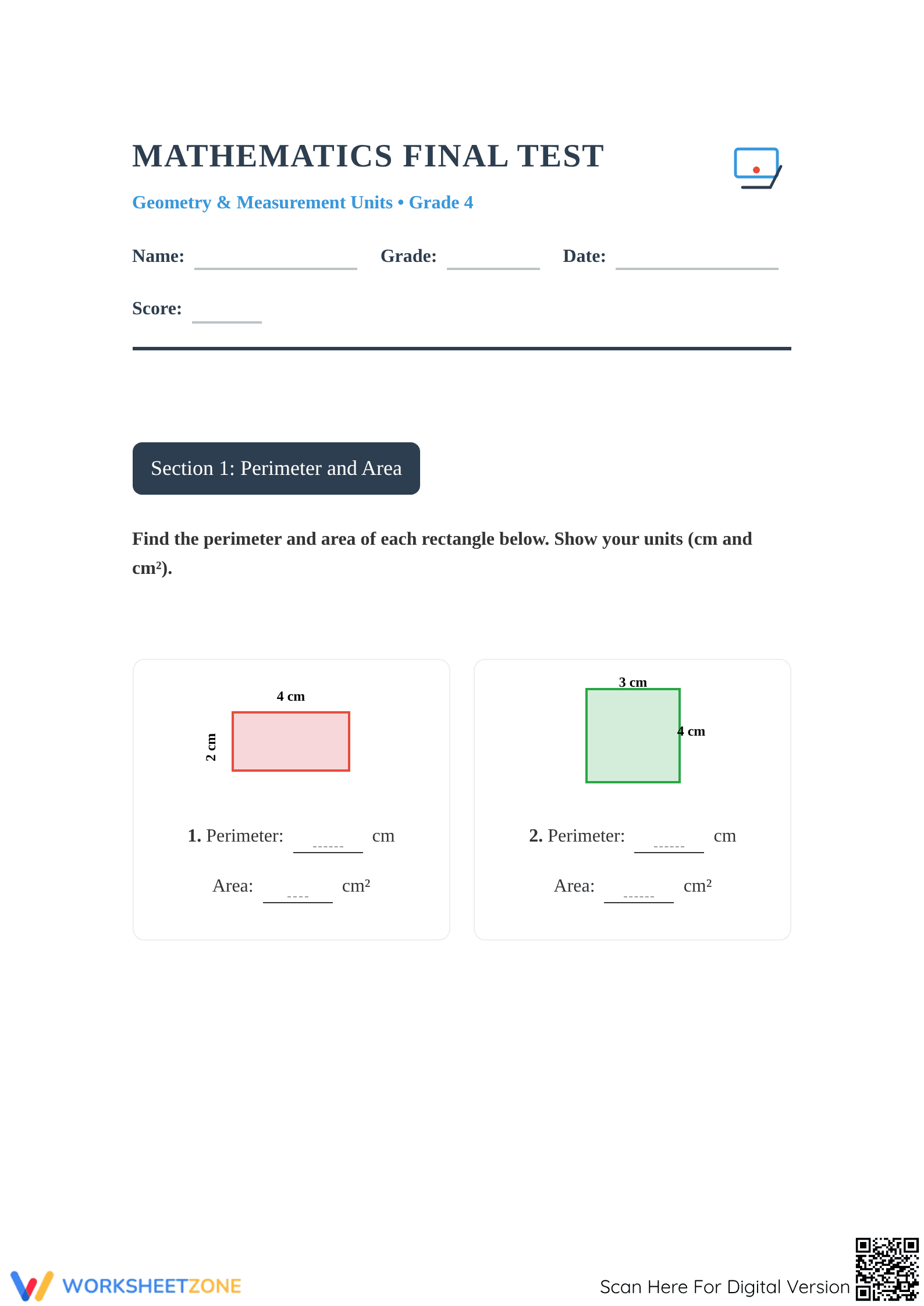
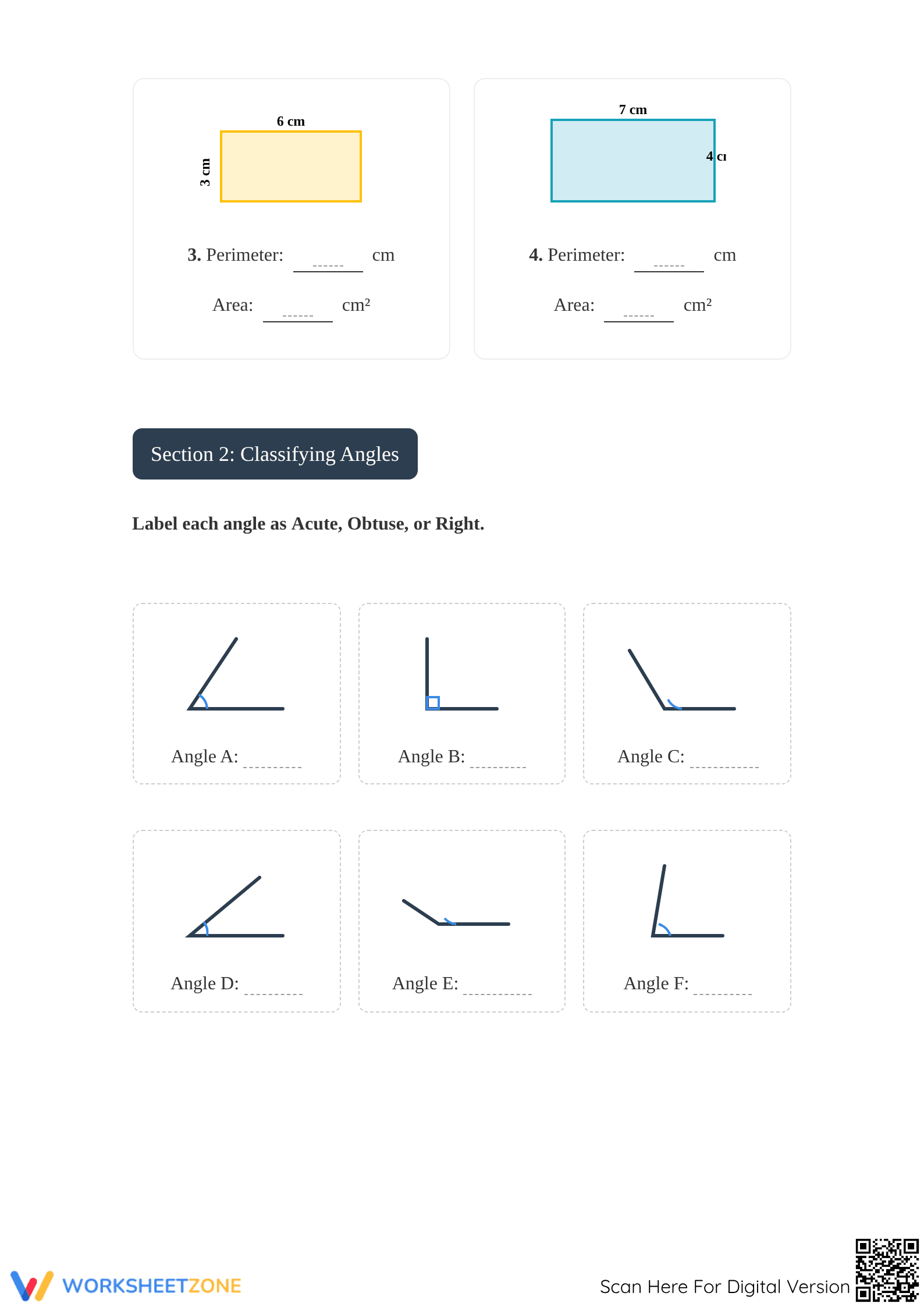
This Grade 4 geometry assessment provides a rigorous evaluation of student proficiency in measurement and data. Students demonstrate mastery by calculating perimeter and area, classifying various angle types, and using protractors for precise measurement and construction. It serves as a definitive tool for verifying end-of-unit comprehension and identifying specific geometric skill gaps.
At a Glance
- Grade: 4 · Subject: Math
- Standard:
4.MD.C.6— Measure angles in whole-number degrees using a protractor and sketch angles- Skill Focus: Geometry and Measurement
- Format: 5 pages · 22 problems · Answer key included · PDF
- Best For: Summative assessment or end-of-year review
- Time: 45–60 minutes
This 5-page comprehensive test features 22 distinct tasks organized into five logical sections. It includes visual area and perimeter models, six angle classification exercises, and four protractor-based measurement tasks. The final pages challenge students with angle construction and additive angle calculations. A complete answer key is provided for efficient grading and immediate feedback.
Each section of this assessment maps directly to specific sub-skills within the Common Core geometry domain. The progression from basic classification to complex additive angle calculations allows teachers to categorize student performance into clear tiers: Approaching, Meeting, or Exceeding standards. Results can be entered directly into gradebooks or used to document progress toward specific IEP goals regarding spatial reasoning.
The primary focus is CCSS.MATH.CONTENT.4.MD.C.6, which requires students to measure and sketch angles using a protractor. It also supports 4.MD.A.3 through area and perimeter applications and 4.MD.C.7 via additive angle problems. Both standard codes can be copied directly into lesson plans, IEP goals, or district curriculum mapping tools.
Administer this as a formal summative assessment after completing a unit on geometry and measurement. For formative use, assign individual sections as check-ins during the learning cycle. Observe how students align the protractor vertex; this common error point provides immediate insight into their procedural fluency. Expect completion within 45 to 60 minutes.
This resource is designed for general education fourth-grade students, but it also serves as an excellent challenge for advanced third graders. It is particularly useful for teachers needing documented evidence of standards mastery or for tutors conducting comprehensive skill evaluations before state testing.
This assessment aligns with the instructional shifts identified in the RAND AIRS 2024 report, which emphasizes the necessity of multi-modal geometric tasks to build conceptual depth. By integrating the primary standard 4.MD.C.6—measuring angles in whole-number degrees—with area and perimeter calculations, the worksheet ensures students move beyond rote memorization toward procedural fluency. Research from Fisher & Frey (2014) suggests that structured assessments featuring visual scaffolds, such as the protractor overlays included here, significantly improve student accuracy during independent practice. This 5-page resource provides 22 targeted problems that allow educators to pinpoint specific misconceptions in spatial reasoning. The inclusion of additive angle measurements further supports the development of algebraic thinking within a geometric context. This comprehensive tool is essential for verifying that Grade 4 learners have met the rigorous demands of national mathematics frameworks before transitioning to middle school geometry.


