


























Views
Downloads

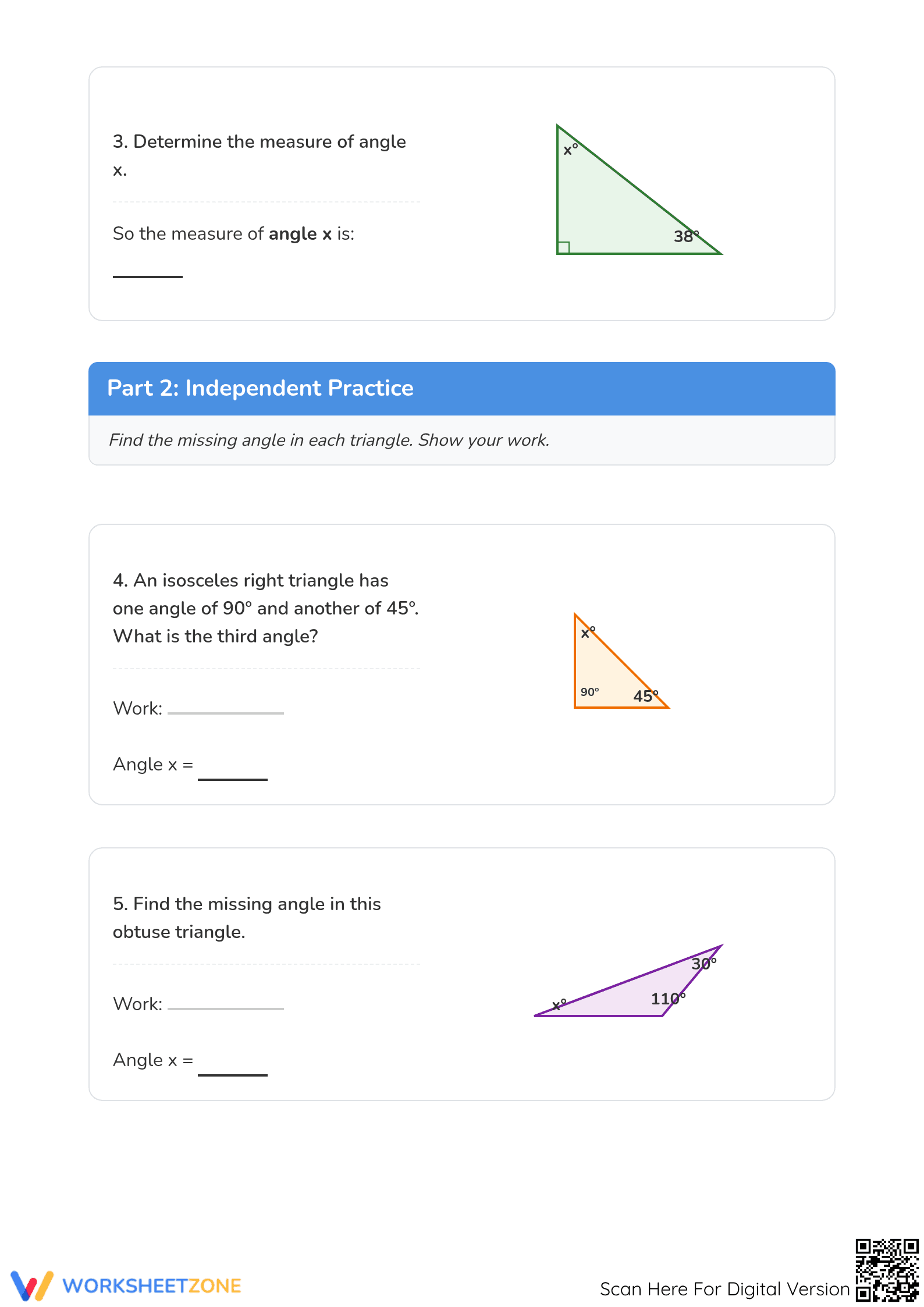


Find Missing Angles in Triangles | Essential Grade 5 Math
Paste this activity's link or code into your existing LMS (Google Classroom, Canvas, Teams, Schoology, Moodle, etc.).
Students can open and work on the activity right away, with no student login required.
You'll still be able to track student progress and results from your teacher account.
This Grade 5 geometry worksheet provides a structured approach to mastering interior angle sums. Students apply the fundamental rule that triangle angles total 180 degrees to solve for unknown variables. By progressing from visual models to abstract word problems, learners build the computational fluency required for advanced geometric reasoning and spatial analysis.
At a Glance
- Grade: 5 · Subject: Math
- Standard:
4.MD.C.7— Solve addition and subtraction problems to find unknown angles on a diagram- Skill Focus: Interior angle sums of triangles
- Format: 3 pages · 8 problems · Answer key included · PDF
- Best For: Core instruction or formative assessment
- Time: 20–30 minutes
The 3-page PDF features 8 distinct tasks organized into three pedagogical phases. It includes a "Remember" anchor box stating the 180-degree rule, three guided practice problems with visual supports, three independent practice problems involving isosceles and equilateral properties, and two challenging word problems. A full answer key is provided for rapid grading.
Skill Progression
- Guided Practice: Problems 1-3 provide clear triangle diagrams with two known angles, prompting students to set up the subtraction equation from 180.
- Supported Practice: Problems 4-6 introduce specific triangle types, such as right and equilateral triangles, requiring students to recall property-based angle measures.
- Independent Practice: Problems 7-8 transition to text-based scenarios without visual aids, forcing students to visualize the geometric relationships independently.
This sequence follows a gradual-release model, moving from high-scaffold visual cues to abstract mathematical application.
Standards Alignment
This resource aligns with CCSS.MATH.CONTENT.4.MD.C.7, focusing on recognizing angle measure as additive and solving for unknown angles in geometric diagrams. It also supports CCSS.MATH.CONTENT.5.G.B.3 by requiring students to understand the properties of two-dimensional figures. Both standard codes can be copied directly into lesson plans, IEP goals, or district curriculum mapping tools.
How to Use It
Use this worksheet during the "You Do" phase of a lesson on polygon properties. It works effectively as a mid-unit formative assessment to identify students struggling with the subtraction-from-180 algorithm. Teachers should observe whether students correctly identify the 90-degree symbol in right triangles, as this is a common point of confusion. Completion typically takes 25 minutes.
Who It's For
Designed for Grade 5 general education students, this resource is also suitable for Grade 4 enrichment or Grade 6 intervention. It pairs naturally with a protractor exploration activity or a digital geometry tool like GeoGebra to verify the 180-degree rule through hands-on manipulation.
According to the NAEP framework, proficiency in geometric measurement requires students to move beyond simple identification to solving problems involving properties of shapes. This worksheet facilitates that transition by applying the 180-degree interior angle sum rule across 8 varied tasks. Research from Fisher & Frey (2014) emphasizes the importance of the gradual release of responsibility, which is mirrored here through the progression from guided diagrams to independent word problems. By grounding abstract rules in concrete calculation, students develop the procedural fluency necessary for middle school algebra and coordinate geometry. The inclusion of an answer key and specific standard alignment to 4.MD.C.7 ensures this resource meets the criteria for high-quality, standards-aligned supplemental material as defined by EdReports 2024. This systematic approach helps bridge the gap between basic shape recognition and complex spatial reasoning.


