




























0
Views
0
Downloads

0.0
0
Save
0 Likes
Share
Classifying Angles Worksheet
0 Views
0 Downloads

Paste this activity's link or code into your existing LMS (Google Classroom, Canvas, Teams, Schoology, Moodle, etc.).
Students can open and work on the activity right away, with no student login required.
You'll still be able to track student progress and results from your teacher account.
Information
Description
What It Is:
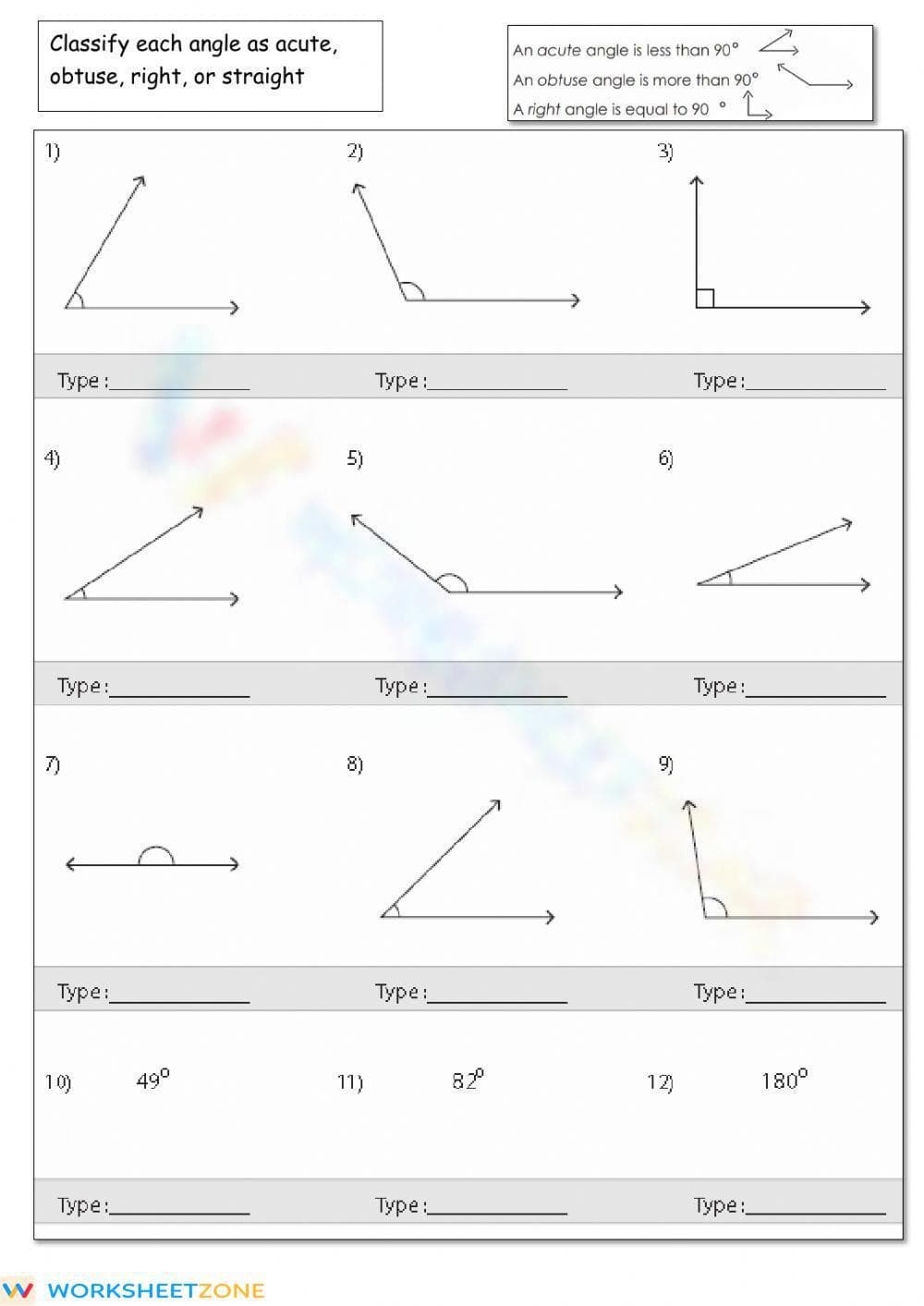
This is a geometry worksheet focused on classifying angles. It presents twelve different angles, some shown graphically and others given in degrees. Students are asked to identify each angle as acute, obtuse, right, or straight, and write the type on the provided lines. The worksheet includes a brief description of acute, obtuse and right angles.
Grade Level Suitability:
This worksheet is suitable for grades 4-6. The concepts of acute, obtuse, right, and straight angles are typically introduced in these grades. The use of both visual representations and degree measurements makes it appropriate for students learning these concepts.
Why Use It:
This worksheet reinforces the understanding of different types of angles. It provides practice in identifying angles based on their visual appearance and degree measurement. It helps students develop their geometric vocabulary and spatial reasoning skills.
How to Use It:
Students should examine each angle presented in the worksheet. They can use a protractor if needed, but many can be identified visually. For each angle, they should determine whether it is acute, obtuse, right, or straight and write the correct term on the line provided.
Target Users:
The target users are elementary and middle school students learning about geometry and angle classification. It is also useful for teachers looking for supplementary material to reinforce angle concepts. It could also be used for students who need remediation or extra practice with angle identification.
This is a geometry worksheet focused on classifying angles. It presents twelve different angles, some shown graphically and others given in degrees. Students are asked to identify each angle as acute, obtuse, right, or straight, and write the type on the provided lines. The worksheet includes a brief description of acute, obtuse and right angles.
Grade Level Suitability:
This worksheet is suitable for grades 4-6. The concepts of acute, obtuse, right, and straight angles are typically introduced in these grades. The use of both visual representations and degree measurements makes it appropriate for students learning these concepts.
Why Use It:
This worksheet reinforces the understanding of different types of angles. It provides practice in identifying angles based on their visual appearance and degree measurement. It helps students develop their geometric vocabulary and spatial reasoning skills.
How to Use It:
Students should examine each angle presented in the worksheet. They can use a protractor if needed, but many can be identified visually. For each angle, they should determine whether it is acute, obtuse, right, or straight and write the correct term on the line provided.
Target Users:
The target users are elementary and middle school students learning about geometry and angle classification. It is also useful for teachers looking for supplementary material to reinforce angle concepts. It could also be used for students who need remediation or extra practice with angle identification.


