


























Views
Downloads




Essential Complementary and Supplementary Angles Worksheet
Paste this activity's link or code into your existing LMS (Google Classroom, Canvas, Teams, Schoology, Moodle, etc.).
Students can open and work on the activity right away, with no student login required.
You'll still be able to track student progress and results from your teacher account.
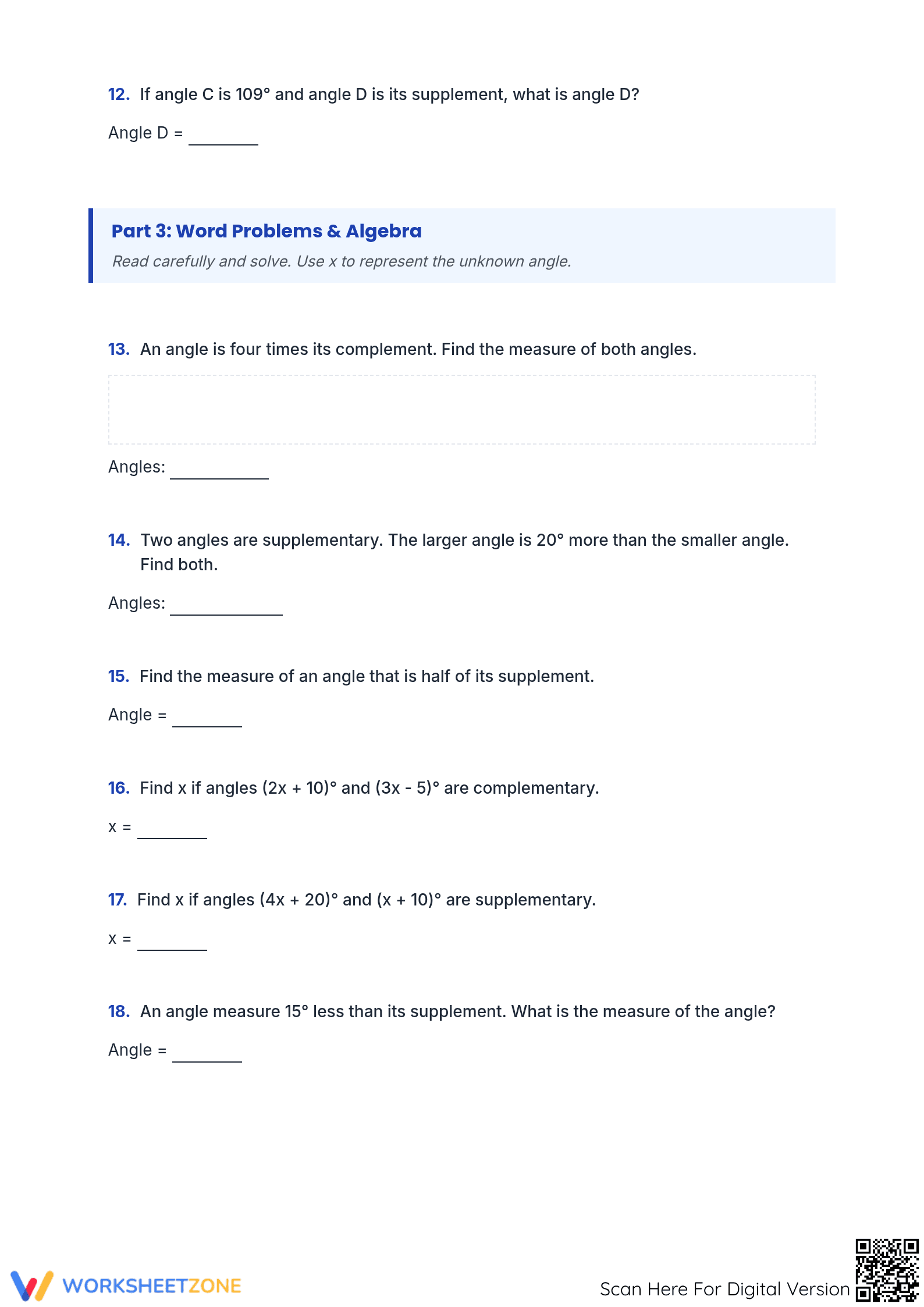
This Grade 7 geometry worksheet helps students master the relationships between complementary and supplementary angles through 28 structured problems. By identifying angle pairs and solving algebraic equations, learners develop the essential geometric reasoning required for middle school success. Students will calculate unknown measures and apply angle facts to multi-step configurations.
At a Glance
- Grade: Grade 7 · Subject: Math
- Standard:
CCSS.MATH.CONTENT.7.G.B.5— Use facts about supplementary and complementary angles to solve for unknown values in figures- Skill Focus: Angle Relationships
- Format: 5 pages · 28 problems · Answer key included · PDF
- Best For: Geometry unit practice and formative assessment
- Time: 45–60 minutes
What's Inside
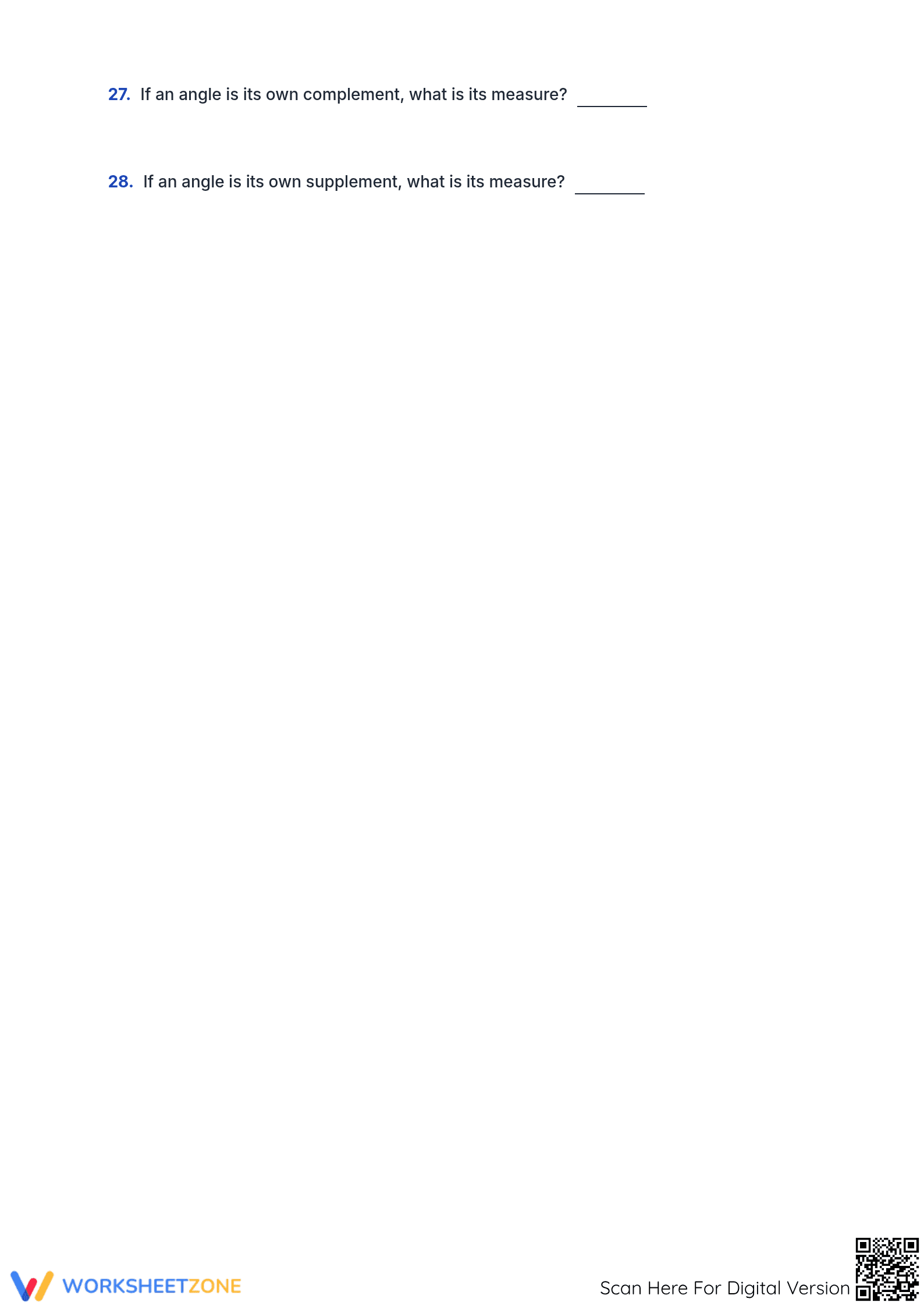
This 5-page PDF contains four sections designed to scaffold learning. It includes 28 problems ranging from basic identification to complex algebraic equations involving variables. The pack comes with a complete answer key and a clear layout that provides space for students to show their calculations and geometric proofs.
Skill Progression
- Guided Practice: The first 6 problems focus on identification, asking students to classify pairs as complementary, supplementary, or neither.
- Supported Practice: Problems 7-12 introduce basic calculations and visual models where students find missing angle measures using established properties.
- Independent Practice: The final sections challenge students with word problems, algebraic expressions, and complex "Challenge" configurations requiring multi-step reasoning.
This resource follows the gradual-release model, moving from basic recognition to high-order application.
Standards Alignment
CCSS.MATH.CONTENT.7.G.B.5 — "Use facts about supplementary, complementary, vertical, and adjacent angles in a multi-step problem to write and solve simple equations for an unknown angle in a figure." This worksheet specifically targets the identification and calculation aspects. This standard code can be copied directly into lesson plans or curriculum mapping tools.
How to Use It
Use this as primary practice during a geometry unit on angle relationships after direct instruction on angle sums. For formative assessment, observe students during the algebra section to see if they can translate words into mathematical equations. Expect students to complete the full set within 45 to 60 minutes.
Who It's For
Designed for Grade 7, this resource is also suitable for accelerated Grade 6 learners or Grade 8 students needing refreshers. The "Challenge Problems" section provides differentiation for advanced learners. Pair this with a protractor activity or a digital passage on geometry to create a complete learning station.
The CCSS.MATH.CONTENT.7.G.B.5 standard requires students to leverage facts about supplementary and complementary angles to solve multi-step problems. This worksheet facilitates mastery by providing 28 tasks that progress from identification to algebraic application. According to the RAND AIRS 2024 report, structured practice integrating algebraic reasoning with geometric properties is highly effective for retention. By moving from numeric calculations to equations like (2x + 10), this resource bridges the gap between arithmetic and formal geometry. The sequential design ensures students build fluency before attempting high-stakes reasoning in the challenge section. Educators can utilize these tasks to generate evidence of mastery for state testing or IEP progress monitoring. This printable is an essential tool for achieving the rigorous demands of 7th-grade geometry standards.


