


























Views
Downloads



Essential Identifying and Naming Angles Worksheet | Grade 4
Paste this activity's link or code into your existing LMS (Google Classroom, Canvas, Teams, Schoology, Moodle, etc.).
Students can open and work on the activity right away, with no student login required.
You'll still be able to track student progress and results from your teacher account.
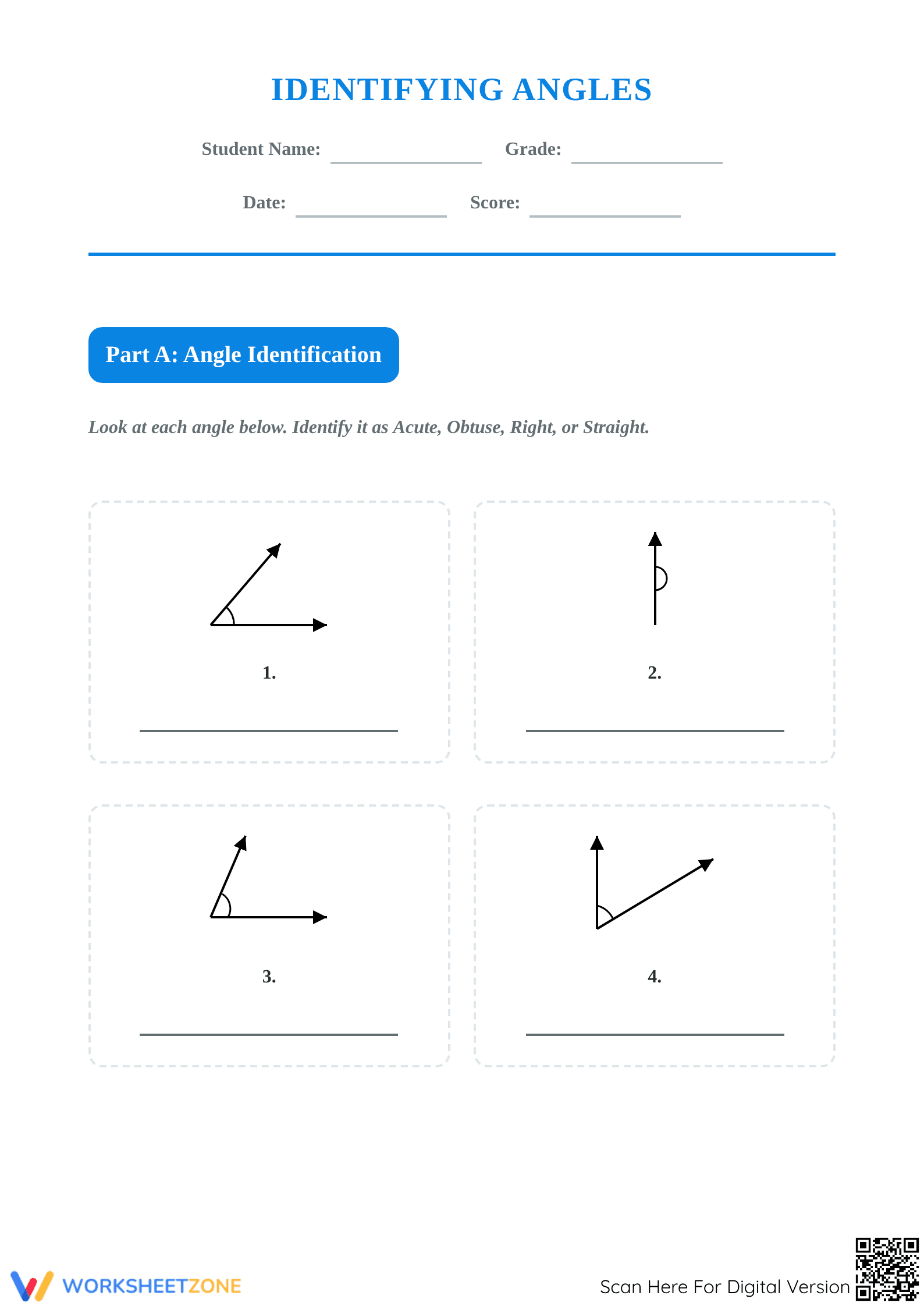
This Grade 4 geometry worksheet helps students master the identification and classification of angles. By engaging with visual representations and diagrams, learners develop the ability to distinguish between acute, obtuse, right, and straight angles while practicing precise naming conventions for various geometric figures.
At a Glance
- Grade: 4 · Subject: Math
- Standard:
CCSS.MATH.CONTENT.4.G.A.1— Draw and identify acute, obtuse, and right angles in two-dimensional figures- Skill Focus: Comprehensive angle classification, naming, and geometric properties
- Format: 4 pages · 20 problems · Answer key included · PDF
- Best For: Independent practice, formative assessment, or homework review
- Time: 25–35 minutes
What's Inside
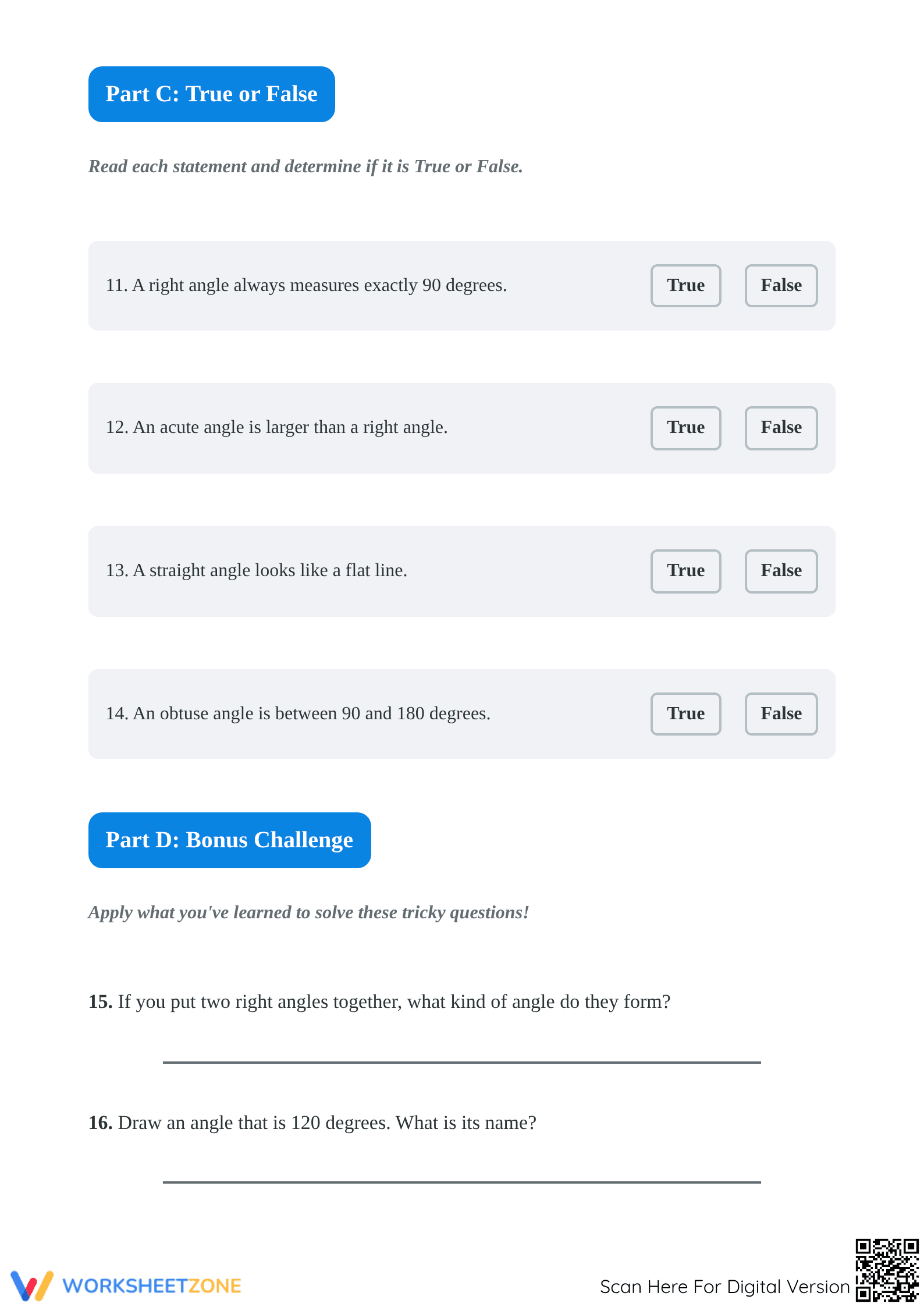
This four-page packet contains twenty structured tasks in four sections. Students begin with visual identification, progress to naming angles in diagrams, evaluate properties through true/false statements, and conclude with critical thinking applications. A complete answer key is provided for immediate feedback and grading.
Zero-Prep Workflow
Designed for immediate implementation with a three-step workflow. First, print the four-page packet. Second, distribute materials for a 30-minute individual session. Third, use the answer key for rapid grading or student self-correction. This streamlined process makes it ideal for emergency sub plans or low-prep centers.
Standards Alignment
Primary focus is CCSS.MATH.CONTENT.4.G.A.1, requiring students to identify and classify angles in two-dimensional figures. The tasks specifically target the identification components of this standard. Both standard codes can be copied directly into lesson plans, IEP goals, or district curriculum mapping tools.
How to Use It
Use this during independent practice after introducing angle types. It serves as a formative assessment to check for misconceptions. Teachers should observe students during Part B to ensure they correctly identify vertices. Expected completion time is roughly 30 minutes for most fourth-grade learners.
Who It's For
Tailored for fourth-grade students, though it provides valuable review for fifth graders. The scaffolded structure supports diverse learners, while the bonus challenge offers extension for advanced students. Pairs naturally with hands-on protractor exploration or a visual anchor chart displaying primary angle types.
According to the EdReports 2024 analysis of mathematics instructional materials, high-quality geometric practice for CCSS.MATH.CONTENT.4.G.A.1 requires a balance of conceptual understanding and procedural fluency. This worksheet addresses both by requiring students to identify angles visually and apply their knowledge to solve word-based challenges and diagrammatic naming tasks. Research indicates that frequent, structured exposure to geometric terminology—such as distinguishing between obtuse and acute angles—is a significant predictor of future success in middle school trigonometry and spatial reasoning assessments. By providing twenty varied problems, this resource ensures that students move beyond simple memorization toward a deeper functional understanding of how angles relate to one another within a coordinate-free plane. The inclusion of a bonus challenge specifically targets higher-order thinking skills, aligning with recommendations for increasing cognitive demand in elementary mathematics. This comprehensive approach effectively bridges the gap between basic identification and complex geometric analysis.


