


























Views
Downloads



Essential Types of Angles Worksheet | Grades 4-6 Math
Paste this activity's link or code into your existing LMS (Google Classroom, Canvas, Teams, Schoology, Moodle, etc.).
Students can open and work on the activity right away, with no student login required.
You'll still be able to track student progress and results from your teacher account.
Master the geometry of angles with this comprehensive five-page practice set designed for upper elementary students. This worksheet guides learners through the identification, classification, and real-world application of acute, obtuse, right, straight, and reflex angles. Students move from basic definitions to drawing challenges, ensuring deep conceptual understanding of geometric measurements.
At a Glance
- Grade: 4–6 · Subject: Math
- Standard:
4.G.A.1— Draw and identify acute, obtuse, and right angles in two-dimensional figures- Skill Focus: Angle Classification & Measurement
- Format: 5 pages · 30 problems · Answer key included · PDF
- Best For: Independent practice and formative assessment
- Time: 30–45 minutes
This robust packet contains thirty distinct tasks spread across five printable pages. It begins with a matching exercise for core definitions before transitioning into visual identification. Students practice naming angles based on degree measures and conduct a real-world "angle hunt" involving everyday objects. The set concludes with true/false checks, a drawing challenge, and a mathematical synthesis problem.
- Guided Practice: Tasks 1-5 use matching to establish a baseline vocabulary for the five primary angle types: acute, obtuse, right, straight, and reflex.
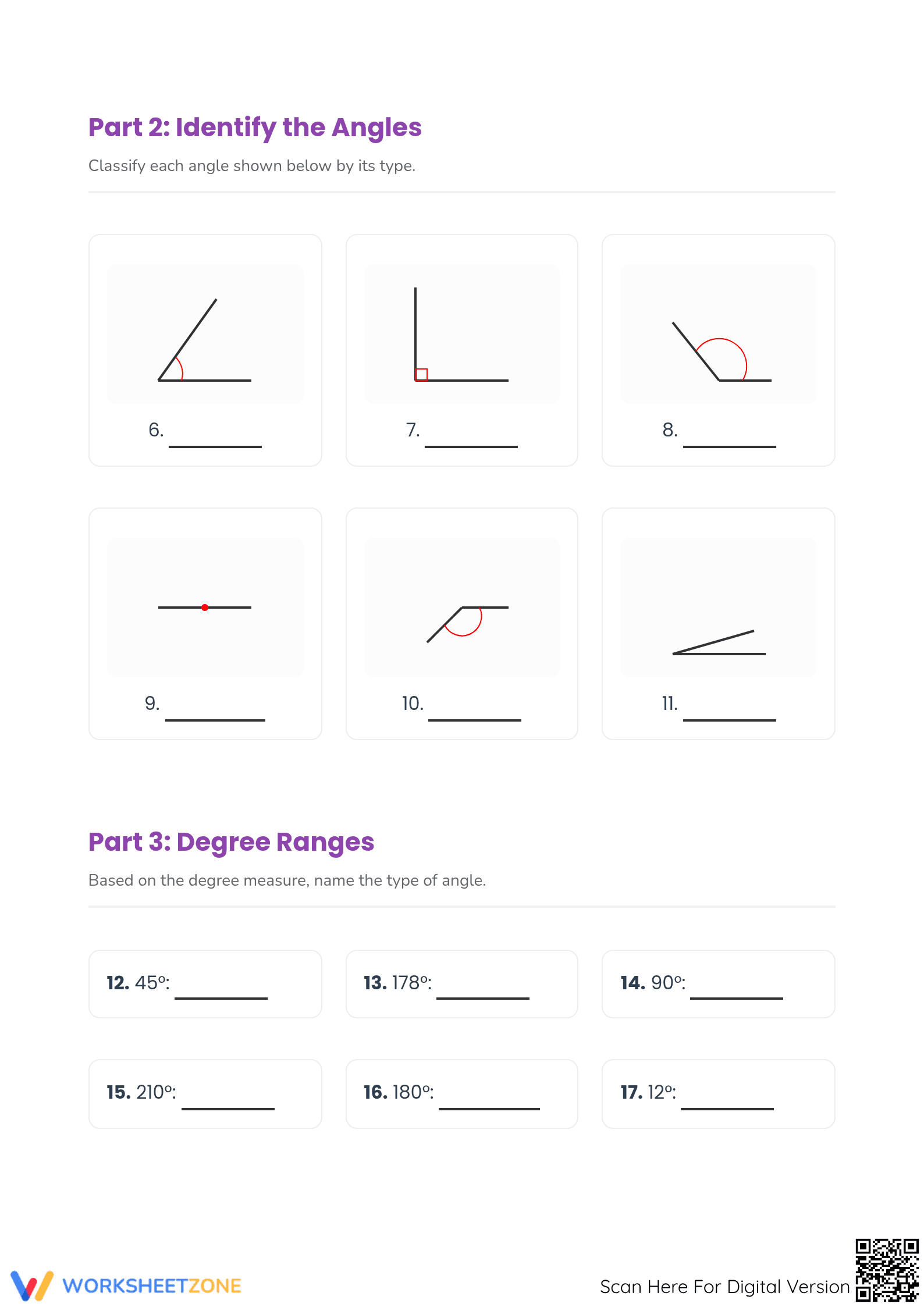
- Supported Practice: Tasks 6-17 provide visual diagrams and numerical degree ranges, allowing students to apply definitions to concrete geometric representations with specific numerical boundaries.
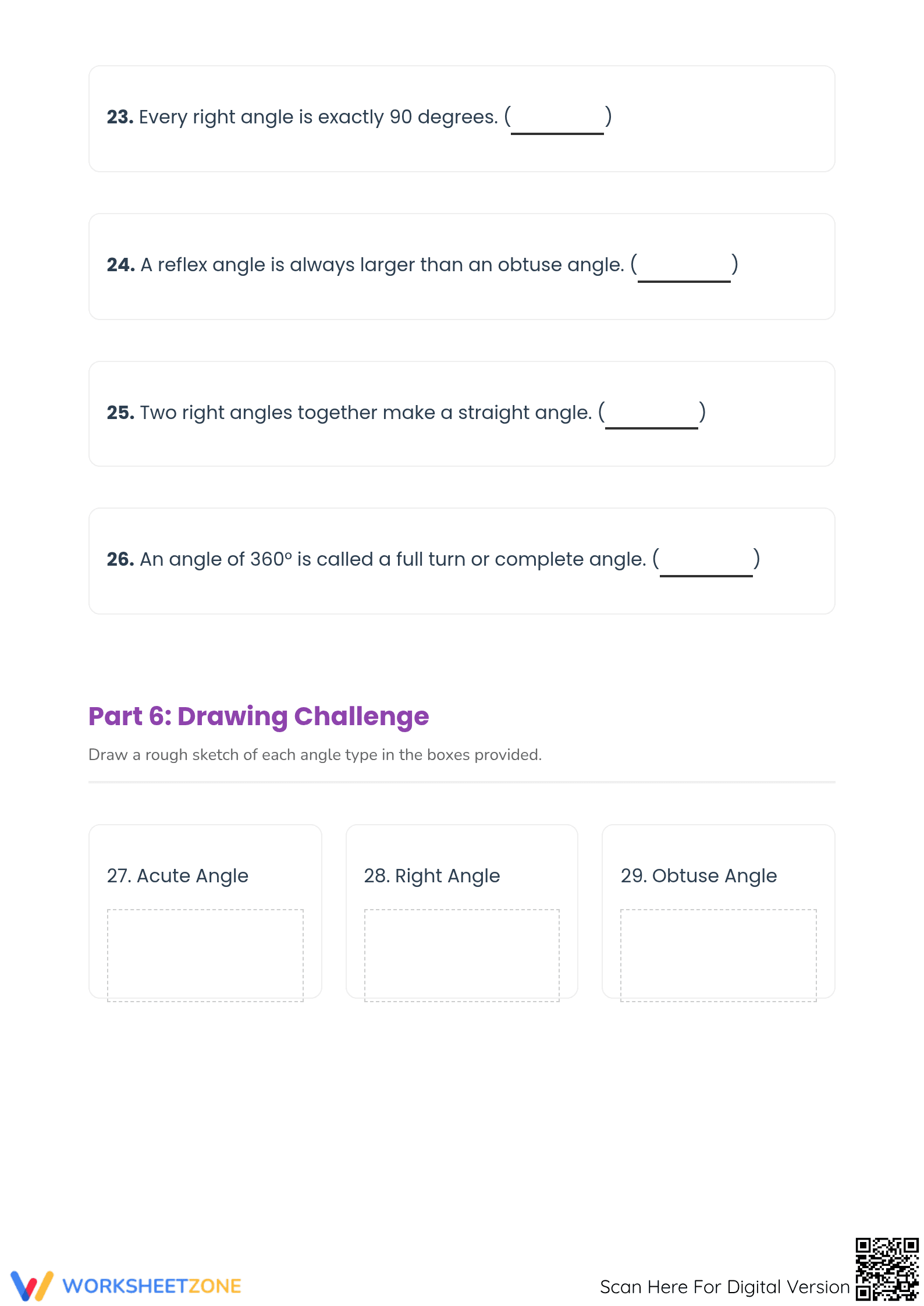
- Independent Practice: The final 13 tasks require students to identify angles in real-world contexts, validate conceptual statements, and draw specific types from scratch.
This sequence follows a gradual-release model, moving from passive recognition to active production, consistent with the I Do, We Do, You Do instructional framework.
The primary focus is aligned with 4.G.A.1, which requires students to draw and identify acute, obtuse, and right angles in two-dimensional figures. This worksheet extends learning to include reflex and straight angles for a complete geometric foundation. Both standard codes can be copied directly into lesson plans, IEP goals, or district curriculum mapping tools.
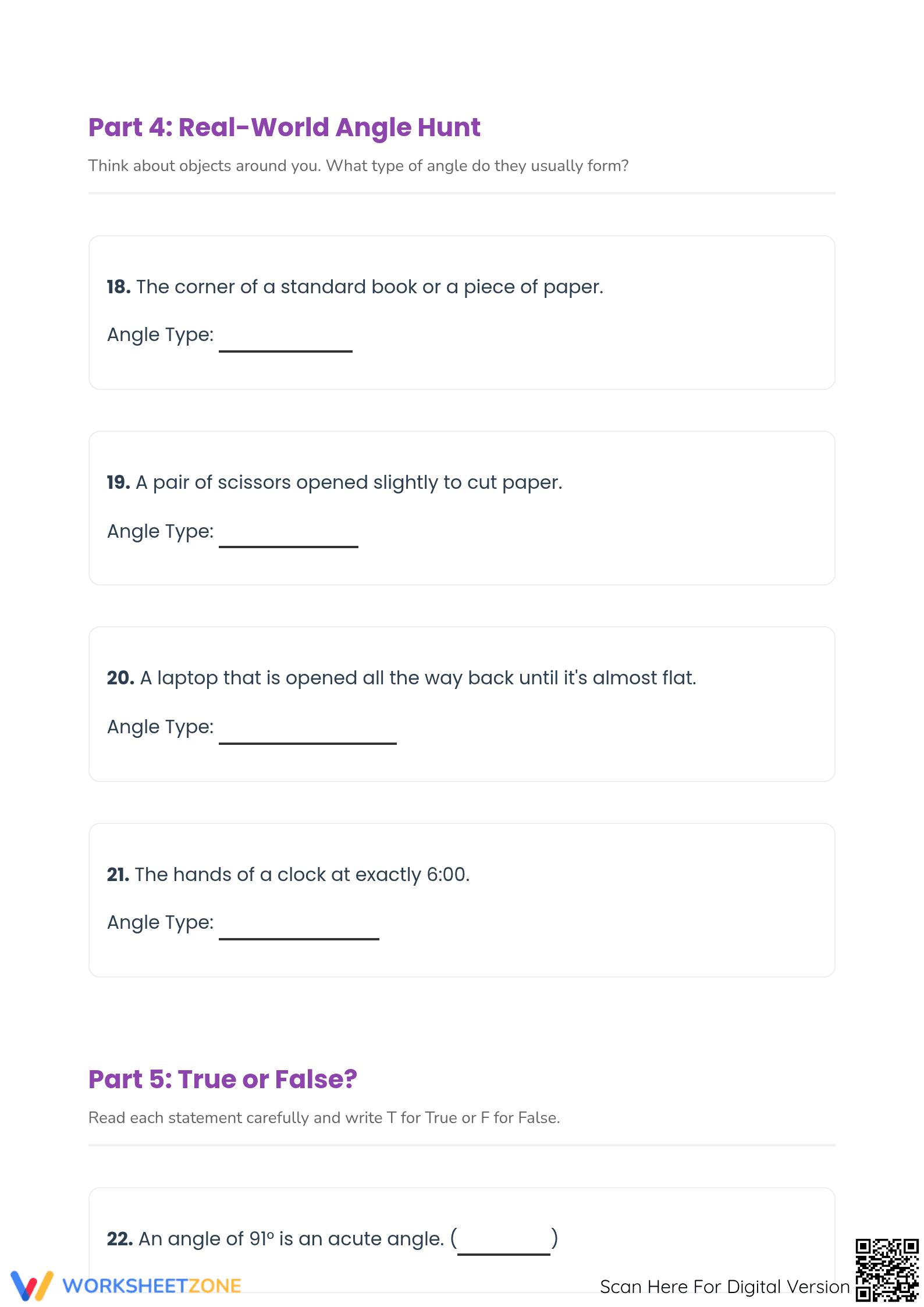
Deploy this worksheet after an initial lesson on identifying angle types to solidify understanding. It works excellently as a "choice board" activity or independent practice. For a formative assessment tip, observe students during the Part 4 Real-World Angle Hunt; their ability to translate abstract concepts into physical observations is a high-signal indicator of mastery.
This resource is tailored for fourth through sixth-grade students beginning formal geometry. It is effective for learners who benefit from multiple modes of interaction, including visual matching and kinesthetic drawing. Pair this packet with classroom protractors or a digital angle-builder tool to provide a multi-sensory learning experience that accommodates diverse instructional needs.
Aligned to the rigorous demands of 4.G.A.1, this worksheet facilitates the critical transition from basic shape recognition to formal geometric classification. By requiring students to identify and draw acute, obtuse, and right angles across 30 varied tasks, the resource ensures that learners internalize the spatial relationships necessary for later success in trigonometry and advanced measurement. Research from EdReports (2024) emphasizes that high-quality instructional materials must provide a balance of procedural fluency and conceptual application to close achievement gaps in mathematics. This five-page packet achieves that balance through its multi-step progression, moving from definitional matching to real-world synthesis. The inclusion of reflex and straight angles further prepares students for middle-school standards involving angle relationships and algebraic equations. This evidence-based approach to geometry instruction provides the repetition and variety needed for students to achieve lasting mastery of angle properties.


