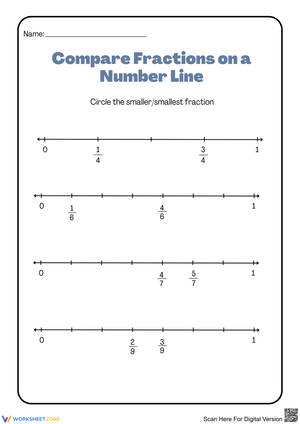
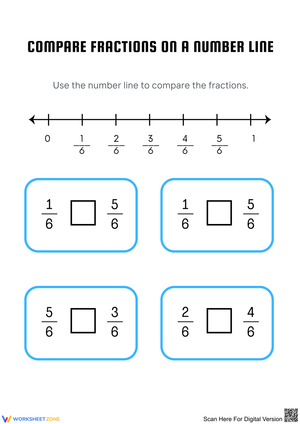
Compare Fractions on the Number Line Worksheets for 3rd Grade
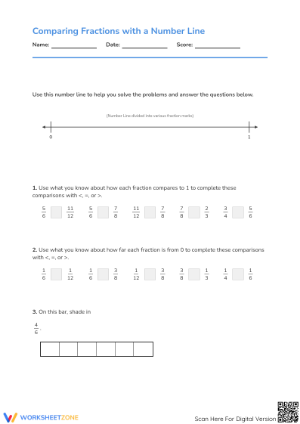
These compare fractions on the number line worksheets for 3rd grade move students through one of the trickiest conceptual shifts in the entire 3.NF unit: treating a fraction as a location and a distance rather than a count of shaded pieces. Each worksheet targets a specific skill within that progression, from partitioning a pre-drawn interval to placing and comparing fractions across parallel number lines.
What Each Worksheet Builds
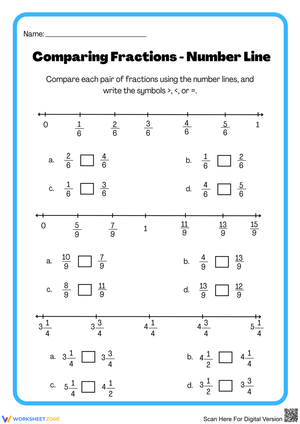
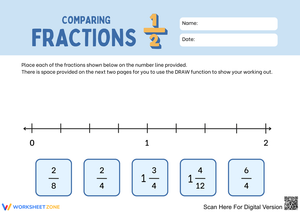
The set addresses fractions with denominators of 2, 3, 4, 6, and 8 — exactly the denominators named in the grade 3 standards — and organizes practice into three distinct skill layers. First, students work with pre-partitioned lines where they only need to label and place fractions; this isolates the placement task before adding the complexity of drawing equal intervals. Second, worksheets ask students to partition blank number lines themselves before placing a given fraction, which reveals whether a student has internalized the denominator-as-divider relationship or is just reading a visual already built for them. Third, comparison worksheets present two or three fractions — sometimes with like denominators, sometimes unlike — and ask students to write an inequality, circle the greater fraction, or order a set from least to greatest.
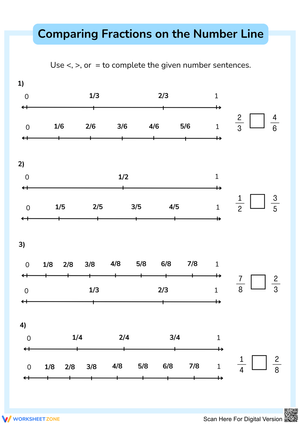
Skills across the worksheets include: partitioning the 0-to-1 interval into equal lengths; labeling unit fractions and non-unit fractions in correct sequence; plotting a named fraction; identifying which of two fractions sits further from zero; using stacked number lines to compare fractions with different denominators; and recognizing equivalent fractions as fractions that occupy the same point.
Standard Alignment
These worksheets align to three standards in the CCSS Numbers and Operations — Fractions domain. 3.NF.A.2a requires students to represent a fraction 1/b on a number line by defining the interval from 0 to 1 as the whole and partitioning it into b equal parts; the partitioning worksheets address this directly. 3.NF.A.2b extends that to representing a/b by marking off a lengths of 1/b from zero; the placement and labeling worksheets cover this. 3.NF.A.3d asks students to compare two fractions with the same or different numerators and denominators by reasoning about their size, with the number line as the recommended representational tool at this grade; the comparison worksheets target that standard explicitly. The equivalent-fraction recognition worksheets also touch 3.NF.A.3a, since students who plot 2/4 and 1/2 on stacked lines and observe they land on the same vertical position are building exactly the visual proof that standard describes.
Mistakes Students Make That These Worksheets Help You Catch
The most persistent error is whole-number bias applied to denominators: students see 1/4 and 1/8 and conclude that 1/8 is larger because 8 is a bigger number. The number line addresses this directly — a line divided into eighths has visibly smaller intervals than one divided into fourths — but the misconception is stubborn. Even after students agree that the eighths intervals look smaller, some will revert to the larger-number logic when the visual is removed. Watch for this especially on comparison problems that present the fractions symbolically without a drawn line.
The second error is tick-mark counting instead of interval counting. A student working with fourths may label their line 0, 1/4, 2/4, 3/4, 1 — and then, when asked to plot 3/4, count four tick marks from zero and land on 1 instead of 3/4. They are counting the marks rather than the spaces. The pencil-jump technique addresses this well: have students physically hop from one interval to the next, saying the fraction name with each hop, so the motion reinforces that the label belongs at the end of a space, not at the start of one.
Third, inconsistent partitioning. A student dividing a line into sixths may draw the first three marks with reasonable spacing and then cram the last two into the remaining gap. Any comparison made on that line will be wrong, and the student often doesn't notice because the tick marks look like sixths in number if not in spacing. Grid paper helps during early practice; the goal is for students to eventually estimate equal spacing with enough accuracy to make valid comparisons.
How to Build These Worksheets Into Your Lesson Plans
The pre-partitioned worksheets work well during the introduction phase of the 3.NF.A.2 sequence — roughly the same days you are using a floor number line or a class-sized projected line for whole-group modeling. Students can use them during independent practice while you circulate, or pull a small group to the back table with dry-erase sleeves over the worksheets for repeated attempts without wasting paper.
Once you have introduced unlike-denominator comparisons, the stacked-line worksheets fit naturally into a math center alongside fraction tiles or a physical stacking activity. They also serve well as the last ten minutes of a lesson when you need a quick formative read before the class moves on — students who are still landing fractions in the wrong position on pre-partitioned lines need a different entry point than students who are misreading stacked lines. The blank-line worksheets, where students must partition before placing, belong later in the sequence, either as an end-of-unit check or a challenge option for students who have demonstrated placement fluency.
Adjusting These Worksheets for a Range of Learners
Students who are not yet secure with the meaning of numerator and denominator benefit from starting with worksheets that use only unit fractions — 1/2, 1/3, 1/4 — where the numerator is always 1 and only the denominator changes. This isolates the insight that a larger denominator produces smaller intervals without adding the complexity of tracking a varying numerator. For those students, withhold the stacked-line worksheets until placement of unit fractions is solid.
On the other end, students who place and compare fractions accurately on pre-partitioned lines can move to worksheets that present fractions symbolically and ask them to draw and partition their own lines from scratch. A further extension is asking students to place two fractions on a single self-drawn line with different denominators — for example, 1/3 and 2/4 — and argue in writing which is greater. That task folds in 3.NF.A.3b (recognizing equivalent and non-equivalent fractions) and surfaces reasoning that pencil-and-paper comparison tasks alone do not reveal.
Frequently Asked Questions
Can students use these worksheets before they have any experience with area models?
It is possible, but most 3rd graders benefit from at least a brief introduction to fractions as equal parts of a whole before moving to linear models. The number line worksheets assume students understand what a denominator represents — the number of equal parts a whole is divided into. Without that foundation, partitioning tasks tend to become a drawing exercise rather than a conceptual one. A few days with fraction tiles or area model work first makes the transition to number lines noticeably smoother.
Why do some worksheets show number lines that extend past 1?
A small number of worksheets in the set show lines from 0 to 2 to give students practice recognizing that fractions greater than 1 — like 5/4 — are numbers with positions on a line, not errors. This is light preview work for 4th grade mixed numbers rather than a 3rd grade mastery expectation, and those worksheets are clearly marked. Skip them if your students are still consolidating the 0-to-1 interval, and return to them as an enrichment option once core comparison skills are secure.
How do I handle students who correctly complete these worksheets but cannot explain their reasoning?
Procedural fluency and conceptual understanding develop at different rates for a lot of 3rd graders. A student who accurately places 3/4 and 2/3 and circles the correct greater fraction may be reading visual position without understanding why the intervals differ in size. The extension task described above — drawing their own line and writing a justification — is the fastest diagnostic. If the explanation falls back on "4 is bigger than 3" rather than "the fourths intervals are smaller," the whole-number bias is still present underneath working procedures, and additional stacked-line work with explicit interval-size discussion will help.
Clear All