


























Views
Downloads

Printable Comparing Fractions Worksheet | Grade 3 Math
Paste this activity's link or code into your existing LMS (Google Classroom, Canvas, Teams, Schoology, Moodle, etc.).
Students can open and work on the activity right away, with no student login required.
You'll still be able to track student progress and results from your teacher account.
Mastering Fraction Comparison for Grade 3
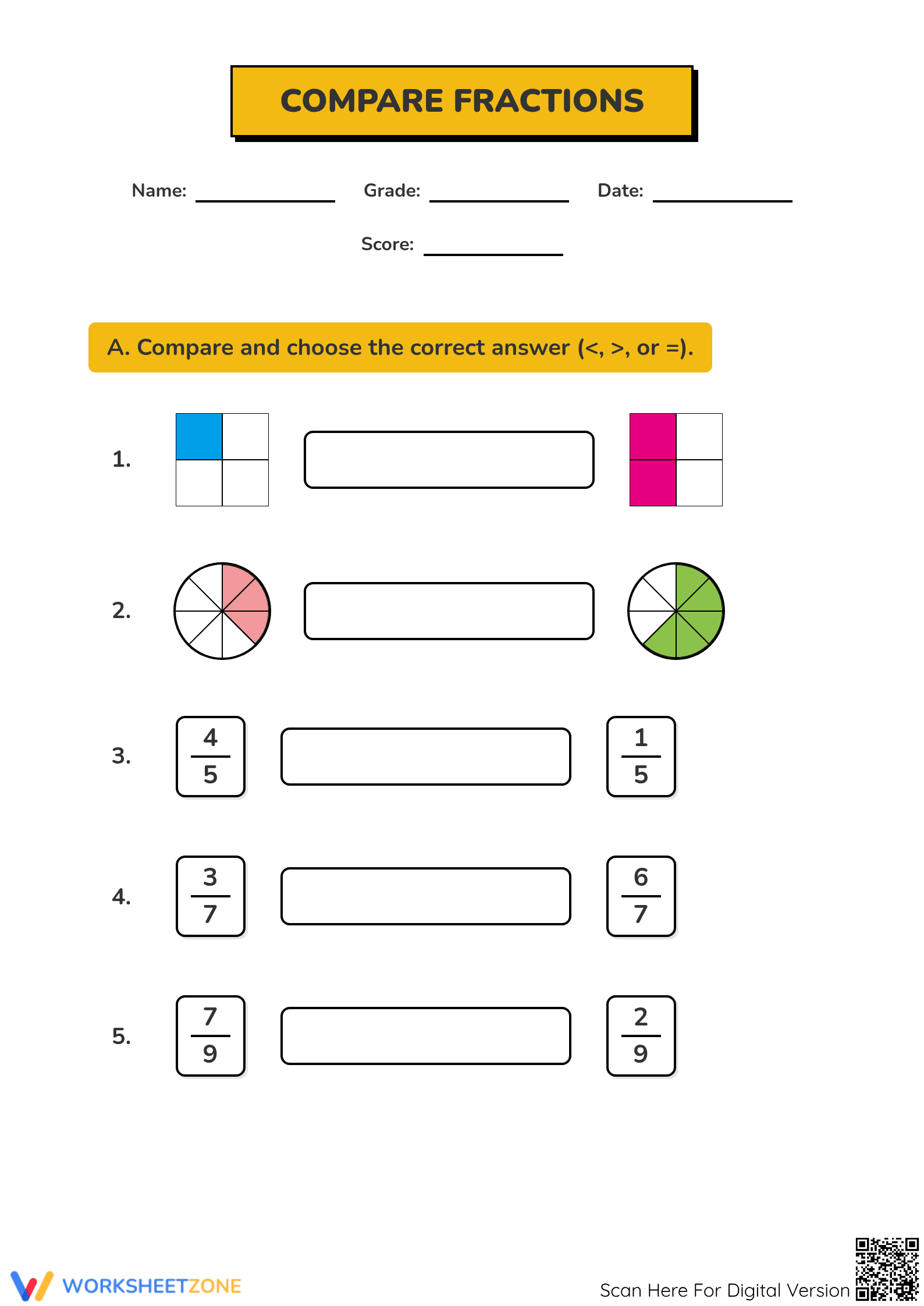
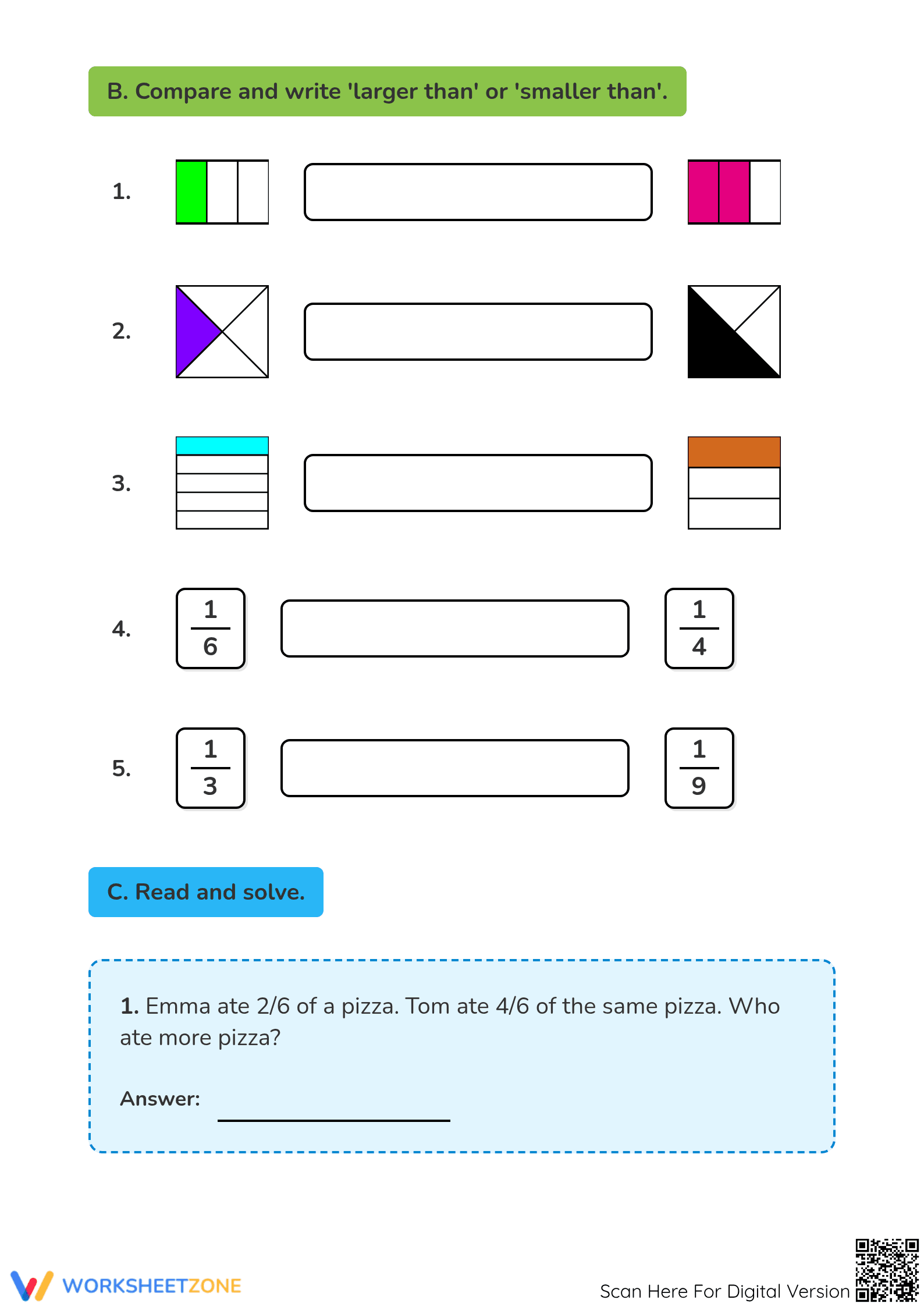
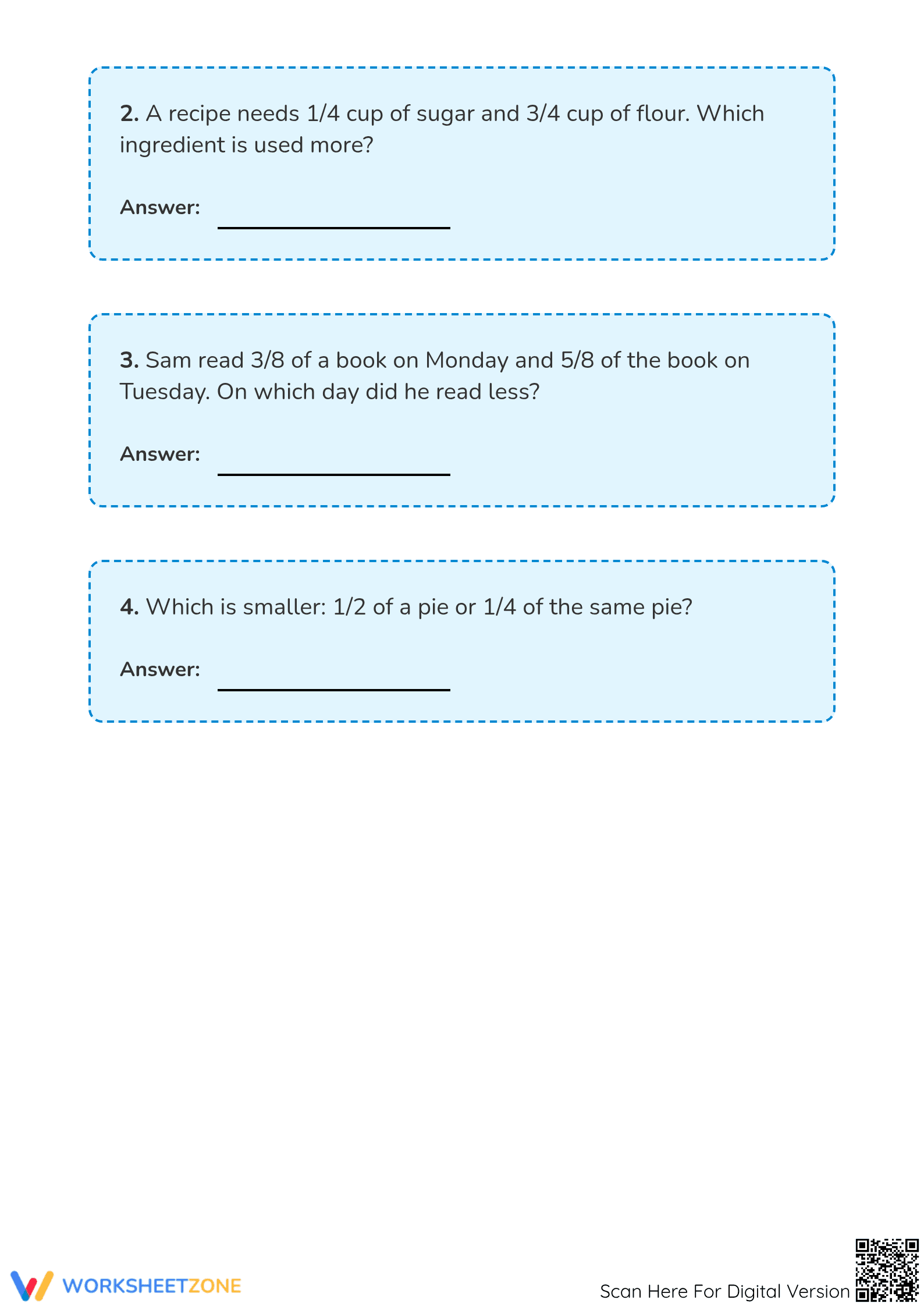
This complete three-page worksheet provides focused practice for Grade 3 students learning to compare fractions. Through a series of 36 scaffolded problems, learners will build confidence and accuracy in determining whether fractions are greater than, less than, or equal to each other, using visual models to support their reasoning. It is a proven resource for building foundational math skills.
At a Glance
- Grade: 3 · Subject: Math
- Standard:
CCSS.MATH.CONTENT.3.NF.A.3— Compare two fractions by reasoning about their size.- Skill Focus: Comparing fractions
- Format: 3 pages · 36 problems · Answer key included · PDF
- Best For: Independent practice, homework, formative assessment
- Time: 20–30 minutes
What's Inside
This resource contains a three-page PDF worksheet with 36 distinct problems focused on comparing fractions. Each problem presents a pair of fractions, accompanied by clear circular or rectangular visual models to aid comparison. A comprehensive answer key is provided as a separate file, showing the correct symbol (<, >, or =) for all 36 items, making review simple and fast.
A Structured Approach to Practice
The worksheet is structured to support a gradual release of responsibility, moving students toward independent mastery. The problem sets are organized to build confidence and skill:
- Guided Practice: The initial 12 problems serve as a strong warm-up. Visual models are prominent and fractions may feature common denominators, reinforcing the core concept as taught in a whole-group lesson.
- Supported Practice: The middle section (problems 13-24) challenges students with a mix of like and unlike denominators, encouraging them to apply reasoning skills while still having the support of visual fraction models.
- Independent Practice: The final 12 problems allow students to demonstrate their fluency and can be used as a formative assessment to check for understanding of this essential skill.
Standards Alignment
This worksheet is directly aligned with Common Core State Standard CCSS.MATH.CONTENT.3.NF.A.3, which requires students to compare fractions by reasoning about their size. The tasks specifically target this foundational concept for all future work with fractions and decimals. The standard code can be copied directly into lesson plans, IEP goals, or district curriculum mapping tools.
How to Use It
This is an essential tool for independent practice after a direct instruction lesson on comparing fractions. Students can work through the 36 problems in class or for homework, which should take approximately 20-30 minutes. For formative assessment, a teacher can quickly observe how students are using the visual models to reason about the fraction sizes before writing the correct symbol. It's a reliable way to gauge student understanding.
Who It's For
Designed for Grade 3 students, this worksheet can also serve as a review for Grade 4 learners or an extension for advanced Grade 2 students. The clean layout and reliance on visual models make it accessible for most learners, including English Language Learners and students in special education. It pairs well with a hands-on lesson using fraction tiles or an anchor chart that defines the <, >, and = symbols.
Developing fluency in comparing fractions is a critical benchmark for third-grade mathematics, as outlined in standard CCSS.MATH.CONTENT.3.NF.A.3. This worksheet provides the focused, repetitive practice necessary for students to internalize the process of reasoning about fraction size. The structure, which moves from simpler to more complex comparisons, mirrors the gradual release of responsibility model of instruction. As noted by Fisher & Frey (2014), providing students with purposeful tasks for independent learning is a key phase in building lasting comprehension and procedural skill. By completing these 36 problems, students get sufficient practice to move beyond procedural mimicry and develop a more robust, conceptual understanding of fractional value, preparing them for more advanced operations. The inclusion of an answer key facilitates immediate feedback, another proven accelerator for student learning.


