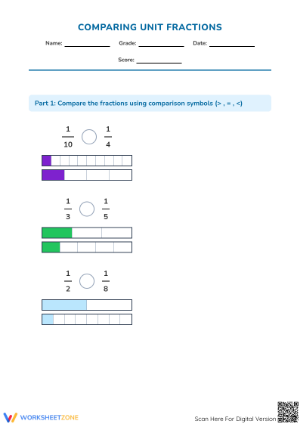
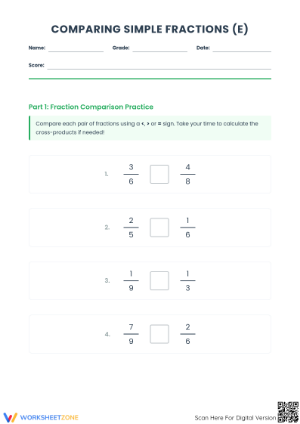
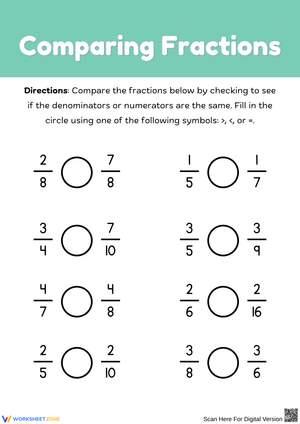
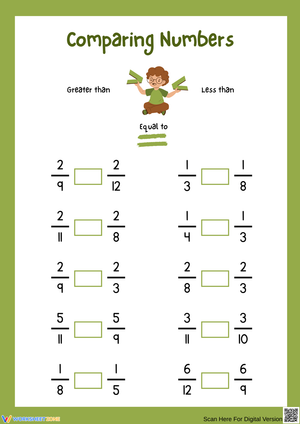
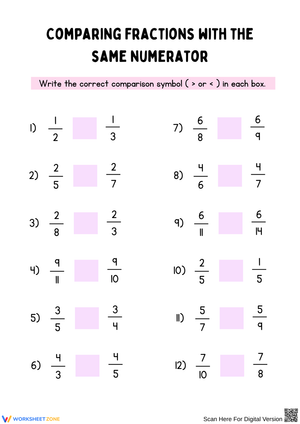
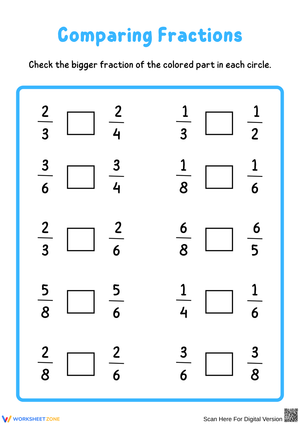
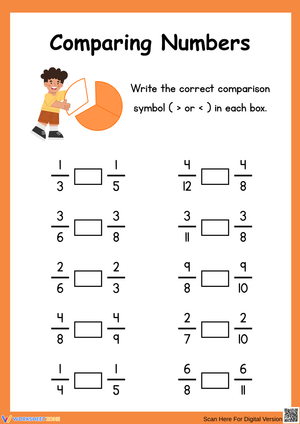
These 3rd grade comparing fractions with same numerator printable worksheets catch students at the specific moment their whole-number reasoning runs into trouble — when they look at 1/8 and 1/4 and reach for the wrong comparison symbol. The set builds the inverse-relationship reasoning students need: when numerators match, a larger denominator means smaller pieces, so the fraction with the bigger bottom number is actually the lesser quantity.
Skills These Worksheets Build
The core task in every worksheet is the same-numerator comparison, but the format rotates so students can't coast on a single surface skill. Across the set, students:
- Shade area models — rectangles and circles drawn to the same dimensions — and place greater than or less than symbols between the resulting fractions
- Mark fraction strips to compare lengths, making the size difference between denominators visible before committing to a symbol
- Write comparison statements in words: "2/5 is less than 2/3 because fifths are smaller pieces than thirds"
- Order three same-numerator fractions from least to greatest, applying the denominator-size rule twice in sequence
- Identify and correct wrong comparisons — a deliberate error-analysis format that forces students to articulate the reasoning rather than just produce an answer
The written justification tasks carry real weight. A student who writes "1/6 is less than 1/3 because when you cut something into 6 pieces, each piece is smaller than when you cut it into 3" has internalized the concept. A student who only circles the correct answer may be applying a pattern without understanding it — and that surface fluency will fall apart the moment the task changes.
Errors That Surface Consistently in Third-Grade Fraction Work
Whole-number bias is the dominant error here, and it's stubborn because it feels like legitimate reasoning to the student. Seeing 1/8 and 1/2 side by side, a third grader who writes "1/8 is greater than 1/2" isn't guessing — they're applying a rule that has worked reliably since kindergarten. The error shows up most clearly on three-fraction ordering tasks, where students rank 2/3, 2/5, and 2/8 in the wrong direction entirely, listing 2/8 as the greatest because 8 is the largest digit.
A second, less obvious error involves the size of the whole. Students can look at 1/2 of a small square next to 1/4 of a large rectangle and — in that image — correctly observe that the shaded 1/4 region looks bigger. Each worksheet in this set uses models drawn to the same size to close that loophole and force reasoning about the denominators. Teachers should name this constraint explicitly during instruction: the comparison only holds when the wholes are equal in size. 3rd grade comparing fractions with same numerator printable worksheets that use consistent model sizing make this a teachable moment rather than a recurring source of wrong answers.
Building These Worksheets Into Your Fraction Unit
One worksheet works well as a whole-class walkthrough on the first day students encounter same-numerator comparison. Project it and work through two or three problems together — narrating the reasoning aloud — before students attempt problems independently. The pizza analogy earns its place here: same-size pizza, more people sharing means smaller slices. Students who have sat at a crowded birthday table already understand this; the worksheet connects the denominator to something they've actually experienced.
After that opening lesson, a new worksheet at the start of the next two or three class periods works as a retrieval opener — five to eight problems, five to seven minutes, no new instruction. Spaced retrieval does real work at this stage: students rebuild the reasoning from memory each morning rather than just recognizing it when it appears in front of them. For small-group intervention, pair a worksheet with physical fraction tiles. Students build each comparison with the tiles before writing the symbol, which removes a full layer of cognitive demand from the abstract step because the reasoning is already visible on the table. Reserve worksheets with three-fraction ordering tasks or word-problem frames for the final week of the unit, after students show clear fluency on simple pairwise comparisons.
Standard Alignment
These worksheets align to CCSS.Math.Content.3.NF.A.3.d, which requires third graders to compare two fractions with the same numerator or same denominator by reasoning about size, and to recognize that valid comparisons require both fractions to refer to the same-sized whole. That second clause has direct instructional weight — the standard expects students to explain why one fraction is greater than or less than another, not just produce the correct symbol. Several worksheets include a written-justification line for exactly this purpose. Teachers who also address CCSS.Math.Content.3.NF.A.1 — which defines what the denominator means as a count of equal parts — find that students who struggle with comparison almost always have shaky understanding of that earlier standard. The two are worth connecting explicitly rather than treating same-numerator comparison as a standalone procedural rule.
Reaching Different Learners With the Same Set
Students who need more support work best starting with worksheets that provide pre-drawn, same-sized models. Shading the fractions before placing a symbol externalizes the reasoning — students can see the answer before they have to write it — which frees attention for the decision step. Moving to worksheets without models, where students must reason from numbers alone, represents a genuine conceptual progression rather than just a harder version of the same task.
For students who move through pairwise comparisons quickly, the more demanding move is generating their own same-numerator pairs and writing comparison statements that explain the relationship. A student who genuinely understands the concept will produce valid pairs and write accurate justifications; a student working from a memorized rule will often get the pairs right but write explanations that break down under scrutiny — "2/8 is less than 2/3 because 8 is bigger" reveals that the rule is present but the reasoning isn't. The set includes worksheets with open-response prompts that push toward this kind of production work, making differentiation practical without requiring separate preparation. For the highest-readiness students, 3rd grade comparing fractions with same numerator printable worksheets that include mixed same-numerator and same-denominator comparisons extend the practice into the full range of 3.NF.A.3.d.
Frequently Asked Questions
How do I introduce this concept before students use the worksheets on their own?
Start with physical models — fraction tiles or drawn strips — and work through a comparison as a class before a worksheet comes out. Once students agree on two or three comparisons using the physical models, move to the worksheet and ask them to apply the same reasoning on paper. The concrete-to-abstract shift is the actual conceptual leap; the worksheets are where students practice making that leap repeatedly until it becomes automatic.
What's the exact rule students need to hold onto for same-numerator comparisons?
When numerators are equal, the fraction with the smaller denominator represents the larger quantity. Fewer divisions of the whole means each piece is larger. For 2/3 compared to 2/5, both count two pieces — but thirds are bigger pieces than fifths, so 2/3 is greater than 2/5. The rule runs directly against whole-number intuition, which is why it needs repeated retrieval practice rather than a single explanation and a check mark.
Why do these worksheets include written justification lines instead of just answer blanks?
Because placing the correct symbol and understanding why it's correct are two different skills. A student who writes "1/4 is greater than 1/8 because 4 is smaller" has the right answer but a broken explanation — still anchored to digit size rather than piece size. The written line makes that diagnostic visible. Teachers who review justification responses alongside the completed comparisons get a much clearer picture of who genuinely holds the concept and who needs a follow-up conversation about what the denominator actually represents.
How many practice sessions should students complete before moving to mixed comparisons?
The right marker is fluency on the written justification, not a specific worksheet count. Students should be able to explain the piece-size logic in their own words without prompting before the unit advances. For most third graders, that takes four to six practice sessions spread across a week or more. Rushing past this because students produce correct symbols underestimates how often that surface fluency collapses when the numerators no longer match. 3rd grade comparing fractions with same numerator printable worksheets used at a spaced-practice pace — spread across several days rather than concentrated into a single block — produce more durable understanding of fraction magnitude.













 Interactive Worksheet Maker
 Quiz Maker
 Word Search Maker
 Crossword Puzzle Maker
 Word Scramble Generator
 Sentence Scramble Generator
 Handwriting Worksheet Generator
 Name Tracing Generator
 Fill In The Blank Generator