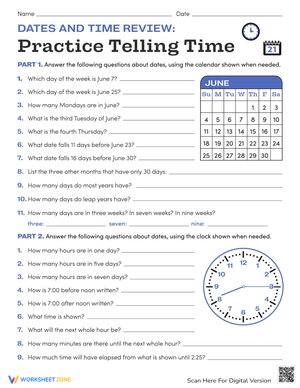
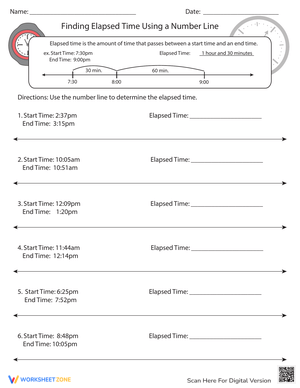
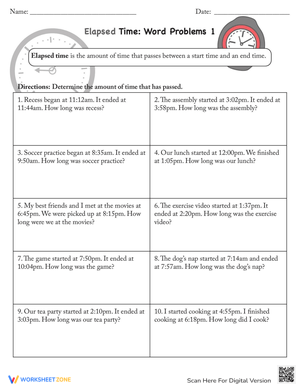
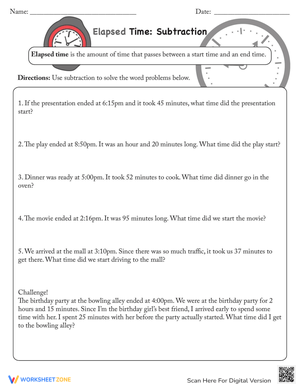
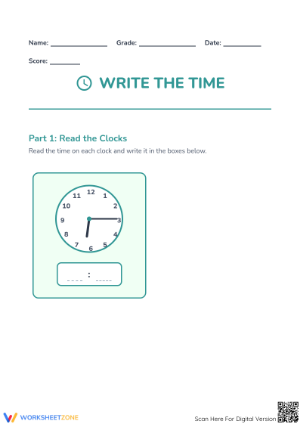
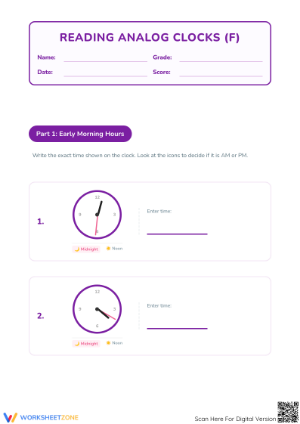
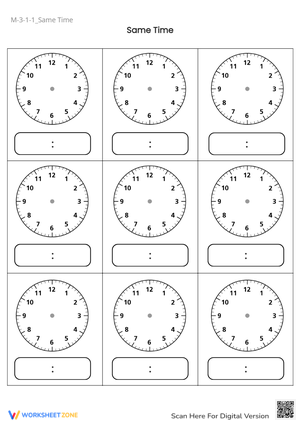
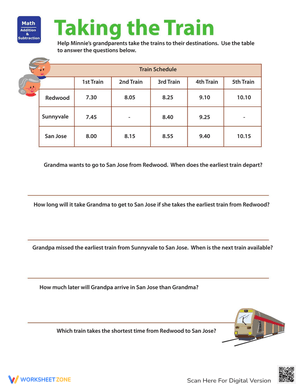
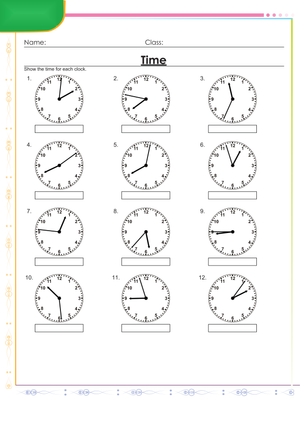
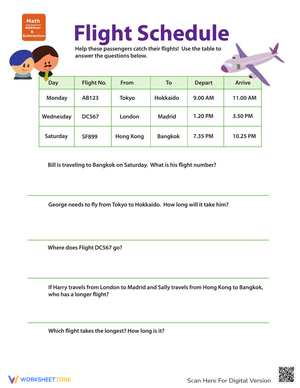
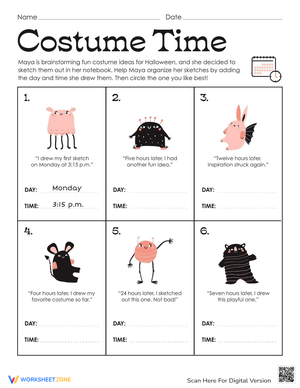
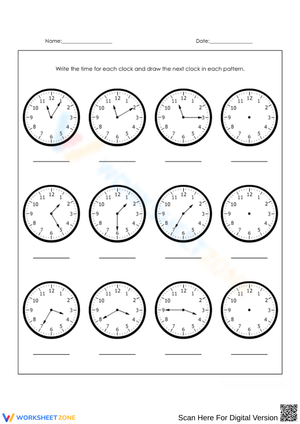
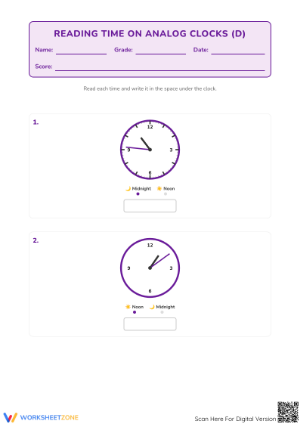
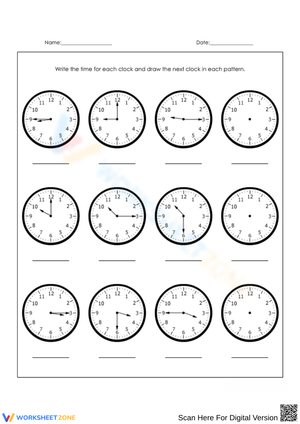
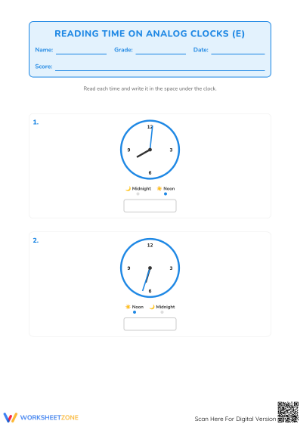
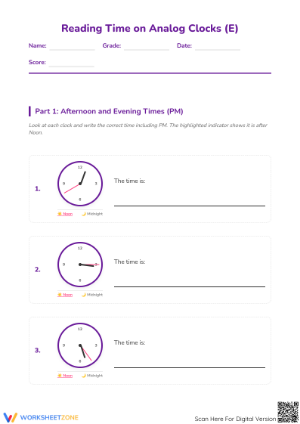
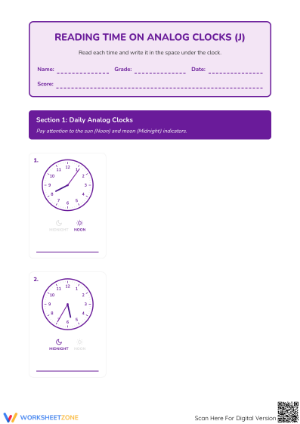
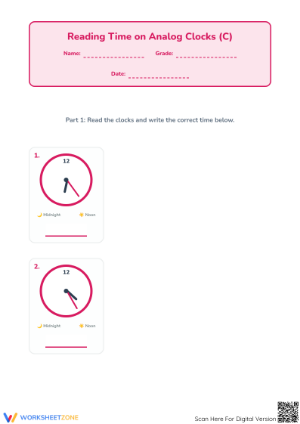
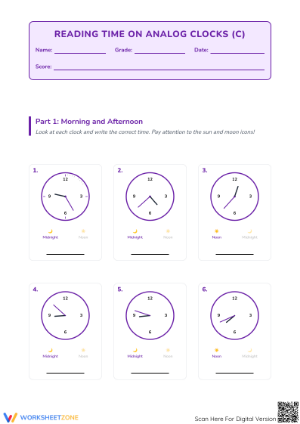
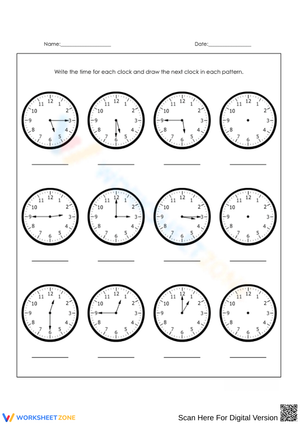
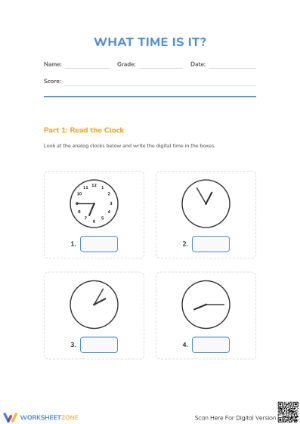
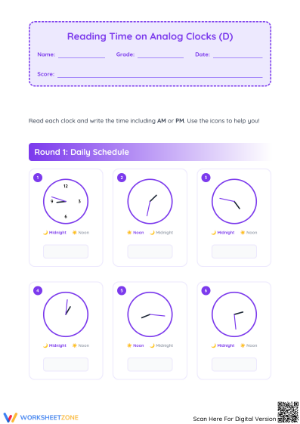
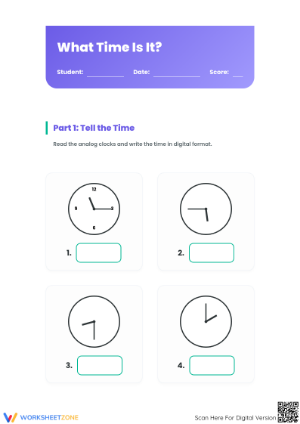
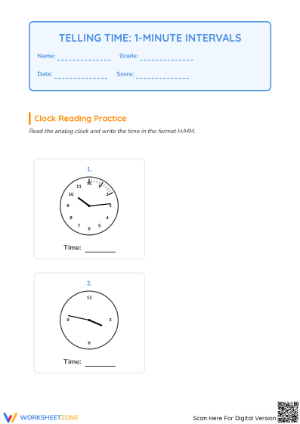
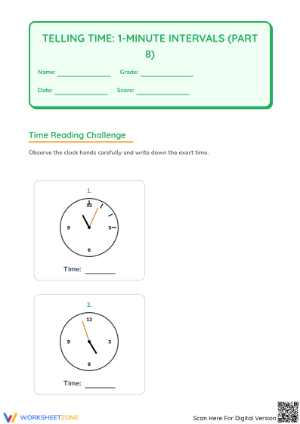
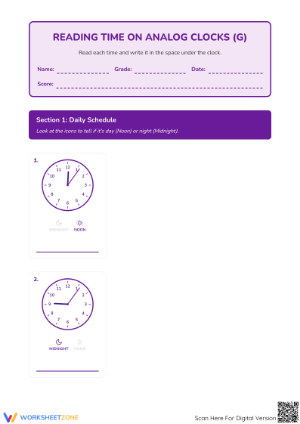
These time to the minute pdf worksheets for 3rd grade give teachers focused, print-ready practice for one of the trickiest clock-reading transitions in the elementary math sequence: the shift from reading clocks in five-minute jumps to identifying the exact minute. Each worksheet uses analog clock faces that show all sixty tick marks clearly, and the set includes both read-the-clock problems and draw-the-hands tasks so teachers can assess the skill from both directions.
Skills These Worksheets Build
The core task across the set is locating the minute hand on the sixty-part scale and translating that position into a two-digit minute value — then doing the reverse by constructing a clock from a written time. Students practice:
- Skip-counting by fives to the nearest large numeral, then tapping individual tick marks to reach the exact minute
- Recording time in digital notation, including zero-padded minutes like 3:07 where the minute hand sits only slightly past the 12
- Drawing the hour and minute hands to match a given time, which reveals gaps that pure reading tasks often hide
- Reading times in the final five minutes of an hour, where the hour hand sits misleadingly close to the next numeral
- Applying benchmark thinking — recognizing that a minute hand near the 11 represents both 55 minutes past and five minutes before the next hour
Frequent Student Errors Worth Watching For
The most persistent error in third-grade clock work is what some teachers call the hour-hand trap. At 4:57, the hour hand has nearly reached the 5 — it reads, to most eight-year-olds, as pointing directly at that numeral. Students write 5:57 with complete confidence. The correction requires explicit instruction on the "last passed" rule: the hour stays at whichever numeral the hour hand most recently crossed, and it does not change until the minute hand completes its full circuit and touches the 12. Saying this once in a lesson is rarely enough. Students need to re-encounter it in problems where the time is deliberately set at 3:56, 7:58, or 11:59, and those problems need to be spread across the set rather than grouped into one obvious section.
A related error surfaces at the hour boundary itself. Students who understand that they count to sixty will still write 4:60 for the moment the minute hand reaches the top. They have not connected the concept that sixty minutes triggers a rollover — resetting the minutes to 00 and advancing the hour. A few problems built around times like 12:57, 3:59, and 8:58 surface this confusion quickly, and catching it here is far better than finding it buried inside an elapsed-time unit three weeks later.
A third pattern is subtler: students who reliably skip-count to the nearest five-minute benchmark lose track when they shift from skip-counting to tapping individual marks, particularly on the left side of the clock where the numerals 7, 8, 9, and 10 sit. The physical spacing in that region can look slightly compressed on smaller clock faces, and uncertain students will count six marks between two numerals instead of five. Asking students to whisper-count aloud while tracing the minute hand's path catches this in real time — it is nearly impossible to count silently and incorrectly at the same time.
Building These Worksheets Into Your Lesson Plans Effectively
The most durable use of this set is not a concentrated two-week time unit followed by moving on. Teachers who return to these problems in small doses throughout the year — one worksheet as a Monday warm-up after morning meeting, another folded into the Friday review block — see significantly stronger retention going into elapsed-time work. Spaced retrieval does more for minute-reading fluency than any single dense unit, and the worksheets are short enough to fit into the eight minutes before a specials transition without feeling rushed.
During direct instruction, one technique consistently pays off: hand each student a worksheet and have them use a highlighter to trace the minute hand's path from the 12 to its current position before writing down the time. The physical act of drawing that arc reinforces the idea that the minute hand has traveled a measurable distance — 43 minutes stops being an abstraction when a student has drawn a 43-minute curve with their own hand. This technique also slows down students who rush and skip tick marks, because tracing and counting happen simultaneously.
These resources fit three other classroom settings naturally: morning-work rotations during a time unit, math centers paired with a student manipulative clock, and reteach lessons targeting the hour-hand trap with a small group while the rest of the class works independently. In each context, the draw-the-hands problems serve a different diagnostic purpose than the read-the-clock problems — a student who reads correctly but draws incorrectly has a different instructional need than a student who struggles with both.
Standard Alignment
CCSS.MATH.CONTENT.3.MD.A.1 — Tell and write time to the nearest minute and measure time intervals in minutes. This standard sits in the Measurement and Data domain and arrives after students have read clocks to the hour and half-hour in Grade 1 and to the five-minute mark in Grade 2. The minute-level precision it calls for is the final step before elapsed time, which is addressed in the second part of the same standard. Teachers using time to the minute pdf worksheets for 3rd grade as a bridge between five-minute reading and elapsed-time calculation are placing them at exactly the right instructional moment in the 3.MD.A.1 progression.
Differentiating These Worksheets Across Ability Levels
Students who are still building confidence with skip-counting by fives work more effectively when they have a reference strip showing the five-minute benchmarks (5, 10, 15... 55, 60) written alongside the numerals 1 through 12. This support shifts cognitive load away from recall and onto the target skill: accurately locating where the minute hand falls on the tick-mark scale. Once students can reliably count individual marks, the reference strip comes away naturally — it does not need to be removed as a formal step.
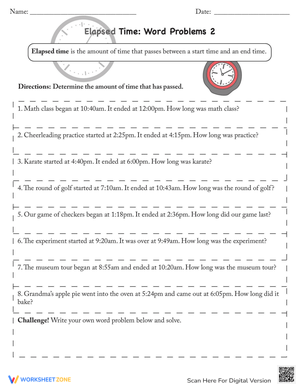
Students who read analog clocks accurately and quickly can move toward benchmark-subtraction thinking: recognizing that a minute hand near the 11 means "three minutes before the next hour" rather than laboriously counting forward from 50. Pairing these students with a partner during center time — with one student explaining their reasoning aloud — makes the mental strategy visible for both. For students ready to reach toward elapsed time, ask them to select two times from different worksheets and figure out how many minutes apart they are by counting across the clock face. That is a natural on-ramp to the more demanding work coming later in 3.MD.A.1.
Frequently Asked Questions
Do these worksheets include both reading and drawing tasks?
Yes. Each worksheet in the set includes problems where students read a clock face and write the time in digital format, and problems where students draw the hour and minute hands to match a given time. The two task types test different parts of the skill — reading requires interpretation, drawing requires construction — and students who appear confident on reading problems sometimes reveal clear gaps when they have to place the hands themselves. Looking at both together gives a fuller picture of where a student actually is.
What's the best approach for students who are still counting all sixty tick marks from scratch every time?
Re-teach the skip-and-tap method explicitly: skip-count by fives to the large numeral just before the minute hand, then tap individual tick marks to count on by ones. Modeling this aloud while students follow along — "five, ten, fifteen... thirty-five, thirty-six, thirty-seven" — and having them say it with you while tracing a problem from one of the time to the minute pdf worksheets for 3rd grade helps internalize the rhythm faster than silent independent work. The goal is getting students to hear the shift from counting by fives to counting by ones as a natural part of a single process, not two separate steps.
How do I use these worksheets as a formative check rather than just practice?
Look at the draw-the-hands problems first. A student who writes the correct time but draws the hour hand pointing directly at the hour numeral — rather than slightly past it — has learned to read a clock without fully understanding that the hour hand moves continuously throughout the hour. That gap matters when elapsed time arrives. Collecting two or three worksheets at intervals across a unit gives a cleaner picture of growth than a single end-of-unit check, and the draw-the-hands problems catch the conceptual gaps that multiple-choice or fill-in-the-blank formats often miss.
Should AM and PM come up alongside this skill?
Grade 3 is a reasonable point to reinforce AM and PM, and some problems in the set include scenario language that asks students to connect a given time to a part of their day. The main work stays on reading to the minute accurately, but tying that to a context — "it's 7:43; are you eating breakfast or dinner?" — gives students a reason to care about the precision they're building. When time to the minute pdf worksheets for 3rd grade are used alongside a classroom schedule posted on the wall, the AM/PM distinction tends to click without needing its own dedicated lesson.













 Interactive Worksheet Maker
 Quiz Maker
 Word Search Maker
 Crossword Puzzle Maker
 Word Scramble Generator
 Sentence Scramble Generator
 Handwriting Worksheet Generator
 Name Tracing Generator
 Fill In The Blank Generator