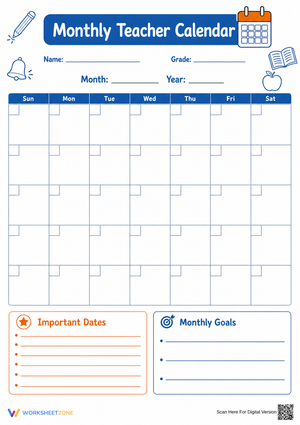
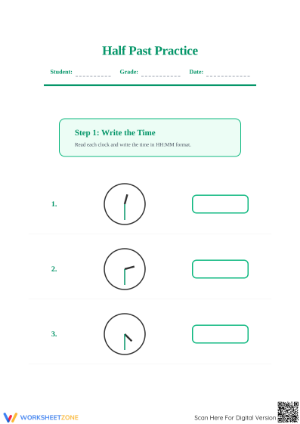
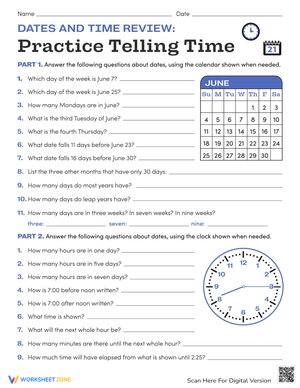
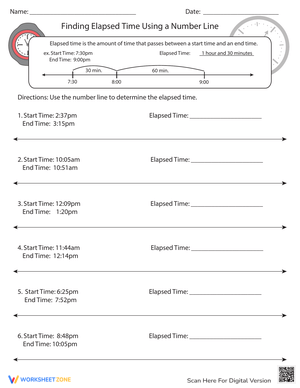
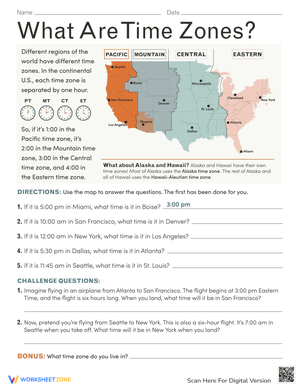
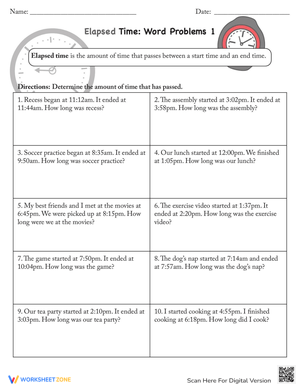
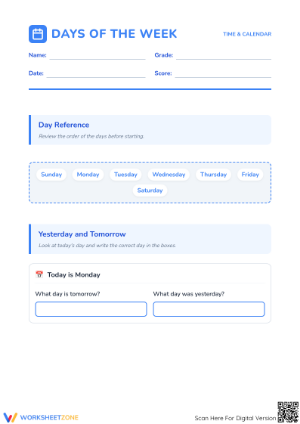
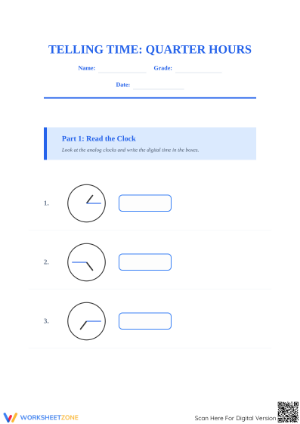
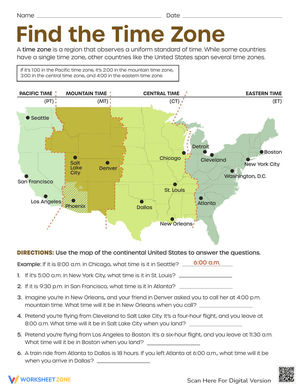
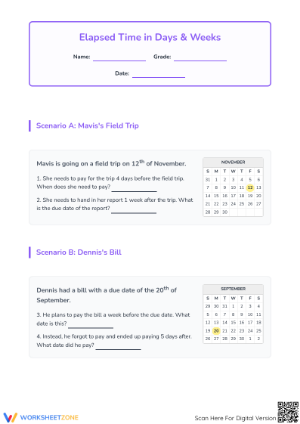
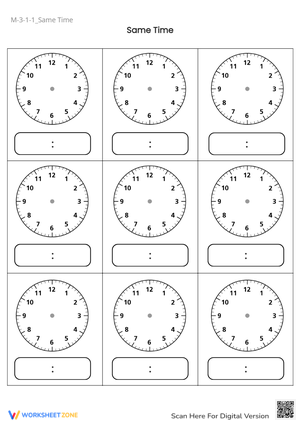
These date and time worksheets for 3rd grade address the two skill jumps that define third-grade time instruction: reading an analog clock to the nearest minute and computing elapsed time. Both demands arrive in the same year, and the set meets them through four distinct task formats — reading clock faces, drawing hands from a given time, solving elapsed time problems on open number lines, and navigating a monthly calendar to answer date questions.
The Specific Skills Targeted
The set covers six core tasks:
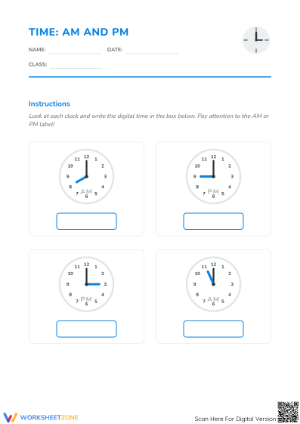
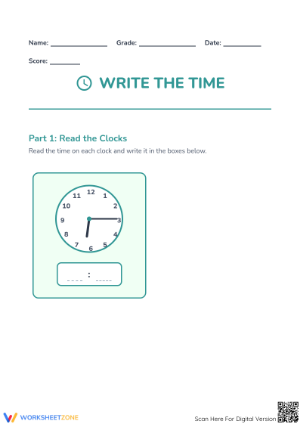
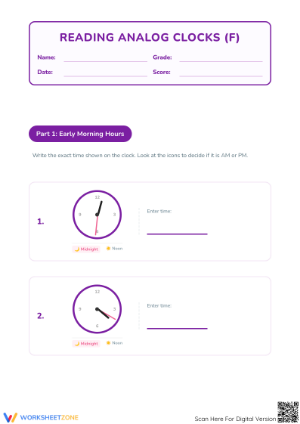
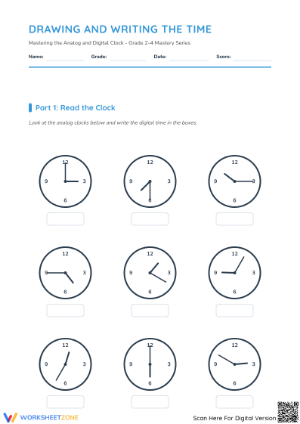
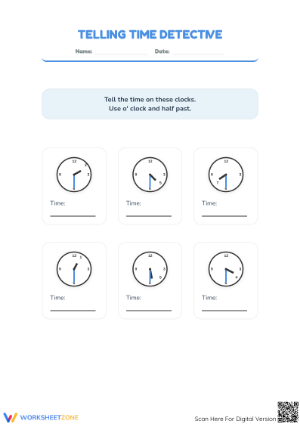
- Reading analog clocks to the nearest minute — students identify times like 4:17 or 10:52, not just five-minute benchmarks
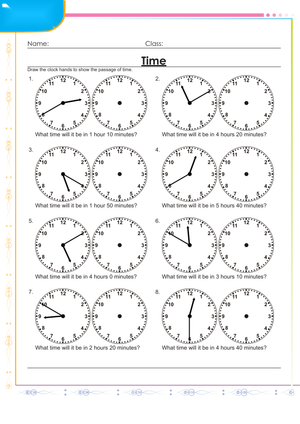
- Drawing hands on a blank clock face — students place both the hour and minute hands from a given digital time
- Translating between analog and digital formats — both directions, so students aren't practicing only one side of the conversion
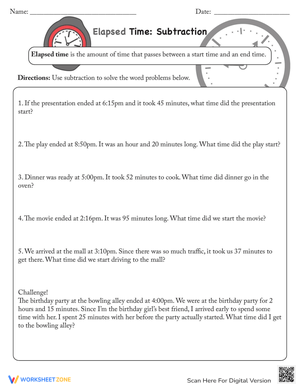
- Elapsed time on open number lines — students break a time interval into manageable forward jumps rather than attempting vertical subtraction in base 60
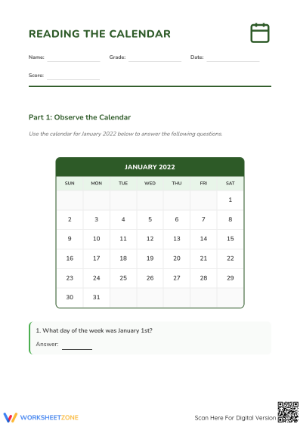
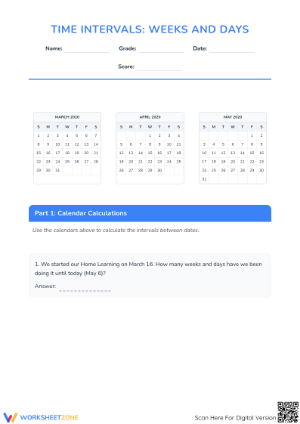
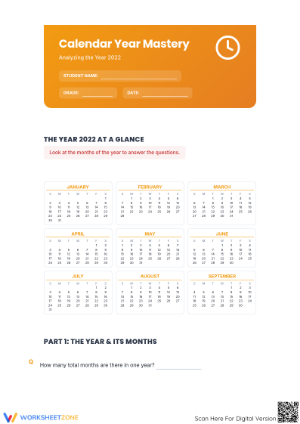
- Calendar reading and date calculation — students use a monthly grid to identify days of the week, count days forward or backward, and interpret date ranges
- Writing dates in standard numerical format — month/day/year conventions and abbreviations for days and months
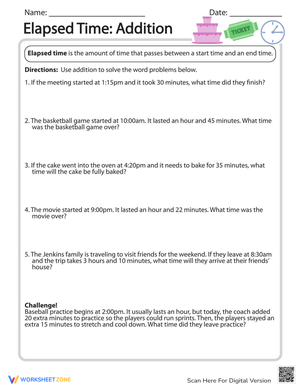
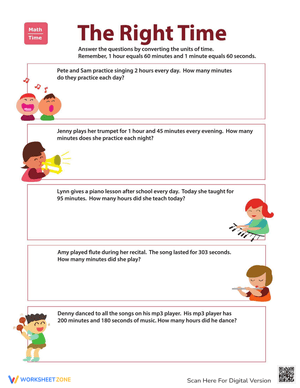
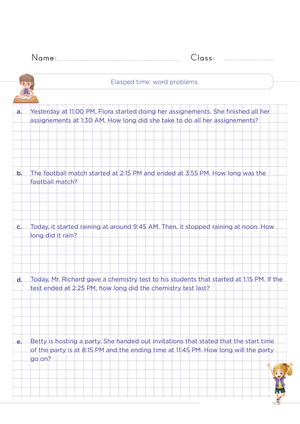
Within the elapsed time worksheets, problems build from simpler tasks — finding a time 30 minutes after a given start — to multi-step word problems where the interval spans the top of the hour. That progression lets teachers choose an entry point that matches where the class currently sits rather than assigning the full set at once.
Common Misconceptions to Watch For Before You Hand These Out
The most consequential error in this unit comes from students who are otherwise strong in math. A third grader who has spent the year learning to borrow in subtraction will apply that logic to elapsed time: to find the duration between 2:45 and 4:15, they subtract 45 from 15, see they need to borrow, and treat 1 hour as 10 minutes rather than 60. The number they land on looks plausible enough that some students won't flag it as wrong. Open number lines head this off by requiring students to count forward in chunks — 2:45 to 3:00 is 15 minutes, 3:00 to 4:00 is 60, 4:00 to 4:15 is 15 more — which keeps the base-60 structure visible throughout the work.
The other reliable error pattern appears on "draw the hands" tasks. Students who can read a clock correctly will still draw the hour hand pointing directly at the number rather than between two numbers. At 6:45, the hour hand belongs three-quarters of the way from the 6 toward the 7 — a spatial judgment that requires understanding the hour hand as a continuously moving indicator, not a pointer that snaps to a number on the hour. This error shows up in student work consistently, and it's faster to address it during a clock-drawing task than to wait for it to appear on a test.
How to Build These Worksheets Into Your Lesson Plans
The most reliable slot for clock-reading practice is the five to eight minutes at the start of math, before direct instruction begins. One worksheet used as a warm-up keeps the skill active without eating into teaching time. That matters because time concepts, once taught and then left untouched for two weeks, degrade noticeably in student work. Brief, repeated exposure maintains accuracy far better than a single deep-practice session followed by a long gap.
For elapsed time specifically, the open number line worksheets work well as a follow-along during the lesson itself, then as independent practice the following day. Teachers who assign elapsed time problems for independent work the same day they introduce the concept typically find students reverting to the base-10 subtraction error. A day's gap — or even just an hour of other activity — helps the number-line strategy settle before students attempt it without support.
The calendar worksheets suit Monday morning routines particularly well. After a weekend, asking students to mark dates, count remaining days in the month, or identify what day a given date falls on reconnects them to calendar fluency in a way a Thursday afternoon lesson rarely matches. Some teachers work through a calendar worksheet during morning meeting, then send an equivalent one home the same week for additional repetitions.
Each worksheet also functions as a clean exit ticket. A single clock-reading or elapsed time task handed out with two minutes left in the period gives a fast read on who has the concept and who needs a small-group conversation the next morning before the class moves on.
Standard Alignment
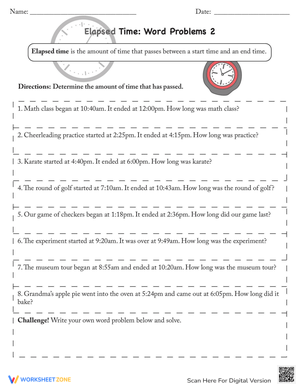
CCSS.MATH.CONTENT.3.MD.A.1 is the anchor standard for this set. It requires third-grade students to tell and write time to the nearest minute, measure time intervals in minutes, and solve word problems involving addition and subtraction of time intervals — explicitly naming the number line as an appropriate representational tool. The elapsed time worksheets address that word-problem requirement directly, placing time calculations in real contexts rather than presenting them as bare computation exercises.
Calendar tasks in the set connect to the broader measurement and data domain, which treats time as a continuous attribute measured at multiple scales. Students who understand the nested relationship between minutes, hours, days, weeks, and months have a meaningfully easier time with elapsed time problems because they can reason flexibly across units rather than treating each time unit as a separate piece of trivia to memorize.
Adjusting the Set for a Range of Learners
For students who are still unsteady on five-minute intervals, the clock-reading worksheets remain useful if you set aside the tasks with irregular times — 7:23, 11:47 — and start with clocks that land on five-minute benchmarks. That is a reasonable entry point in September before the class has shifted to single-minute precision. By mid-year, most students are ready for the full range of clock faces. Starting them there too early tends to produce guessing rather than the two-step process of skip-counting by fives to the nearest benchmark and then counting on by ones.
Students who have already secured the basics benefit from the elapsed time problems that require crossing the hour — finding the duration between 10:40 and 12:15, for instance, which requires three separate jumps rather than a single calculation. That three-part jump strategy transfers directly to the elapsed time items most third-grade assessments use, and it's worth extended practice time for students who are ready for it.
For students who struggle to hold the number line strategy in working memory, pairing the elapsed time worksheets with a physical clock that has movable hands reduces the mental load considerably. Students set the clock to the start time, advance the minute hand through the interval in chunks, and track each chunk on the number line on paper. The concrete clock and the abstract line reinforce each other without requiring students to manage both the visual and the arithmetic at the same time.
Frequently Asked Questions
What standard does this set address?
The primary alignment is CCSS.MATH.CONTENT.3.MD.A.1, which covers telling time to the nearest minute, measuring time intervals in minutes, and solving word problems involving addition and subtraction of time intervals. The standard explicitly identifies number line representation as an appropriate strategy, which is why open number lines appear throughout the elapsed time worksheets rather than as an optional hint.
Are word problems included?
Yes. The elapsed time worksheets present problems in real-world contexts — how long a practice runs, what time a student arrives somewhere after traveling for a given duration — rather than asking students to find the difference between two bare clock times. Word problems are where the standard places its depth-of-knowledge requirement, and these resources treat that context as the actual target rather than an occasional variation.
How do I handle students who keep subtracting time like a regular subtraction problem?
The most effective correction is to stop accepting vertical subtraction for elapsed time entirely during this unit and require the number line on every problem. When students use the algorithm, they apply base-10 borrowing to a base-60 system — that is the root of the error, not carelessness. After a week or two of consistent number line use, most students internalize why 1 hour equals 60 minutes in a way that a single explanation during a lesson does not produce.
Can this set work for students who need review of earlier time concepts?
The date and time worksheets for 3rd grade set includes clock-reading tasks at half-hour and quarter-hour precision within the early worksheets, which makes the set usable for students who need to revisit second-grade material before advancing. It is also worth checking whether a struggling student is solid on skip-counting by fives, since that skill underlies minute-hand reading at every level of precision — not just the nearest-minute tasks.
Are these worksheets a good fit for independent work during rotations?
The date and time worksheets for 3rd grade set works well for independent rotation blocks because the clock-reading and calendar worksheets require nothing beyond a pencil. The elapsed time worksheets benefit from access to a manipulative clock, but students who have seen the number line modeled during whole-group instruction can generally work through the number line tasks on their own. A short reference card showing the jump strategy — posted at the center or kept in students' math folders — tends to reduce interruptions to other rotations significantly.













 Interactive Worksheet Maker
 Quiz Maker
 Word Search Maker
 Crossword Puzzle Maker
 Word Scramble Generator
 Sentence Scramble Generator
 Handwriting Worksheet Generator
 Name Tracing Generator
 Fill In The Blank Generator