




























Views
Downloads


Essential Telling Time Worksheet | Grade 3 Printable

Paste this activity's link or code into your existing LMS (Google Classroom, Canvas, Teams, Schoology, Moodle, etc.).
Students can open and work on the activity right away, with no student login required.
You'll still be able to track student progress and results from your teacher account.
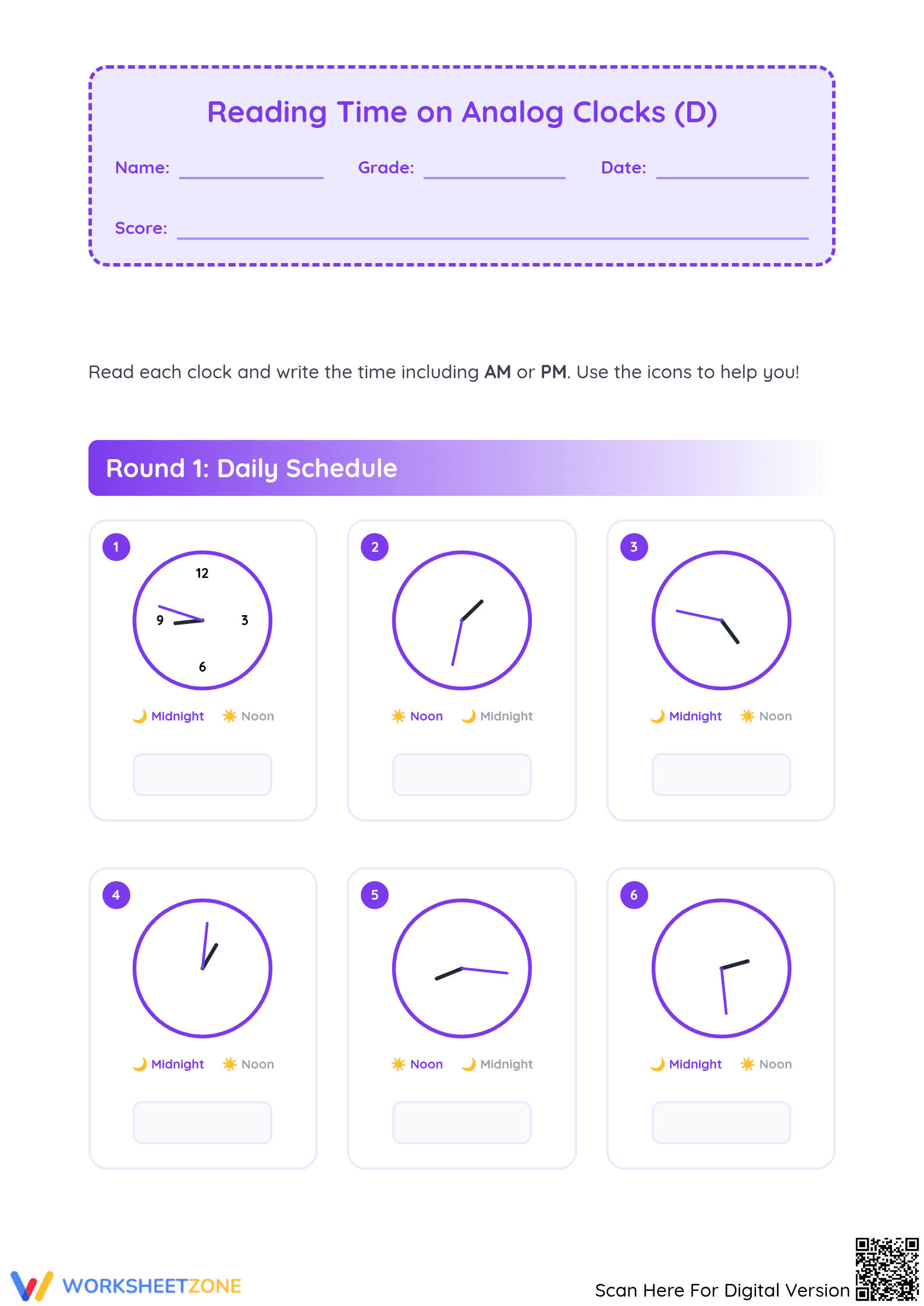
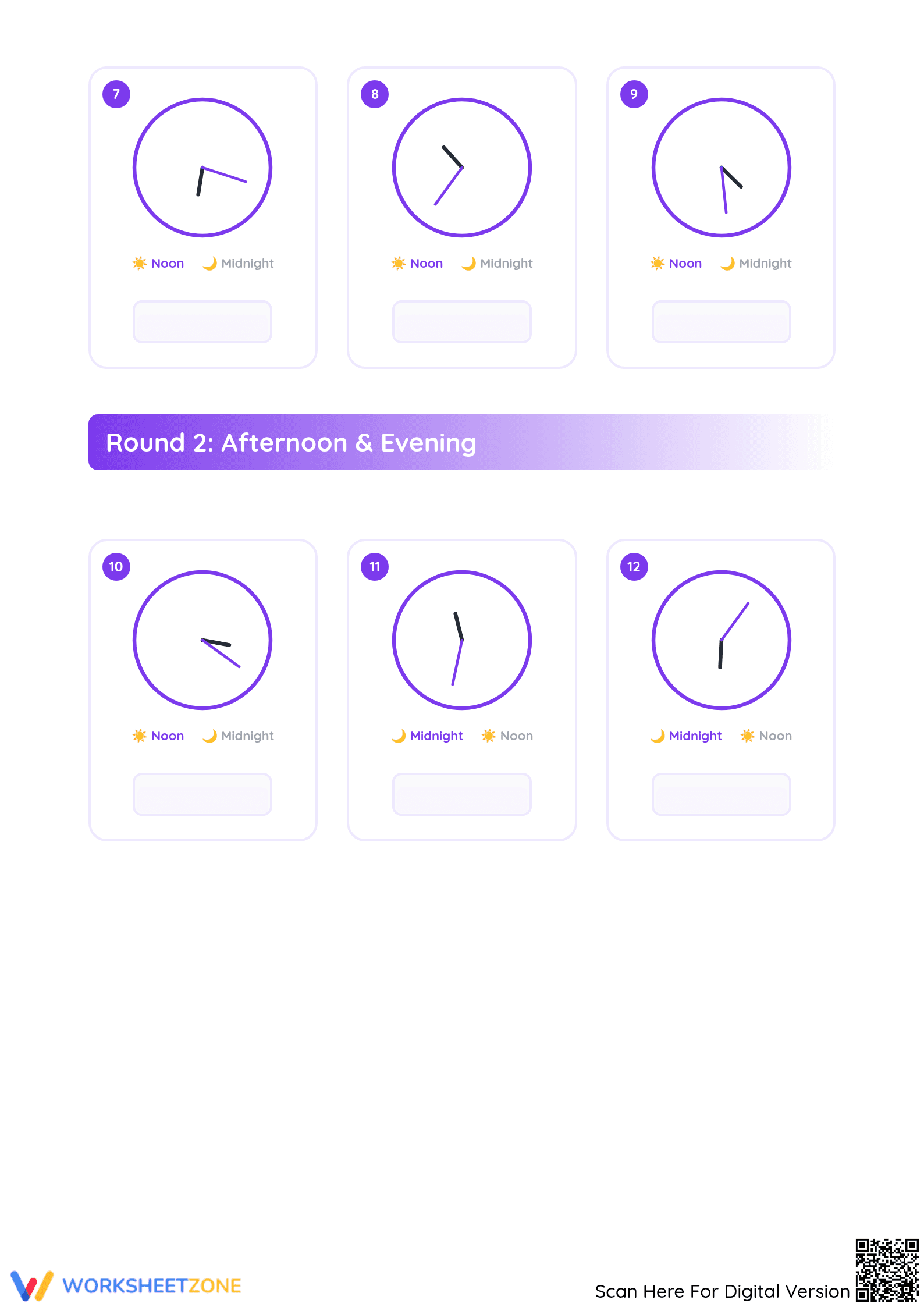
This Grade 3 math worksheet provides targeted practice for students learning to read analog clocks with precision. By focusing on one-minute intervals, students move beyond basic five-minute increments to achieve true time-telling fluency. The structured format ensures students can accurately identify the exact time while correctly applying AM and PM designations based on visual cues.
At a Glance
- Grade: 3 · Subject: Math
- Standard:
CCSS.MATH.CONTENT.3.MD.A.1— Tell and write time to the nearest minute using analog clocks- Skill Focus: 1-minute interval precision and AM/PM identification
- Format: 3 pages · 21 problems · Answer key included · PDF
- Best For: Independent math centers or quick formative assessment
- Time: 20–30 minutes
The "Reading Time on Analog Clocks (D)" collection is divided into three logical rounds across three pages. Each page contains high-quality analog clock faces with clear minute markings. Below each clock, students are prompted with "Noon" and "Midnight" icons to help them determine the correct AM or PM suffix for their written answers, reinforcing situational awareness of time.
The zero-prep workflow for this resource is designed for teacher efficiency. Print the three-page PDF (10 seconds), distribute to students (30 seconds), and use the included answer keys for rapid grading (1 minute). Total teacher preparation time is under two minutes, making it ideal for busy mornings or emergency sub plans.
This resource is strictly aligned to the CCSS.MATH.CONTENT.3.MD.A.1 standard, which requires students to tell and write time to the nearest minute. By requiring the inclusion of AM and PM, the worksheet also supports broader measurement and data goals within the elementary curriculum. The standard code and plain-English skill focus can be copied directly into lesson plans, IEP goals, or district curriculum mapping tools.
Educators can implement this worksheet as a mastery check following direct instruction. One effective strategy is having students complete Round 1 independently, then performing a "turn and talk" to compare AM/PM reasoning before moving to Round 3. Observe if students count by fives or use benchmarks to identify the minute. Expect completion within 25 minutes.
This worksheet is primarily designed for third-grade students working toward standard mastery, though it serves as excellent remediation for fourth graders. It is particularly effective for students who struggle with the abstract nature of AM/PM or those needing fine-motor practice in writing digital times. This resource pairs naturally with a classroom manipulative clock or a digital time-telling interactive slide deck.
Mathematics education research highlights that the transition from five-minute increments to one-minute precision represents a significant cognitive leap for elementary learners. According to the RAND AIRS 2024 analysis of instructional materials, high-frequency exposure to clear, uncluttered analog representations is essential for developing "time sense"—the ability to internalize the circular nature of time measurement. This worksheet addresses this by providing 21 distinct opportunities for students to decode minute-level detail without the distraction of unnecessary decorative elements. By integrating AM/PM icons directly into the task, the resource bridges the gap between abstract numerical reading and the practical application of the CCSS.MATH.CONTENT.3.MD.A.1 standard in daily life. This specific scaffolding supports more durable retention and prevents the common error of neglecting temporal context, ensuring students are prepared for more complex elapsed-time word problems in future units.


