


























Views
Downloads




Reading Clocks at 1-Minute Intervals | Printable Math
Paste this activity's link or code into your existing LMS (Google Classroom, Canvas, Teams, Schoology, Moodle, etc.).
Students can open and work on the activity right away, with no student login required.
You'll still be able to track student progress and results from your teacher account.
Mastering the art of telling time requires precision and consistent practice. This comprehensive math worksheet focuses on reading analog clocks to the exact minute, helping students transition from five-minute increments to high-accuracy timekeeping. By engaging with these structured problems, learners build the fluency needed for real-world scheduling and precise time management.
At a Glance
- Grade: 3 · Subject: Math
- Standard:
CCSS.MATH.CONTENT.3.MD.A.1— Tell and write time to the nearest minute and measure time intervals.- Skill Focus: Minute-level analog clock reading
- Format: 5 pages · 14 problems · Answer key included · PDF
- Best For: Independent practice or formative assessment
- Time: 15–20 minutes
What's Inside
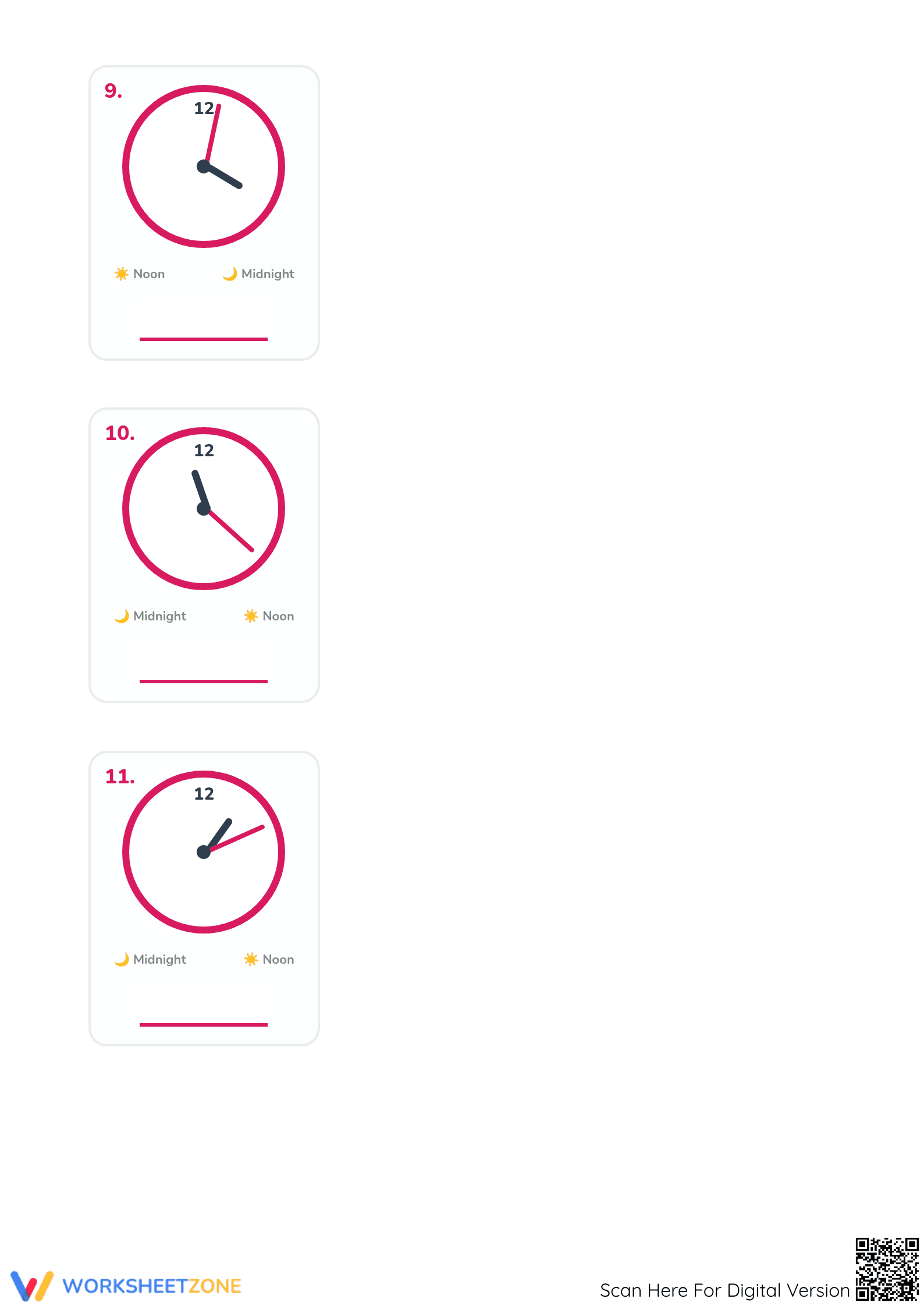
This printable pack contains five clearly organized pages featuring 14 distinct analog clock faces. Each clock displays a unique time, requiring students to identify both the hour and the minute hands with high precision. The layout is clean to minimize visual distractions, featuring large clock faces and dedicated lines for recording answers. A complete answer key is included.
Zero-Prep Workflow
This resource is designed for immediate classroom implementation with a total teacher prep time of less than 60 seconds. Simply print the document and distribute it to your students. Because the instructions are self-explanatory, learners can begin working independently without an introductory lecture. The provided answer key allows for a three-minute review at the end of the period, making this an ideal "grab-and-go" sub plan.
Standards Alignment
The primary focus of this worksheet is `CCSS.MATH.CONTENT.3.MD.A.1`: "Tell and write time to the nearest minute and measure time intervals in minutes." It directly supports the foundational understanding of the 60-minute clock cycle and the relationship between the hour and minute hands. This standard code can be copied directly into lesson plans, IEP goals, or district curriculum mapping tools.
How to Use It
This worksheet is best utilized during the "You Do" phase of a gradual release model, following a direct instruction lesson on minute hands. Use the first three problems as a quick formative check to ensure students aren't misreading the hour hand when it is close to the next digit. If a student consistently misses by exactly five minutes, it indicates a need for remediation on skip-counting.
Who It's For
This resource is tailored for third-grade students who have already mastered reading clocks to the nearest five minutes. It also serves as an excellent extension for second graders or as a vital intervention tool for fourth-grade students requiring additional practice with precise time intervals. It pairs naturally with a physical classroom clock for verification of answers.
Effective mathematics instruction relies on the transition from conceptual understanding to procedural fluency. According to research published by Fisher & Frey (2014) on the gradual release of responsibility, structured independent practice is essential for internalizing complex skills like time-telling at the 1-minute interval level. This worksheet specifically targets CCSS.MATH.CONTENT.3.MD.A.1, ensuring that students move beyond estimated time-reading to absolute accuracy. By providing 14 high-resolution clock faces, the material aligns with the NAEP recommendation for visual representations in early elementary geometry and measurement tasks. Teachers can use the resulting data to verify that students have achieved the necessary precision required for higher-order scheduling and elapsed-time calculations in subsequent units. This self-contained module is designed to integrate smoothly with any standards-based curriculum without requiring additional instructional overhead or teacher preparation.


