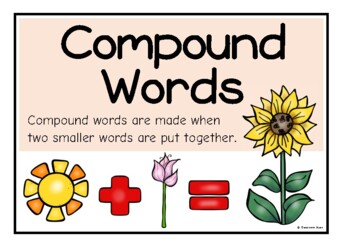
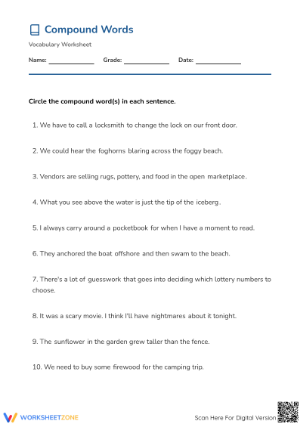
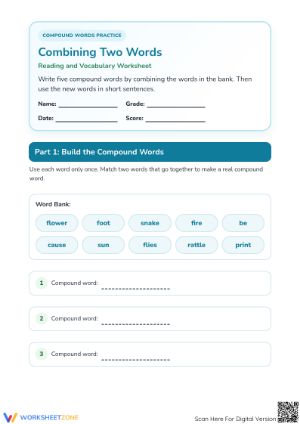
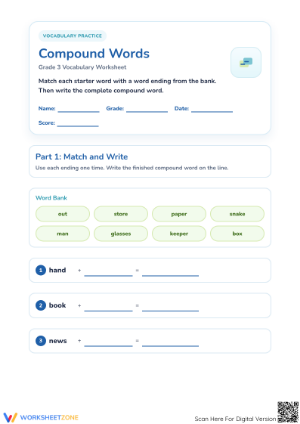
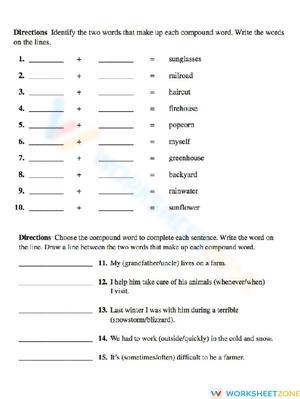
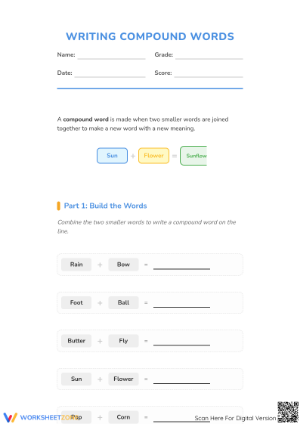
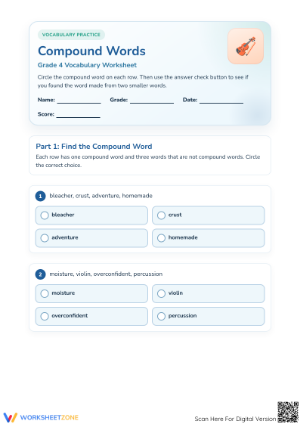
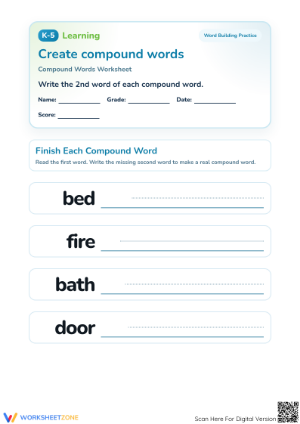
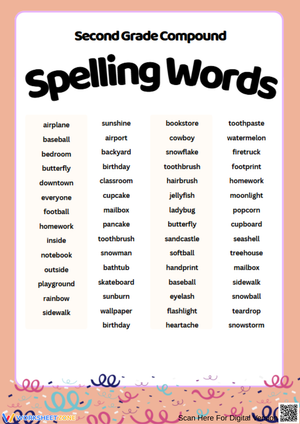
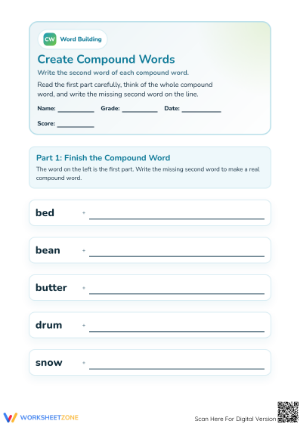
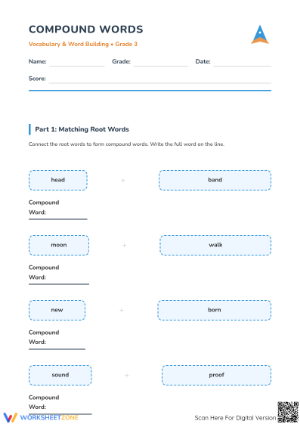
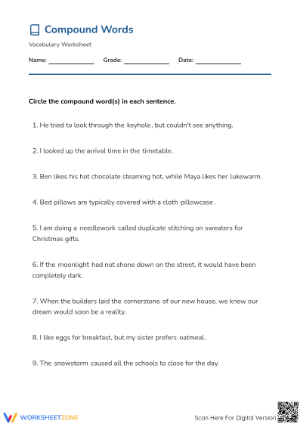
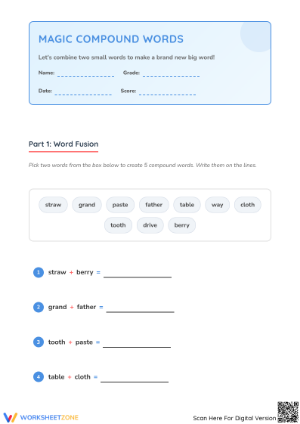
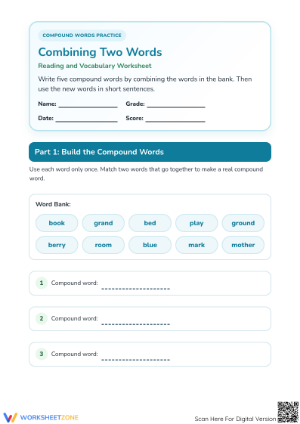
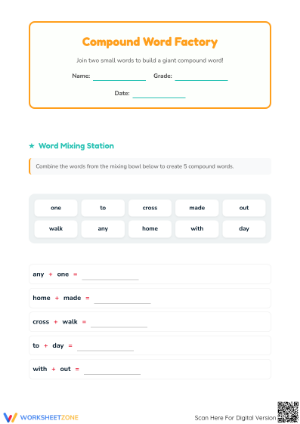
These 3rd grade compound words printable worksheets give teachers a word-study resource built for exactly the right moment in the school year — third grade is when students start meeting longer, multisyllabic words in daily independent reading, and compound words are one of the clearest entry points for teaching them to look for familiar parts inside unfamiliar ones. Each worksheet focuses on closed compound words first, with select worksheets extending into open and hyphenated forms for teachers who want to go further.
Skills Each Worksheet Builds
Each worksheet in this 3rd grade compound words printable worksheets set approaches the concept from a different angle, so students encounter compound words repeatedly without repeating the same task. Across the set, students:
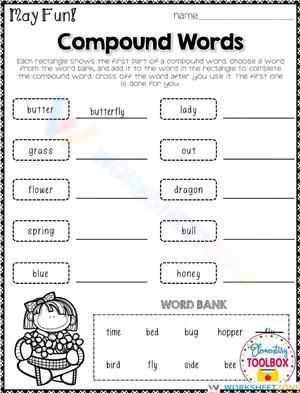
- Split compound words into their two base words — underlining each part or writing the pieces separately
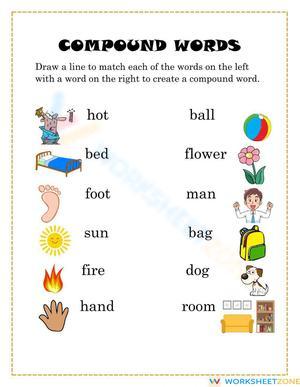
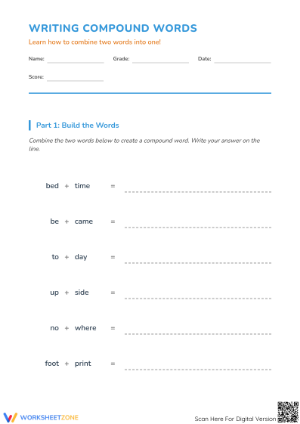
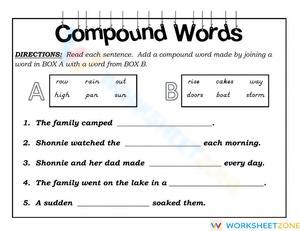
- Match word pairs across two columns to form real compound words
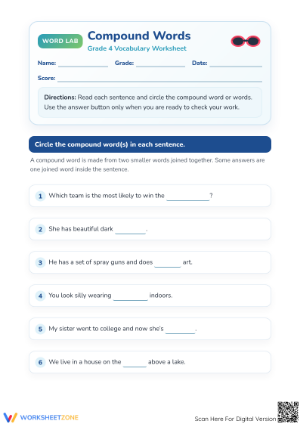
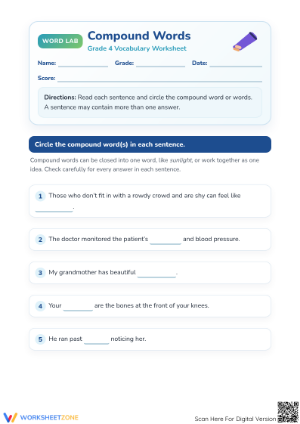
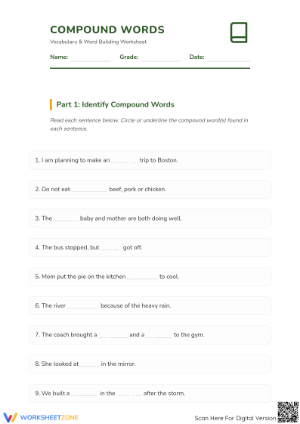
- Complete fill-in-the-blank sentences where the compound word must fit the context
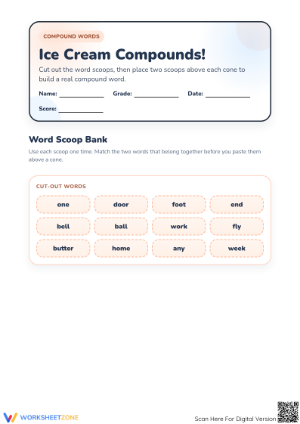
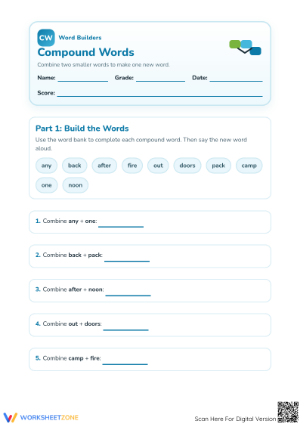
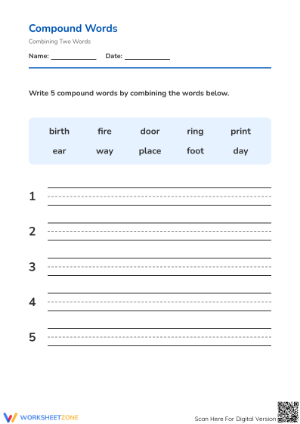
- Build original compound words from a word bank and determine which pairings form real, recognizable words
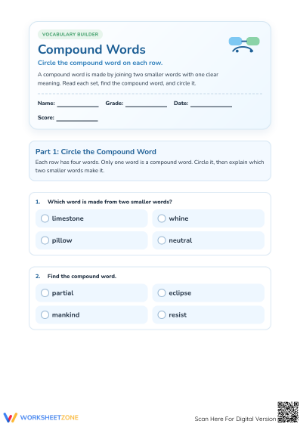
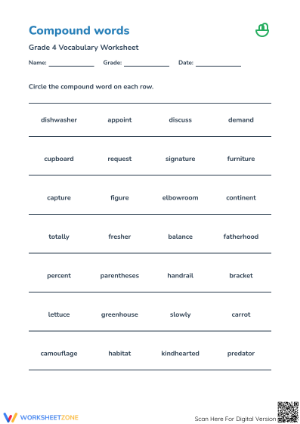
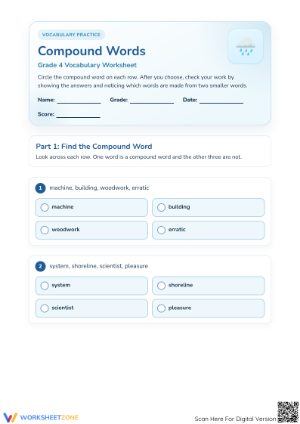
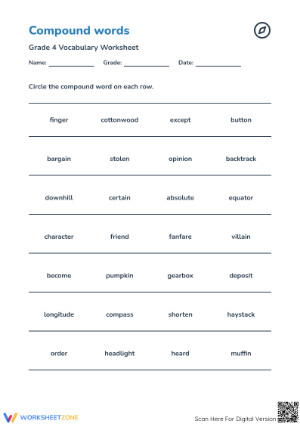
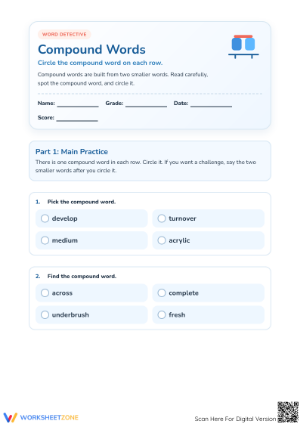
- Sort compound words from other multisyllabic words, which requires applying the definition rather than just recalling examples
The set keeps its emphasis on closed compound words — sunflower, backpack, notebook, raincoat — because these are the forms third graders meet most in print. Open compounds like ice cream and post office appear in several worksheets, and a smaller number introduce hyphenated forms. Third-grade instruction doesn't require mastery of all three types, but exposing students to the full range prevents confusion when they encounter post office written as two words and wonder whether it really counts.
Common Misconceptions to Watch For in Student Work
The most consistent error surfaces in writing, not in reading: a student who recognizes "snowflake" correctly in a passage will still write "snow flake" with a space when composing their own sentences. These two skills develop on different timelines. Compound word worksheets that require students to produce the word in an original sentence — rather than only identify it in isolation — expose this gap early enough to address it.
A second predictable problem involves meaning. Students learn that compound words carry meaning from both base words, so they extend that logic universally. They'll explain raincoat accurately — a coat for rain — then define butterfly as "a fly that has something to do with butter." This isn't careless guessing; it's the same schema working exactly as taught, just applied too broadly. Asking students to predict a compound word's meaning from its parts before checking it against a definition makes the limitation visible without derailing the lesson. The sorting and sentence-level worksheets create natural moments for exactly that conversation.
Fitting These Worksheets Into Your Literacy Rotation
The matching and deconstruction worksheets take eight to ten minutes, which makes them clean Monday warm-ups after morning meeting — enough time to activate prior vocabulary knowledge before a read-aloud or guided reading transition without eating into that block. The fill-in-the-blank and sentence-writing worksheets are better placed mid-week, after students have already seen the target words a few times. Word-building and sorting worksheets, where students have to make judgment calls and defend them, work well as Friday review or as center tasks where pairs of students can push back on each other's choices.
One classroom technique worth trying: project a worksheet on the board and work through it orally as a class before students complete their own copy. The sorting worksheets especially generate productive disagreements — a student who argues that "sunroom" is a valid compound word is making the right cognitive move, and the class discussion that follows tends to stick harder than any explicit definition will.
Standard Alignment
These printable compound word activities connect to two standards that are meant to work together. CCSS.ELA-LITERACY.RF.3.3 asks students to apply grade-level phonics and word analysis skills in decoding — which includes recognizing meaningful word parts inside longer words. CCSS.ELA-LITERACY.L.3.4 extends that into meaning: using known word structure and context to figure out unfamiliar vocabulary. In practice, RF.3.3 covers the decoding act (seeing "thunder" and "storm" inside "thunderstorm"), while L.3.4 covers the meaning inference that follows. Compound word study is one of the few places in third grade where phonics and vocabulary instruction genuinely overlap, which makes it worth deliberate lesson time rather than a quick definition and move-on.
Adjusting These Worksheets for a Range of Learners
For students still uncertain about base-word recognition, the matching worksheets are the right starting place. The format reduces the task to pairing two known words — no generation required — which narrows the cognitive demand enough that students can complete it accurately before they tackle open-ended production. Moving those students to fill-in-the-blank after they match reliably gives them a step-by-step progression without changing the core skill.
Students who have closed compound words well in hand benefit from the worksheets covering open and hyphenated forms — same underlying skill, harder application because the visual cues disappear. An extension that works without any extra preparation: ask those students to find three compound words in their independent reading book that day, copy the sentence, and underline both parts. That task moves compound word awareness out of the worksheet and into live reading, which is where the transfer actually needs to happen.
Frequently Asked Questions
Which type of compound word should I teach first?
Start with closed compound words. They're visually clear — two words fused into one — and they're the form students encounter most in third-grade texts. Open and hyphenated forms deserve brief, explicit attention later in the year, but introducing all three types simultaneously tends to muddy what students think counts as a compound word.
How can I tell whether students have genuinely internalized compound words or just recognize them on worksheets?
Check their independent writing. A student who correctly identifies watermelon on a worksheet but writes "water melon" in a journal entry hasn't transferred the skill yet. Asking students to use three target compound words in original sentences — without the worksheet present — is a reliable quick check. When writing performance matches worksheet performance, the concept has moved past surface recognition.
Can these worksheets serve as formative assessment rather than just practice?
Yes. The sentence-writing and word-building worksheets are particularly useful as formative evidence — when a student builds and correctly uses a compound word in context without a word bank, that's a clear signal of transfer. The 3rd grade compound words printable worksheets that ask for original sentence construction give you concrete work samples for a portfolio or for documenting progress toward L.3.4.
My students already recognize most common compound words. Is there still value in working through this set?
Recognition and application are different skills. Students who know backpack and sunflower as familiar words may not yet apply compound word logic when they meet an unfamiliar multisyllabic word in a chapter book. These 3rd grade compound words printable worksheets push past recognition into active deconstruction and production — the two places where the skill actually transfers to independent reading.












 Interactive Worksheet Maker
 Quiz Maker
 Word Search Maker
 Crossword Puzzle Maker
 Word Scramble Generator
 Sentence Scramble Generator
 Handwriting Worksheet Generator
 Name Tracing Generator
 Fill In The Blank Generator