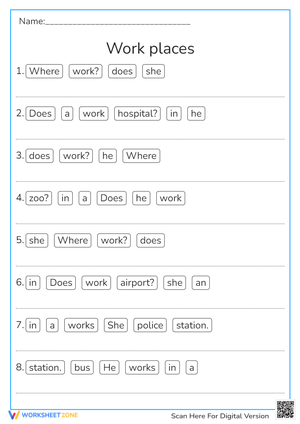
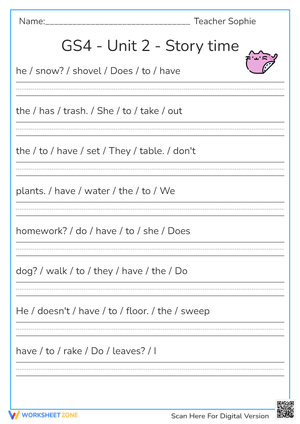
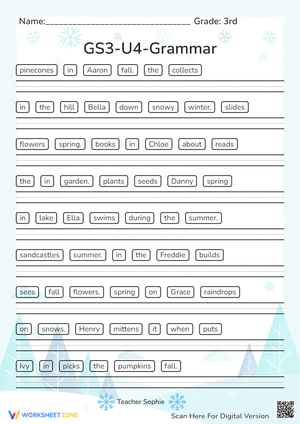
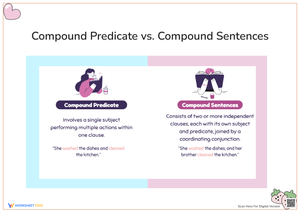
These 3rd grade simple compound and complex sentences worksheets give teachers a set of targeted practice exercises built around the shift students make in third grade from short, repetitive writing toward sentences with real structural control. Each worksheet isolates one skill — identifying sentence types, selecting the right conjunction, or combining two ideas into one — so teachers can assign them as warm-ups, center activities, or take-home review without adapting anything first.
What's Inside the Set
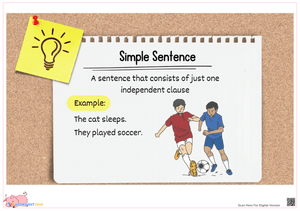
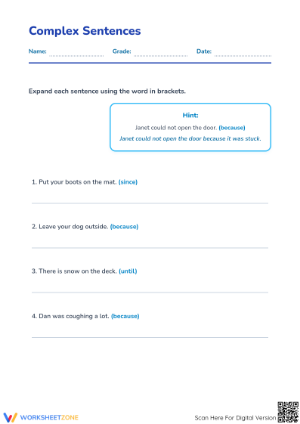
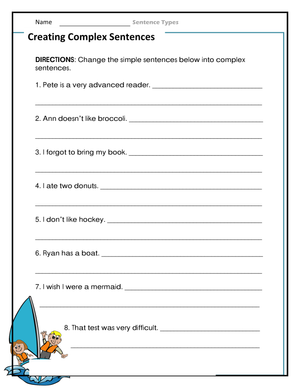
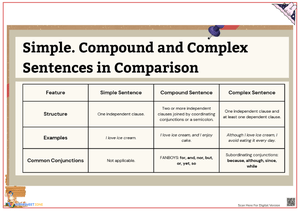
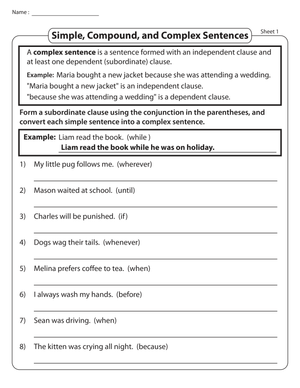
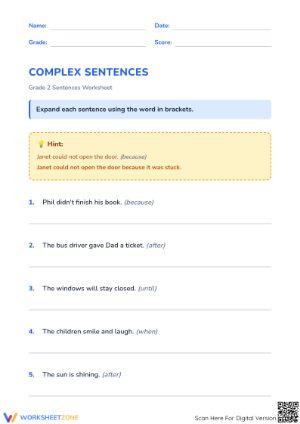
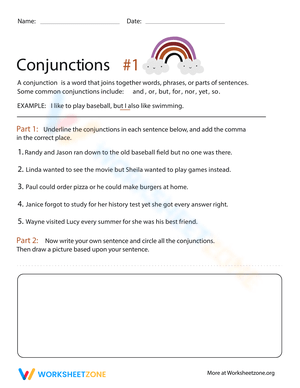
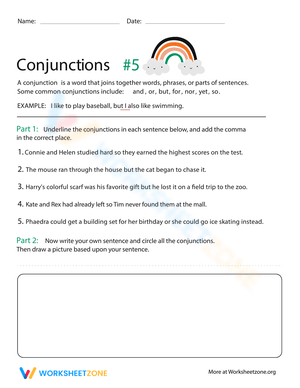
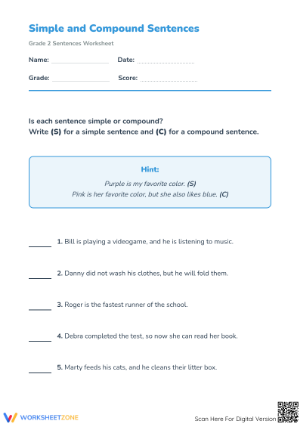
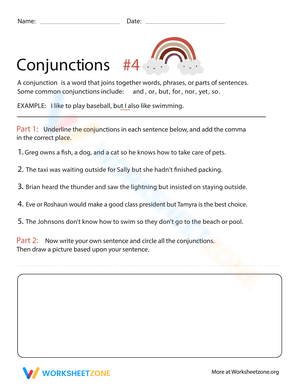
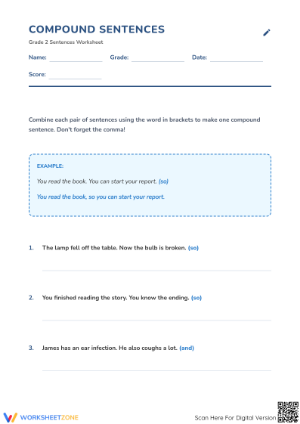
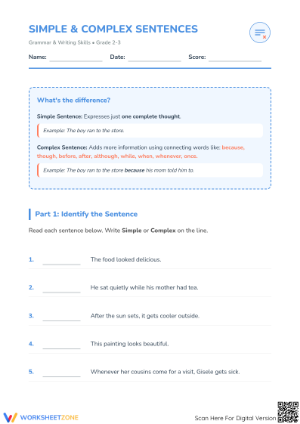
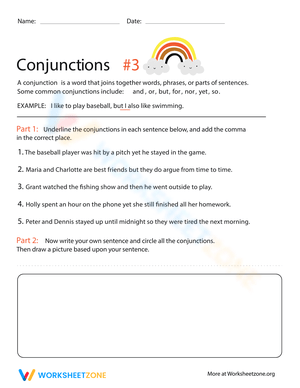
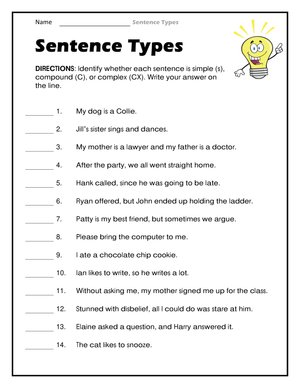
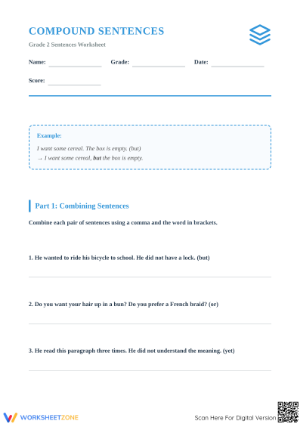
Each worksheet in the 3rd grade simple compound and complex sentences worksheets set targets a specific layer of sentence knowledge. Students mark subjects and predicates in simple sentences, sort compound and complex examples into labeled columns, and complete sentence frames using FANBOYS (For, And, Nor, But, Or, Yet, So). Several worksheets focus on subordinating conjunctions — because, when, if, before, after — asking students to construct a complex sentence from a given independent clause. A final category of exercises presents two short simple sentences and asks students to rewrite them as a single compound or complex sentence.
That sentence-combining work is where the most meaningful thinking happens. Students have to ask themselves whether the two ideas are equal in weight (compound) or whether one explains, qualifies, or sets up the other (complex). Choosing between but and although, or between so and because, is a reasoning task about meaning — not just a grammar rule to retrieve.
Where Students Reliably Go Wrong With These Structures
The most consistent complex-sentence error in third grade is the dependent-clause fragment. A student who uses because fluently in conversation will still write "Because it was raining." as a complete sentence on the worksheet. This problem is worse when the dependent clause leads — students read "Although she was tired" and pause, which makes the clause feel resolved even though nothing has been completed. These exercises surface that confusion directly, because students must label both the dependent clause and the independent clause rather than just circle a conjunction.
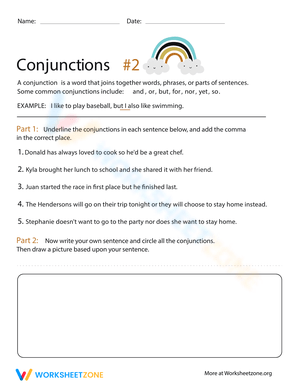
Compound sentences bring a different, predictable problem: the missing comma before the coordinating conjunction. Students write "We went to the park but it started to rain" without hesitation, even with an anchor chart in view. Asking students to circle the FANBOYS word and then look one space to the left before they move on redirects their attention at exactly the right moment. There is also the and-overuse problem — students default to and for nearly every compound sentence because choosing so, but, or yet requires thinking about the relationship between the two clauses rather than just connecting two sentences. Exercises that ask students to explain why a specific conjunction fits better than and push back against this habit effectively.
Building These Worksheets Into Your Week's Grammar Work
The most useful sequence starts with a whole-group anchor chart lesson on simple sentences — identifying subject and predicate together — followed by one worksheet the same day as independent confirmation of the concept. Mid-week, introduce compound sentences using FANBOYS. Assign a worksheet focused on selecting the right coordinating conjunction and placing the comma correctly, and hold there until most students can do both reliably before moving on. By Thursday or Friday, introduce complex sentences with one or two subordinating conjunctions at a time; because first, since students already use it in speech, then when and if.
The sentence-combining worksheets have a second life in writing workshop. Ask students to find two choppy consecutive sentences in their own drafts and use the skills from the worksheet to combine them into one. That transfer from grammar exercise to actual student writing is what moves the skill out of the worksheet and into permanent use. For low-prep review later in the year, these worksheets also hold up well as Monday morning warm-ups — five minutes identifying and labeling sentence types in a short passage keeps the vocabulary active after a weekend gap without eating into instructional time.
Standard Alignment
The 3rd grade simple compound and complex sentences worksheets set addresses CCSS.ELA-LITERACY.L.3.1.I, which requires students to produce simple, compound, and complex sentences. In planning terms, this standard typically falls in the second or third quarter of third grade — after students have reviewed subjects and predicates, and before writing standards push them toward multi-paragraph pieces where sentence variety becomes visible at the paragraph level. Building fluency with L.3.1.I in third grade pays forward directly into fourth grade, where students are expected to deploy these structures automatically rather than encountering them as a unit focus.
Adapting the Exercises When Your Class Isn't Starting From the Same Place
Students who are still uncertain about subjects and predicates need to work through the simple-sentence exercises before touching compound or complex material. Trying to identify a dependent clause when you cannot yet isolate the main subject puts too many simultaneous demands on a student at once. For those learners, add a brief underlining step — subject in one color, predicate in another — before they attempt any sentence-type labeling work.
Students who move through the set quickly can use the sentence-combining exercises as extension work by raising the constraint: combine three sentences instead of two, or rewrite a short paragraph using only complex sentences and then compare how the rhythm differs from the original. Students who engage closely with mentor texts often find it compelling to notice how authors use a short simple sentence for emphasis immediately after a long complex one. Once they see that pattern in books they are already reading, they start experimenting with it in their own writing without being prompted.
Frequently Asked Questions
How do you explain a complex sentence to a third grader without losing them?
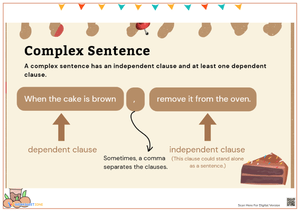
Start with because. Students use it constantly in speech — "I was late because the bus was slow" — so they already understand intuitively that the because-clause explains the main idea but cannot stand alone as a sentence. Calling the dependent clause the "explainer" part and the independent clause the "main" part maps onto language students already have. Once they are solid with because, move to when and if, which follow the same logic but with time and condition rather than cause.
What is the difference between a compound and a complex sentence, in terms students can remember?
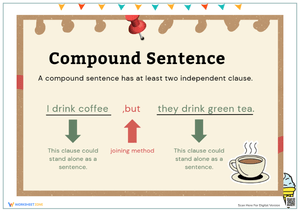
A compound sentence joins two thoughts that could both stand independently as complete sentences — two equal ideas connected by a FANBOYS conjunction and a comma. A complex sentence has one strong part and one part that cannot stand alone; the weaker part is introduced by a subordinating conjunction like although, since, or because. A classroom check that works reliably: cover the conjunction and try to split the sentence into two complete sentences. If both halves hold up on their own, it is compound. If one half collapses without the other, it is complex.
Which conjunctions should I teach first?
For coordinating conjunctions, prioritize and, but, or, and so — these cover the large majority of compound sentences students write and encounter in reading. Post the full FANBOYS list as a classroom reference, but build real fluency on those four before moving to the others. For subordinating conjunctions, because, when, if, before, and after are sufficient to handle most complex sentences students will need through the end of third grade and into fourth.
Can I use these worksheets for grades rather than just practice?
The identification and labeling exercises function well as formative checks — they give a clear picture of whether a student can distinguish between sentence types without requiring you to evaluate a full piece of writing. The sentence-combining exercises reveal something deeper: whether students understand how conjunction choice changes meaning, not just whether they can recall a definition. Neither replaces a writing sample as a summative tool, since the real measure is whether varied sentence structures appear in students' independent work. That said, using a 3rd grade simple compound and complex sentences worksheets exercise as a weekly quick-check gives you actionable data on individual students without the time cost of grading full drafts every week.












 Interactive Worksheet Maker
 Quiz Maker
 Word Search Maker
 Crossword Puzzle Maker
 Word Scramble Generator
 Sentence Scramble Generator
 Handwriting Worksheet Generator
 Name Tracing Generator
 Fill In The Blank Generator