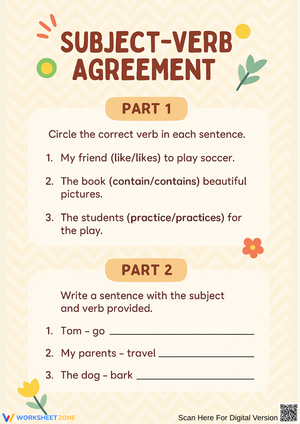
3rd grade subject verb agreement worksheets give students the repeated, focused practice they need to stop treating the present-tense -s rule as optional — and to start applying it automatically in their own writing. The set works across several agreement contexts, from straightforward singular and plural noun subjects through the more demanding territory of compound subjects joined by "or" and "nor."
What the Set Covers
Each worksheet targets one agreement context with enough varied problems to move a student from shaky recognition toward reliable application. The skill areas across the set include:
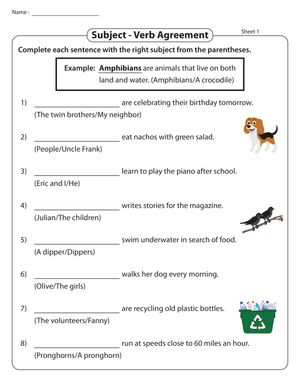
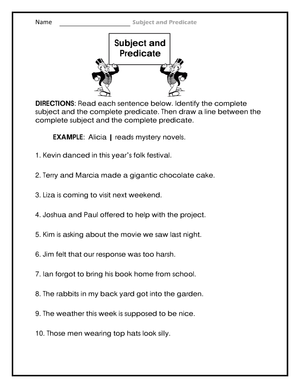
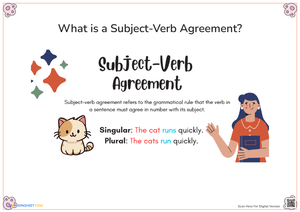
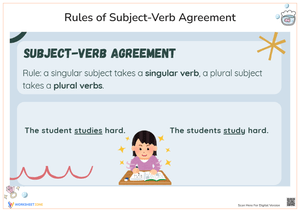
- Singular and plural noun subjects in clear, present-tense sentences ("The bird sings" / "The birds sing")
- The irregular pairs is/are and has/have, which don't follow the standard -s pattern
- Pronoun subjects — including I and you, which always take the plural verb form regardless of how many people they refer to
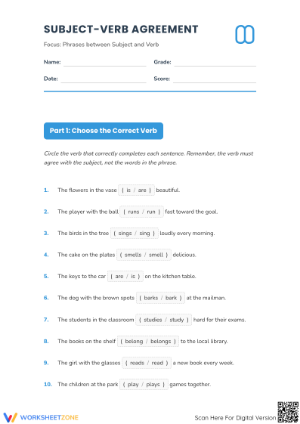
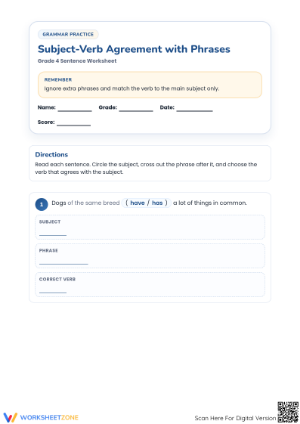
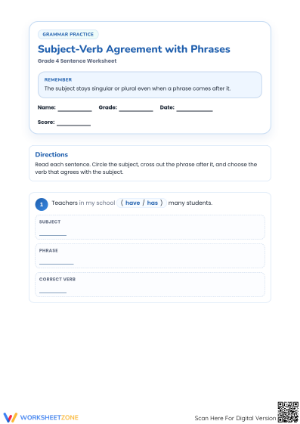
- Sentences where a prepositional phrase falls between the subject and the verb
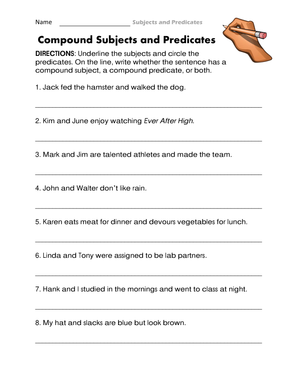
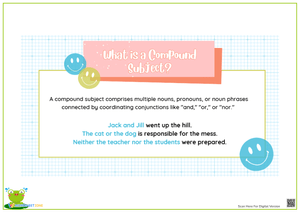
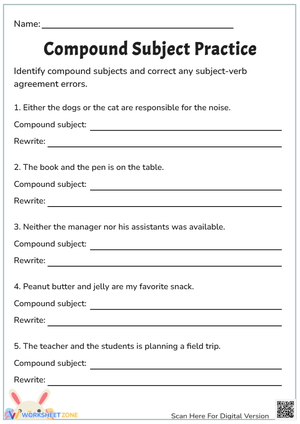
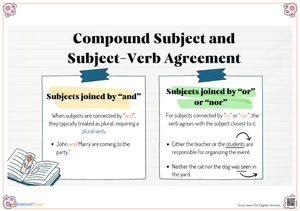
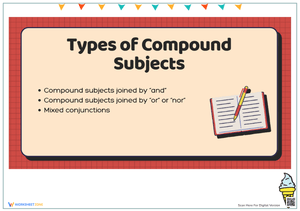
- Compound subjects joined by "and"
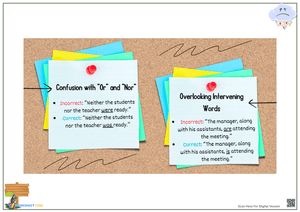
- Compound subjects joined by "or" or "nor," where the verb agrees with the nearest subject
- Collective nouns — "team," "class," "family" — treated as singular subjects
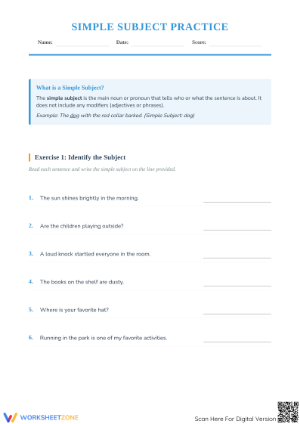
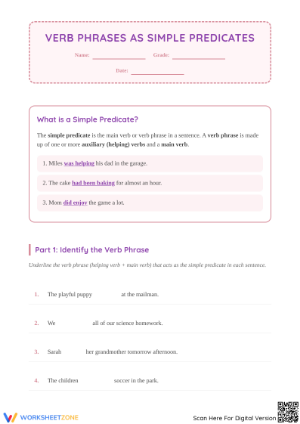
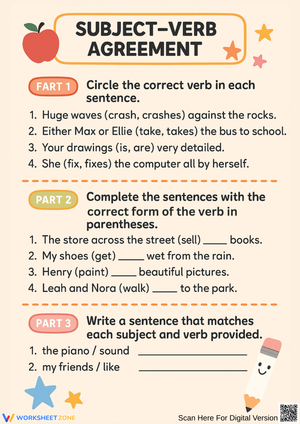
Students move through several formats on each worksheet: fill-in-the-blank, error correction, and sentence rewriting. They underline subjects, circle verbs, and mark errors rather than only selecting from multiple choice. That active annotation means you can see their reasoning when you review, not just whether they got the right answer.
Student Errors That These Worksheets Surface
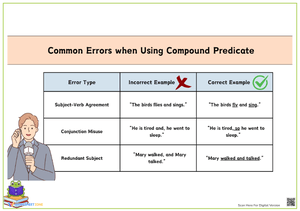
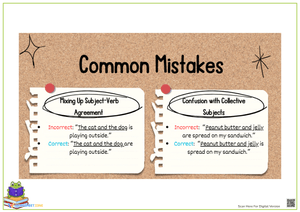
The most consistent mistake in third-grade agreement work is what teachers sometimes call the reverse -s problem. Students who have recently mastered plural nouns — adding -s to make one dog into many dogs — overapply that logic to verbs. They write "the dogs barks" because adding -s to both words feels symmetrical. This is not sloppiness; it is a reasonable generalization of a rule they learned correctly. What it signals is that the student has internalized noun plurals but hasn't yet grasped that verbs work in the opposite direction. Recognizing this pattern early lets you address it directly rather than just marking individual sentences wrong.
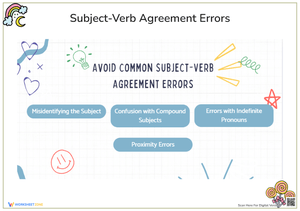
The second predictable error cluster involves prepositional phrase interference. In "The jar of cookies sits on the shelf," a student looking for the subject will often land on "cookies" because it is the last noun before the verb. She then writes "sit" — choosing the verb that agrees with "cookies" rather than "jar." 3rd grade subject verb agreement worksheets that include several of these sentences give you a reliable diagnostic: if a student answers them correctly across the worksheet, the prepositional phrase problem is solved; if not, it needs more attention before you move on to compound subjects.
Fitting These Worksheets Into Your Lesson Plans
The two contexts where this set earns its place most consistently are bell-ringers and small-group instruction. As a morning warm-up, one worksheet gives students a contained, eight-to-ten-minute task while you settle the room. The error-correction format works especially well here because students must read the sentence, find the problem, and rewrite it — three separate cognitive moves that produce better retention than circling an answer. On Mondays, this sequence also works as a low-pressure way to reconnect students to grammar after the weekend without re-teaching from scratch.
In a writing workshop context, 3rd grade subject verb agreement worksheets bridge the gap between grammar drills and real editing. After students finish a draft, pull a small group and work through the error-correction worksheet together as a model for proofreading their own writing. Students who practice agreement in isolation but never apply it to their drafts often show no transfer by spring — connecting the worksheet directly to a draft they care about closes that gap faster.
Standard Alignment
These worksheets address CCSS ELA-Literacy L.3.1f: "Ensure subject-verb and pronoun-antecedent agreement." That standard sits in the Language strand under third-grade Conventions of Standard English. In most district pacing guides, agreement instruction lands in the second or third unit — after students have consolidated basic sentence structure — and resurfaces in editing instruction throughout the year. The standard is broad enough to include irregular verbs and compound subjects, so the full set, not only the simpler worksheets, satisfies its scope. Agreement also appears consistently in the editing and revision tasks on state ELA assessments in grades three through five, making this work relevant beyond the grammar lesson itself.
Adjusting the Set for a Range of Learners
For students who struggle to identify subjects and verbs before they can match them, begin with the singular/plural noun worksheet paired with a physical sentence-building activity: students arrange subject and verb word cards before writing anything. Separating the identification task from the production task reduces the cognitive load of holding both in mind at once. Once a student can reliably identify the subject in a simple sentence, the fill-in-the-blank format on the worksheet becomes manageable.
For students who move through basic agreement quickly, the compound-subject worksheets — especially the "or/nor" problems — provide genuine challenge. These require sentence analysis rather than pattern recognition. A student who can explain why "Either the coach or the players are responsible" takes "are" is doing something meaningfully different from a student who has simply memorized the -s rule. The collective noun worksheet also works well as an extension: it introduces the idea that agreement isn't always visually obvious, which is the kind of nuance strong third-grade grammarians are ready to wrestle with.
English language learners often benefit from approaching the is/are and has/have worksheet through sentence comparison before independent practice. Writing both forms side by side — "The dog is outside" and "The dogs are outside" — and reading both aloud together before the student chooses gives auditory processing a role alongside the written task, lowering the barrier of entry considerably.
Frequently Asked Questions
How do these worksheets handle the "I" and "you" exceptions?
The pronoun worksheet addresses I and you directly. Because these pronouns always take the plural verb form — "I run," "you run" — even when they refer to a single person, students need direct exposure to these pairs rather than trying to derive them from the main -s rule. The most common errors we see are "I has" and "you is," both of which follow the standard rule logically but are wrong. Isolating these pronouns on one worksheet gives students enough practice that the correct form becomes automatic rather than something they have to reason through mid-sentence.
Can these worksheets function as a quick formative assessment?
The error-correction format on several worksheets works well as formative assessment. When a student marks and rewrites sentences, you see both whether she identified the error and whether her correction is grammatically accurate. That two-step evidence is more informative than a fill-in-the-blank item, which tells you only whether the student got it right — not how she was thinking. Use those results to decide whether to move forward or to reteach a specific agreement type before continuing to compound subjects.
How does this set fit into a classroom that already uses a grammar textbook?
Most published grammar programs introduce agreement through direct instruction but provide limited practice volume — typically ten to fifteen items per lesson. For students still building automaticity with the rule, that is rarely enough. 3rd grade subject verb agreement worksheets work alongside any textbook as reinforcement: once a rule has been introduced, use the appropriate worksheet to extend practice before expecting students to apply it consistently in their writing.












 Interactive Worksheet Maker
 Quiz Maker
 Word Search Maker
 Crossword Puzzle Maker
 Word Scramble Generator
 Sentence Scramble Generator
 Handwriting Worksheet Generator
 Name Tracing Generator
 Fill In The Blank Generator