


























Views
Downloads

Sentence Scramble Worksheet | Grade 3 Printable
Paste this activity's link or code into your existing LMS (Google Classroom, Canvas, Teams, Schoology, Moodle, etc.).
Students can open and work on the activity right away, with no student login required.
You'll still be able to track student progress and results from your teacher account.
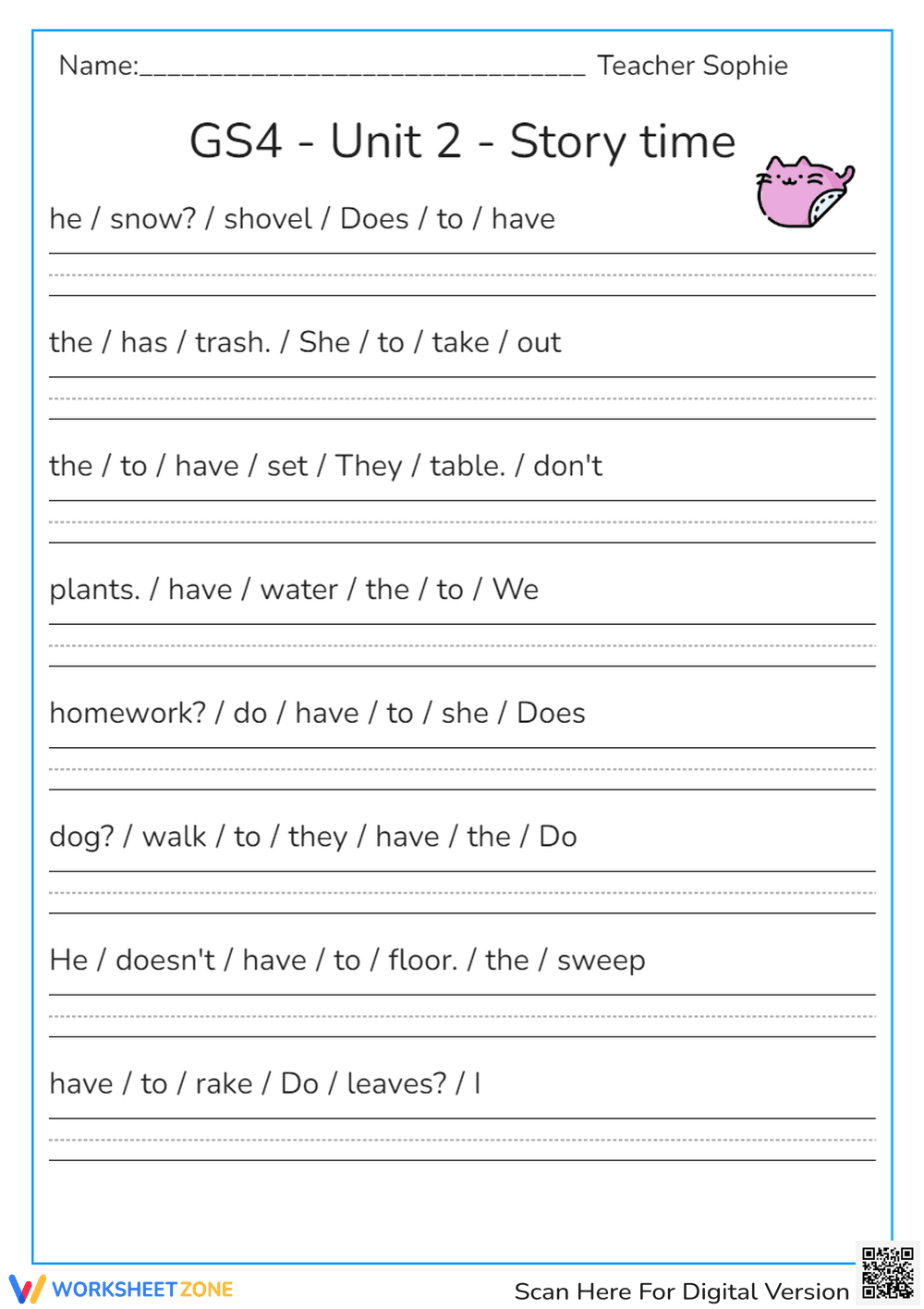
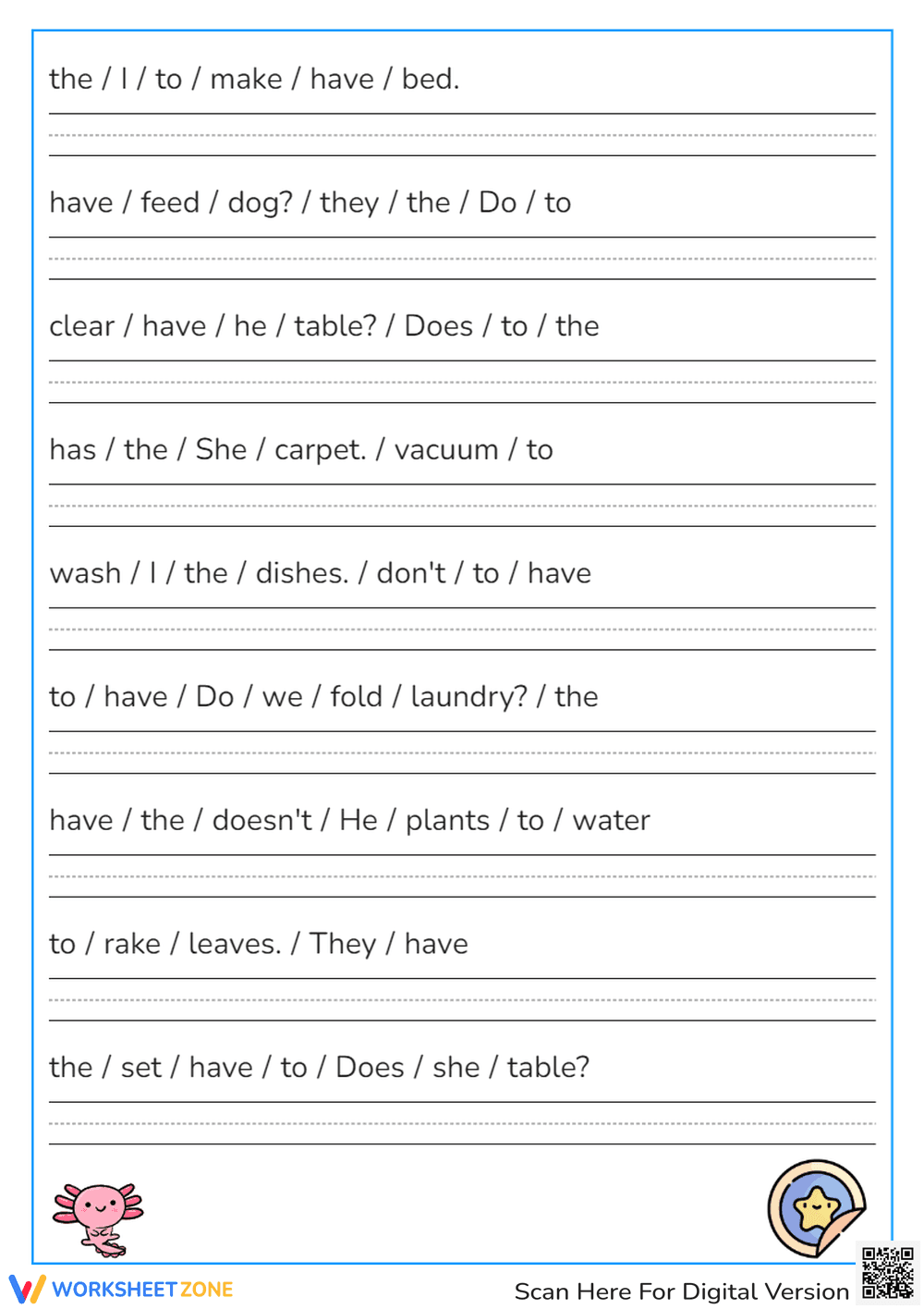
This Grade 3 sentence scramble worksheet helps students master syntax and sentence structure by reordering mixed-up words into coherent statements and questions. By unscrambling these phrases, learners actively practice capitalization, punctuation, and logical word order, building a strong foundation for independent writing and reading comprehension.
At a Glance
- Grade: 3 · Subject: ELA
- Standard:
CCSS.ELA-LITERACY.L.3.1— Produce simple, compound, and complex sentences- Skill Focus: Sentence Structure & Syntax
- Format: 2 pages · 17 problems · PDF
- Best For: Independent practice or morning work
- Time: 15–20 minutes
This resource features two pages of focused grammar practice containing 17 sentence scramble tasks. Each problem presents a series of jumbled words separated by slashes, requiring students to rewrite them in the correct order on the provided handwriting lines. The sentences focus heavily on daily routines and chores, utilizing statements, negative constructions, and question forms. The clear, distraction-free layout includes primary writing lines to support neat penmanship.
Designed for immediate classroom implementation, this worksheet requires absolutely no teacher preparation.
- Print (1 minute): Simply download the PDF and print the two-page set for your class.
- Distribute (1 minute): Hand out the worksheets as students settle into their desks for morning work or a literacy center.
- Review (3 minutes): Go over the first scramble together as a class to model the process of finding the capitalized first word and the ending punctuation.
With a total prep time of under two minutes, this activity is an ideal, stress-free addition to any emergency sub plan or busy Friday afternoon.
This activity is directly aligned to CCSS.ELA-LITERACY.L.3.1, which requires students to demonstrate command of the conventions of standard English grammar and usage when writing or speaking. By organizing words into logical sequences, students implicitly practice subject-verb agreement and proper syntax. Both standard codes can be copied directly into lesson plans, IEP goals, or district curriculum mapping tools.
Teachers can utilize this sentence scramble as an effective morning work activity to activate students' grammar skills right as the bell rings. Alternatively, it serves as a quiet, independent task during literacy rotations while the teacher pulls small groups. As a formative assessment tip, observe which students struggle to identify the capitalized starting word or the punctuation mark that signals the end of the sentence; this often indicates a need for targeted intervention on basic sentence boundaries. Expect students to complete both pages in roughly 15 to 20 minutes.
This worksheet is primarily designed for third-grade students developing their foundational writing and grammar skills. It is also highly beneficial for English Language Learners (ELLs) who need explicit practice with English word order, particularly with question formations and auxiliary verbs. Pair this activity with a mini-lesson or anchor chart on sentence types to maximize student success.
Mastering syntax through activities like sentence scrambles is a critical step in developing fluent writers. Aligned with CCSS.ELA-LITERACY.L.3.1, this resource requires students to produce simple, compound, and complex sentences by organizing jumbled words into logical structures. According to Fisher & Frey (2014), explicit instruction and repeated practice with sentence-level construction significantly improve both reading comprehension and written expression. When students actively manipulate word order, they internalize grammatical rules rather than just memorizing them. This hands-on approach to syntax helps bridge the gap between verbal communication and formal writing. By consistently practicing these foundational skills, young learners build the cognitive automaticity required for more advanced composition tasks in later grades, ensuring they can communicate their ideas clearly and effectively.


