


























Views
Downloads

Printable Complex Sentences Practice | Essential Grade 3 ELA
Paste this activity's link or code into your existing LMS (Google Classroom, Canvas, Teams, Schoology, Moodle, etc.).
Students can open and work on the activity right away, with no student login required.
You'll still be able to track student progress and results from your teacher account.
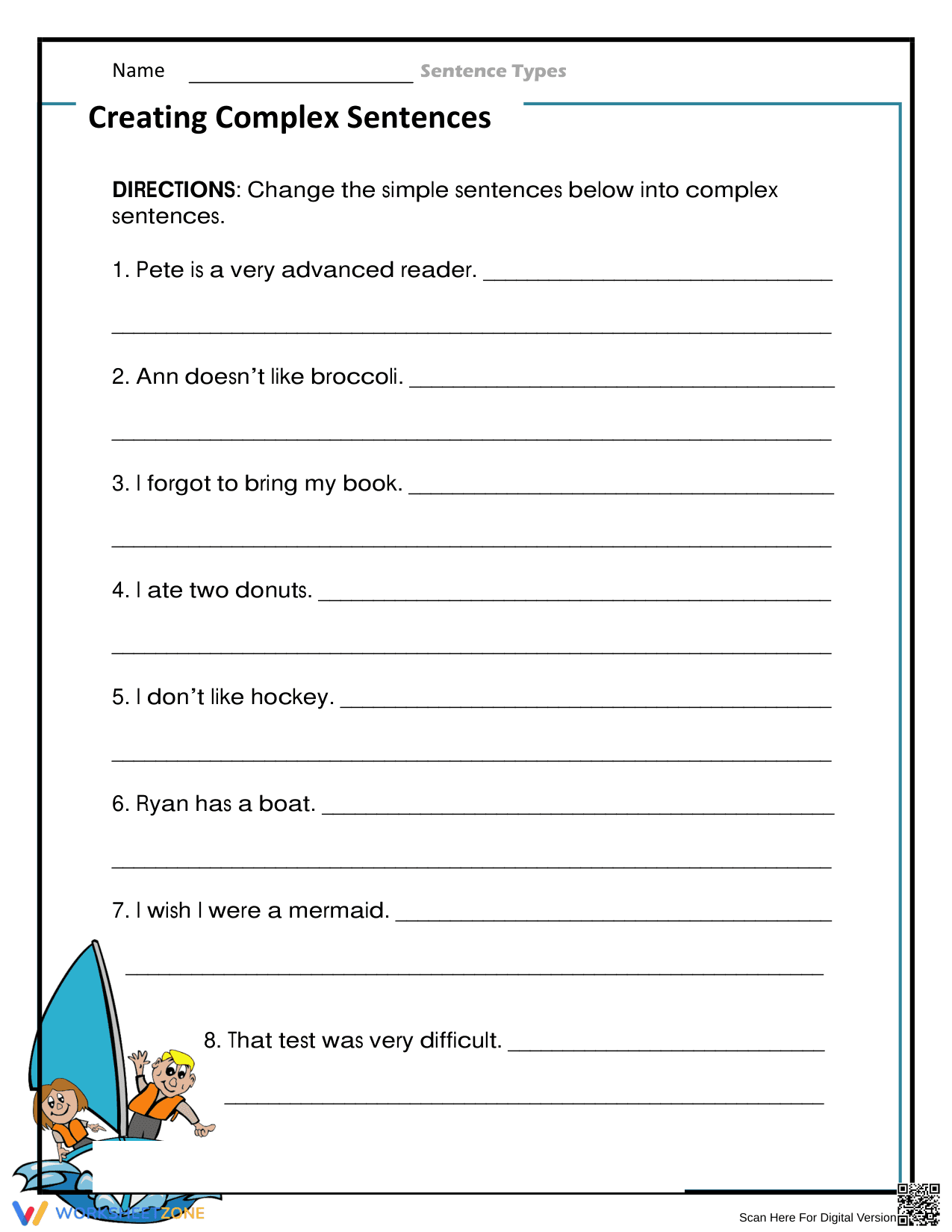
This printable worksheet guides students through the fundamental process of expanding simple thoughts into sophisticated complex sentences. By using subordinating conjunctions to link independent and dependent clauses, learners develop the syntactic variety necessary for academic writing success. This resource ensures students can effectively communicate nuanced relationships between ideas in their compositions.
At a Glance
- Grade: 3 · Subject: English Language Arts
- Standard:
CCSS.ELA-LITERACY.L.3.1.I— Produce simple, compound, and complex sentences to express varied thoughts clearly- Skill Focus: Sentence Structure Transformation
- Format: 1 page · 8 problems · Comprehensive answer key included · PDF Download
- Best For: Independent grammar practice, literacy centers, or homework assignments
- Time: 15–20 minutes of focused classroom work
What's Inside
This single-page PDF resource contains eight distinct simple sentence prompts designed for student transformation. Each item provides a clear independent clause, followed by ample lined space for students to rewrite the statement as a complex sentence. A comprehensive answer key is provided to facilitate rapid grading or student self-correction, ensuring the focus remains on the structural logic of sentence combining.
Zero-Prep Workflow
The streamlined design of this resource minimizes instructional overhead. Teachers can print the required copies in under sixty seconds, distribute them immediately without additional setup, and review student work using the included key in less than two minutes. This efficient workflow makes the worksheet an ideal choice for morning work, literacy centers, or emergency substitute lesson plans.
Standards Alignment
The primary focus is CCSS.ELA-LITERACY.L.3.1.I, which requires students to produce simple, compound, and complex sentences. By practicing these transformations, students demonstrate their understanding of how conjunctions function to create more complex relationships between ideas. This standard code can be copied directly into lesson plans, IEP goals, or district curriculum mapping tools.
How to Use It
Assign this worksheet as a summative check after a direct instruction lesson on subordinating conjunctions such as "because," "although," or "since." During the activity, circulate the room to observe if students are correctly placing commas after introductory dependent clauses. This provides a clear formative-assessment observation tip to gauge mastery of punctuation rules alongside sentence structure.
Who It's For
This resource is specifically crafted for Grade 3 students but serves as an effective intervention tool for Grade 4 or 5 learners who struggle with sentence variety. It pairs naturally with a mentor text passage that illustrates how professional authors use complex sentences to add detail and flow to their storytelling or informational writing.
Sentence-level syntax instruction is a critical component of writing development, as noted in the RAND AIRS 2024 reports on literacy instruction. Developing the ability to create complex sentences allows students to move beyond basic declarative statements to more sophisticated rhetorical structures. Research suggests that explicit practice in sentence combining and transformation, like the 8 tasks provided in this CCSS.ELA-LITERACY.L.3.1.I aligned worksheet, leads to significant gains in overall writing quality and reading comprehension. This worksheet focuses on the specific skill of turning simple sentences into complex ones, which is a foundational requirement for mastering English Language Arts standards in the elementary grades. By providing structured practice with immediate feedback potential through the included answer key, this resource supports the gradual release of responsibility model while ensuring high-quality academic outcomes. Teachers can confidently incorporate this tool into their daily ELA blocks to strengthen student writing.


