




























Views
Downloads

Simple and Compound Sentences | Essential Grade 2 ELA

Paste this activity's link or code into your existing LMS (Google Classroom, Canvas, Teams, Schoology, Moodle, etc.).
Students can open and work on the activity right away, with no student login required.
You'll still be able to track student progress and results from your teacher account.
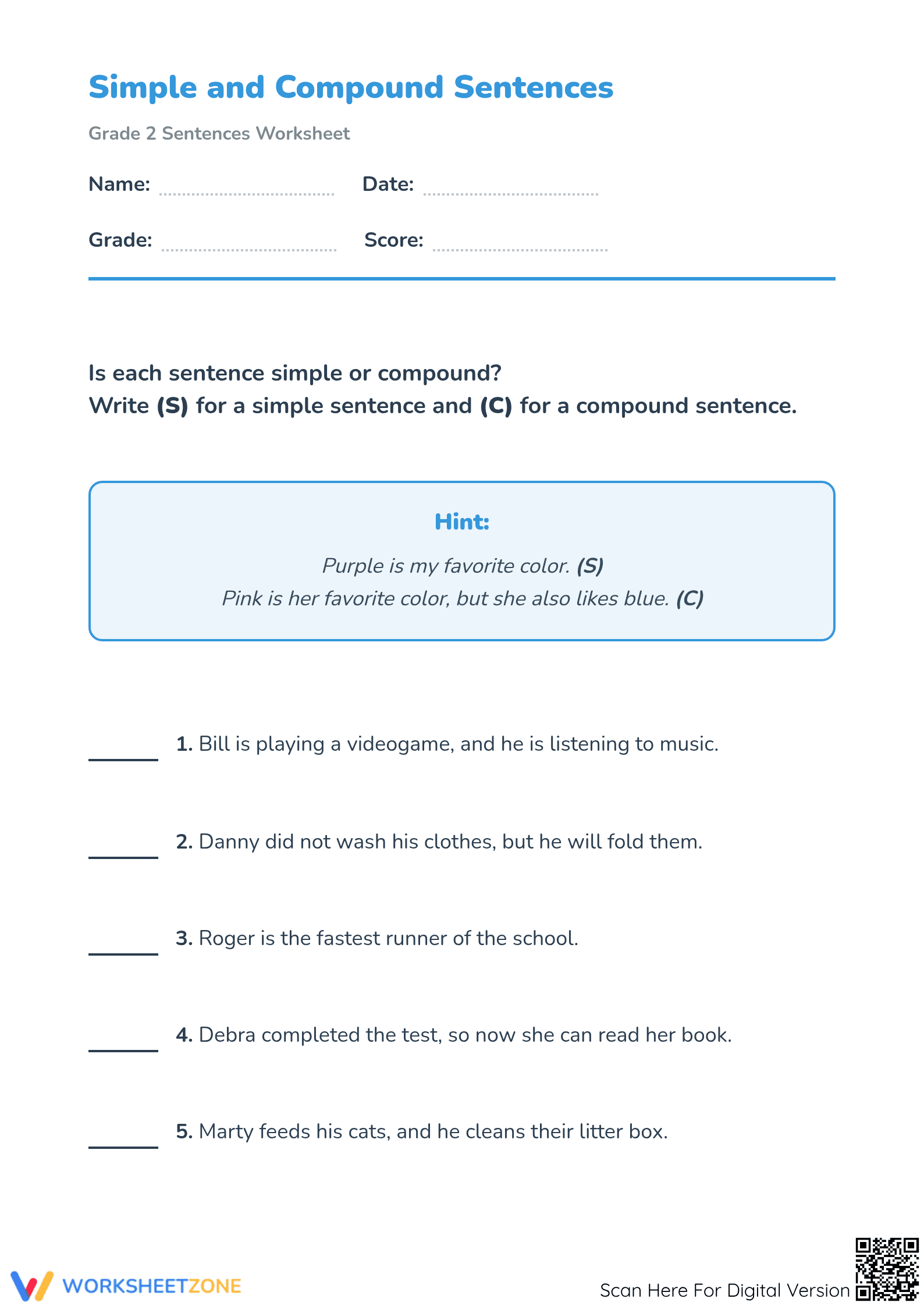
This Grade 2 ELA worksheet helps students distinguish between simple and compound sentences. By identifying independent clauses and coordinating conjunctions, learners build the foundational syntax skills necessary for complex writing. This resource provides clear, focused practice to ensure students can recognize different sentence structures with confidence and accuracy.
At a Glance
- Grade: 2 · Subject: ELA
- Standard:
CCSS.ELA-LITERACY.L.2.1.F— Produce, expand, and rearrange complete simple and compound sentences- Skill Focus: Sentence Structure Identification
- Format: 2 pages · 10 problems · Answer key included · PDF
- Best For: Independent practice or formative assessment
- Time: 15–20 minutes
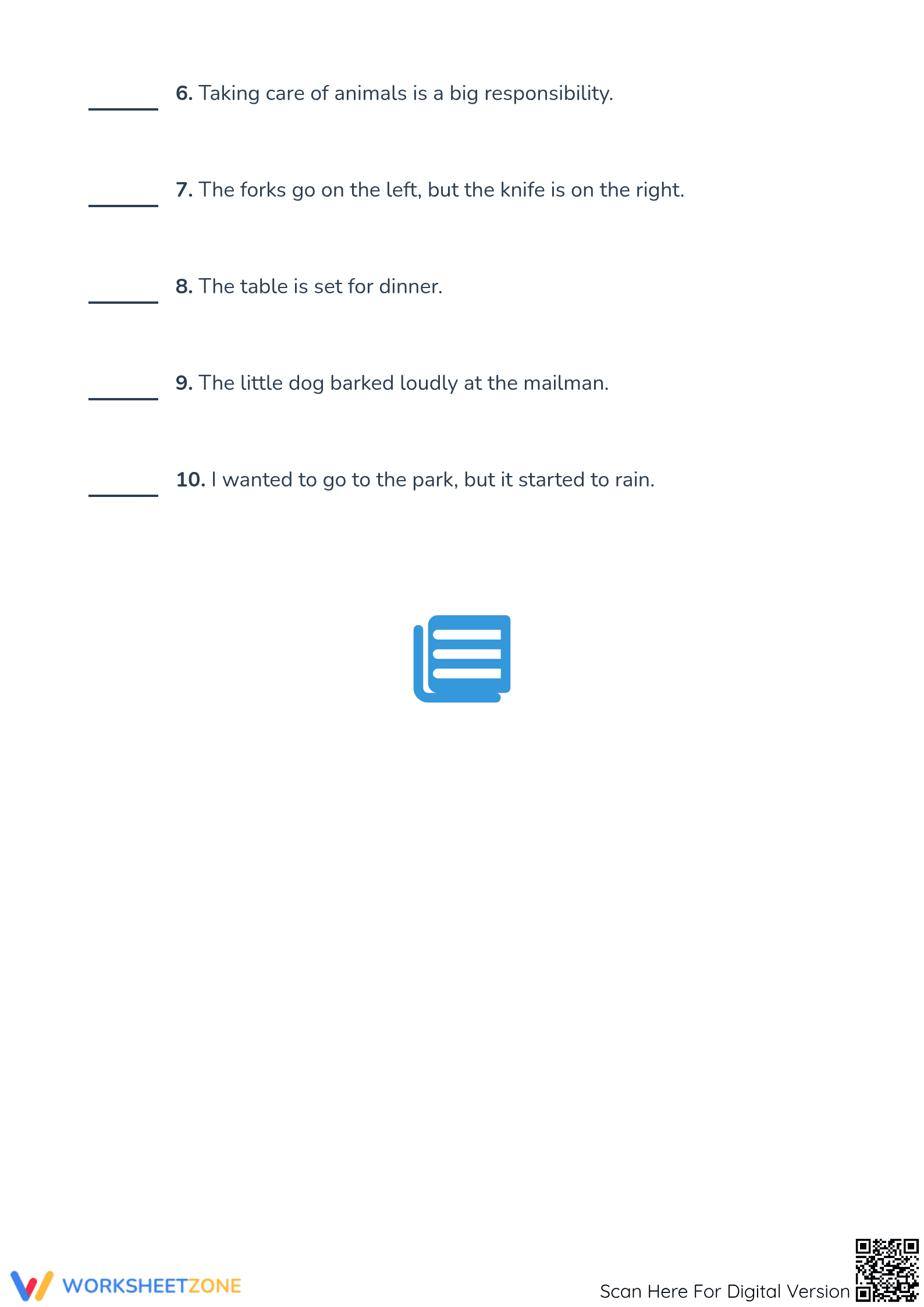
The PDF contains two pages of exercises featuring 10 unique sentences for analysis. Each page includes a clear hint box that provides visual examples of both simple and compound structures to support student memory. A comprehensive answer key is provided, allowing for quick grading or student self-correction during independent work time.
- Guided practice: The worksheet begins with a visual hint box that models the difference between a single clause and joined clauses.
- Supported practice: Students evaluate five initial sentences, using the provided examples as a reference for identifying conjunctions like "and" or "but."
- Independent practice: The second page challenges students with five additional sentences to solidify their understanding without immediate visual cues.
This structure follows a gradual-release model, moving from modeled examples to independent identification.
This resource is specifically aligned to CCSS.ELA-LITERACY.L.2.1.F, which requires students to produce, expand, and rearrange complete simple and compound sentences. By first mastering the identification of these structures, students are better prepared to write their own varied sentences. Both standard codes can be copied directly into lesson plans, IEP goals, or district curriculum mapping tools.
Use this worksheet during the independent practice phase of a lesson on sentence variety. It serves as an excellent formative assessment after a mini-lesson on coordinating conjunctions. Teachers can observe if students are looking for the comma and conjunction signal or if they are reading for multiple subjects and verbs. Expected completion time is 15 to 20 minutes.
This is designed for second-grade students but is also appropriate for third graders needing a grammar refresher or English Language Learners working on syntax. It pairs naturally with a mentor text analysis or an anchor chart highlighting coordinating conjunctions to provide a complete instructional cycle.
According to the RAND AIRS 2024 report, explicit instruction in sentence-level mechanics is a critical predictor of later writing fluency and reading comprehension. This worksheet targets CCSS.ELA-LITERACY.L.2.1.F by requiring students to differentiate between simple and compound sentences, a skill that Fisher & Frey (2014) identify as essential for moving beyond repetitive subject-verb writing patterns. By engaging with 10 targeted examples, students internalize the rhythmic and structural differences between single-clause statements and those joined by coordinating conjunctions. Research from the NAEP indicates that students who master these foundational grammatical structures in early elementary grades demonstrate significantly higher proficiency in complex composition tasks by middle school. This resource provides the high-repetition, low-stakes practice necessary for students to achieve mastery in sentence construction and grammatical accuracy.


