


























Views
Downloads
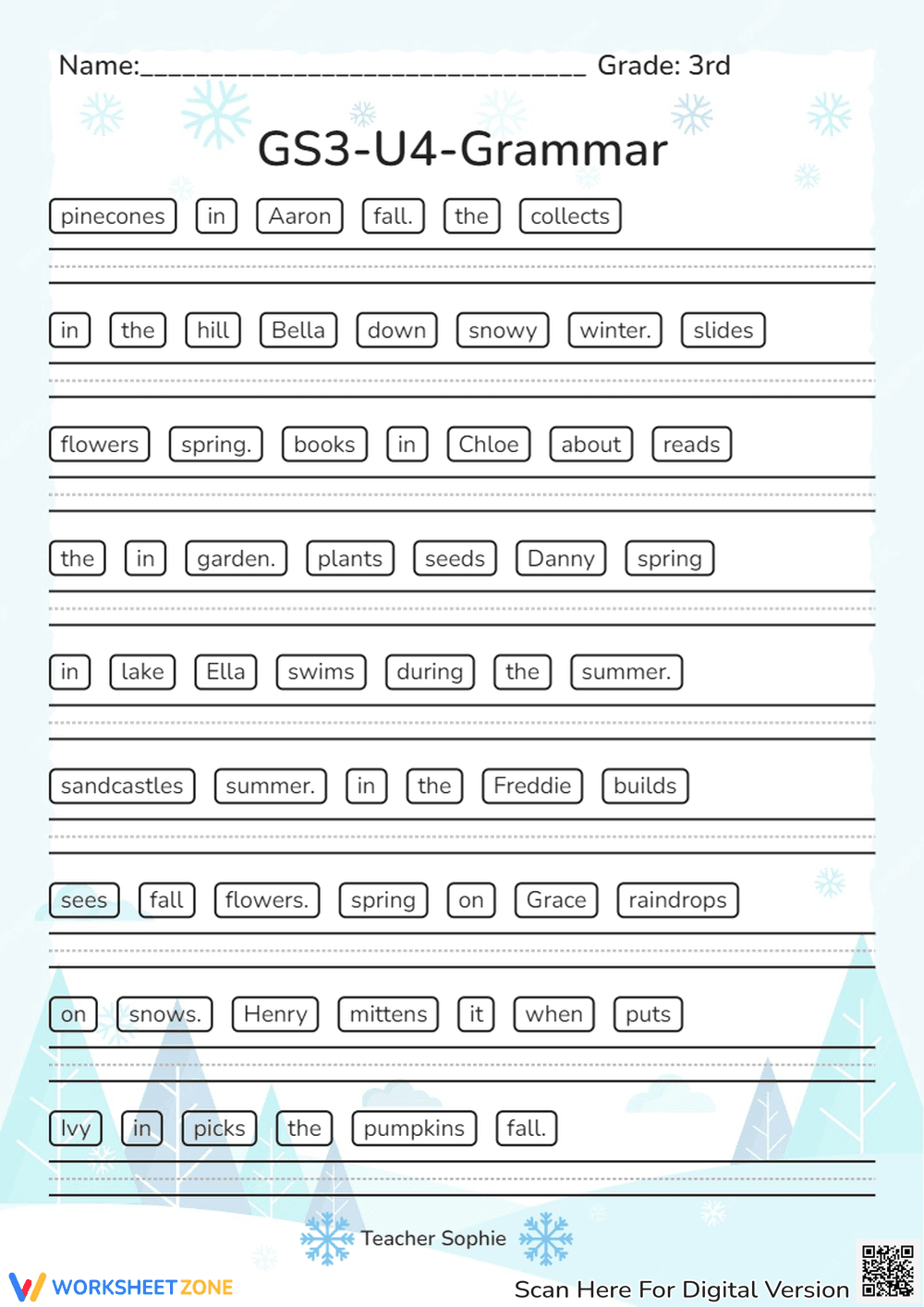

Grade 3 Sentence Scramble — Printable No-Prep Worksheet
Paste this activity's link or code into your existing LMS (Google Classroom, Canvas, Teams, Schoology, Moodle, etc.).
Students can open and work on the activity right away, with no student login required.
You'll still be able to track student progress and results from your teacher account.
This Grade 3 sentence scramble worksheet helps students master syntax and word order through seasonal context. By rearranging jumbled words into coherent sentences, learners strengthen their understanding of subject-verb agreement and punctuation. It provides immediate practice in constructing logical thoughts, ensuring students can communicate clearly in written form while building foundational literacy skills.
At a Glance
- Grade: 3 · Subject: ELA
- Standard:
CCSS.ELA-LITERACY.L.3.1.I— Produce simple, compound, and complex sentences with correct word order- Skill Focus: Sentence structure and syntax
- Format: 1 page · 9 problems · Answer key included · PDF
- Best For: Morning work or grammar centers
- Time: 15–20 minutes
Inside this resource, you will find 9 distinct sentence-building tasks. Each problem features a set of boxed words that students must reorder onto primary-ruled lines. The sentences revolve around seasonal themes like winter, spring, and summer, making the content relatable. The layout includes clear spacing for handwriting practice and a simple header for student identification.
The zero-prep workflow is designed for maximum efficiency. First, print the single-page PDF (30 seconds). Second, distribute the sheets to your class or small group (1 minute). Third, review the completed sentences using the included answer key for immediate feedback (5 minutes). This streamlined process makes it an ideal choice for emergency sub plans or transition periods.
This worksheet aligns with CCSS.ELA-LITERACY.L.3.1.I, which requires students to produce simple, compound, and complex sentences. By focusing on word order and punctuation, it also supports L.3.2 conventions. Both standard codes can be copied directly into lesson plans, IEP goals, or district curriculum mapping tools.
Use this as a formative assessment after a lesson on sentence parts. Observe if students recognize that capitalized words usually start the sentence and periods end them. Alternatively, assign it as a quiet morning work activity to settle the class. Completion typically takes 15 to 20 minutes depending on student writing speed.
This resource is for third-grade students developing their writing mechanics. It is particularly helpful for English Language Learners (ELLs) who need visual support for English syntax. Pair this worksheet with a seasonal anchor chart or a direct instruction lesson on "Who, Doing What, Where" sentence patterns.
Research by Fisher & Frey (2014) emphasizes the importance of scaffolded writing tasks in developing syntactic fluency. This worksheet applies those principles by providing the necessary vocabulary in a "scrambled" format, reducing the cognitive load of word retrieval so students can focus entirely on structural logic. By engaging with 9 specific sentence patterns, learners internalize the rhythmic and grammatical requirements of the English language. This method of deconstruction and reconstruction is a proven strategy for improving writing clarity and confidence in elementary learners. According to the Fisher & Frey framework, such targeted practice bridges the gap between oral language and formal written expression. The inclusion of the CCSS.ELA-LITERACY.L.3.1.I standard ensures that the practice remains rigorous and aligned with national expectations for Grade 3 literacy development, making it a reliable tool for classroom instruction.


