


























Views
Downloads

Compound Sentences Printable Worksheet | Grade 2 ELA
Paste this activity's link or code into your existing LMS (Google Classroom, Canvas, Teams, Schoology, Moodle, etc.).
Students can open and work on the activity right away, with no student login required.
You'll still be able to track student progress and results from your teacher account.
This Grade 2 English Language Arts worksheet helps students master compound sentences by combining simple sentences with coordinating conjunctions. By practicing sentence structure, young learners improve their writing fluency and learn to avoid common grammatical errors. The structured format ensures students build confidence as they progress through the exercises.
At a Glance
- Grade: 2 · Subject: ELA
- Standard:
CCSS.ELA-LITERACY.L.2.1.F— Produce and expand complete simple and compound sentences.- Skill Focus: Compound Sentences
- Format: 4 pages · 20 problems · Answer key included · PDF
- Best For: Independent practice
- Time: 15–20 minutes
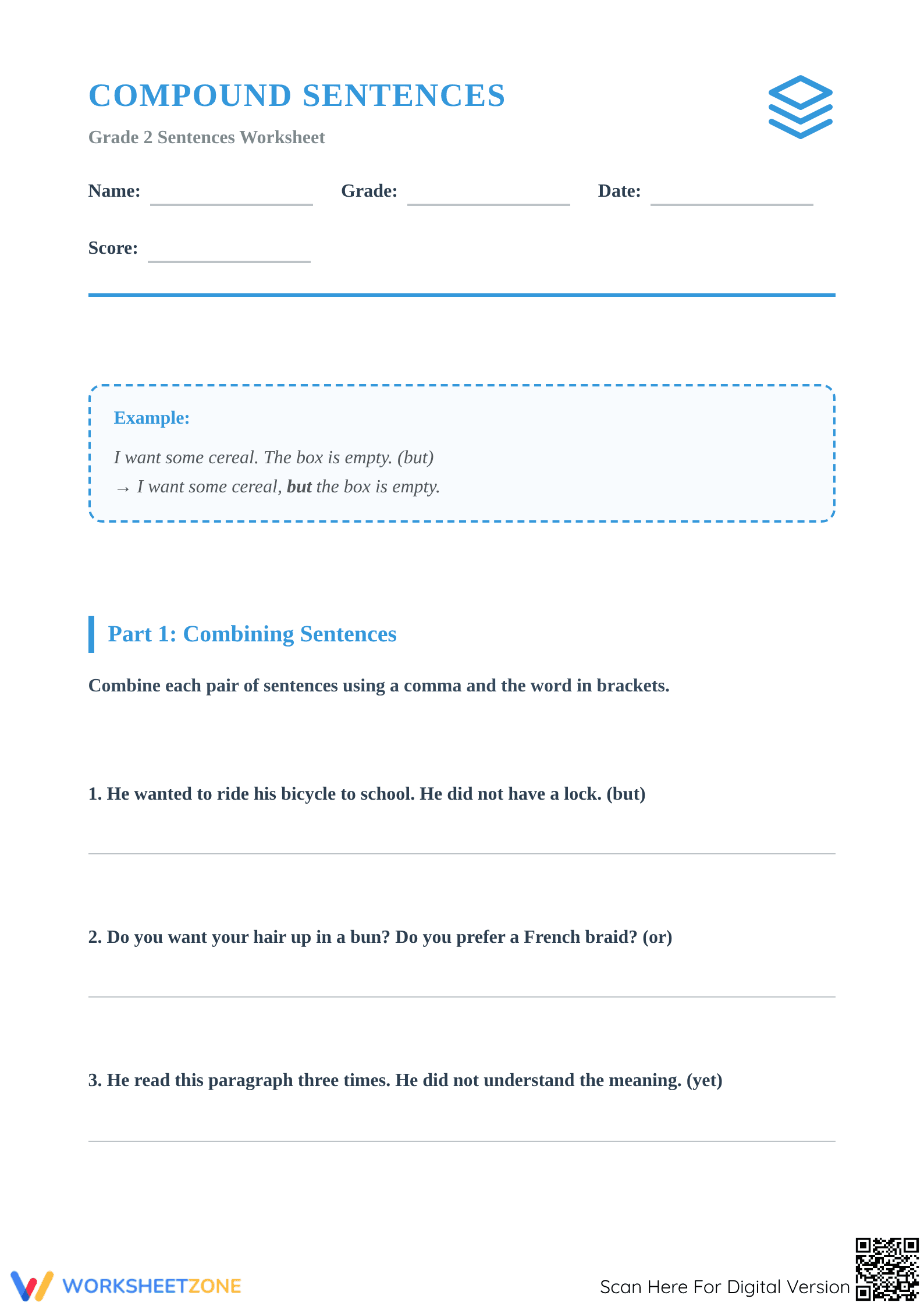
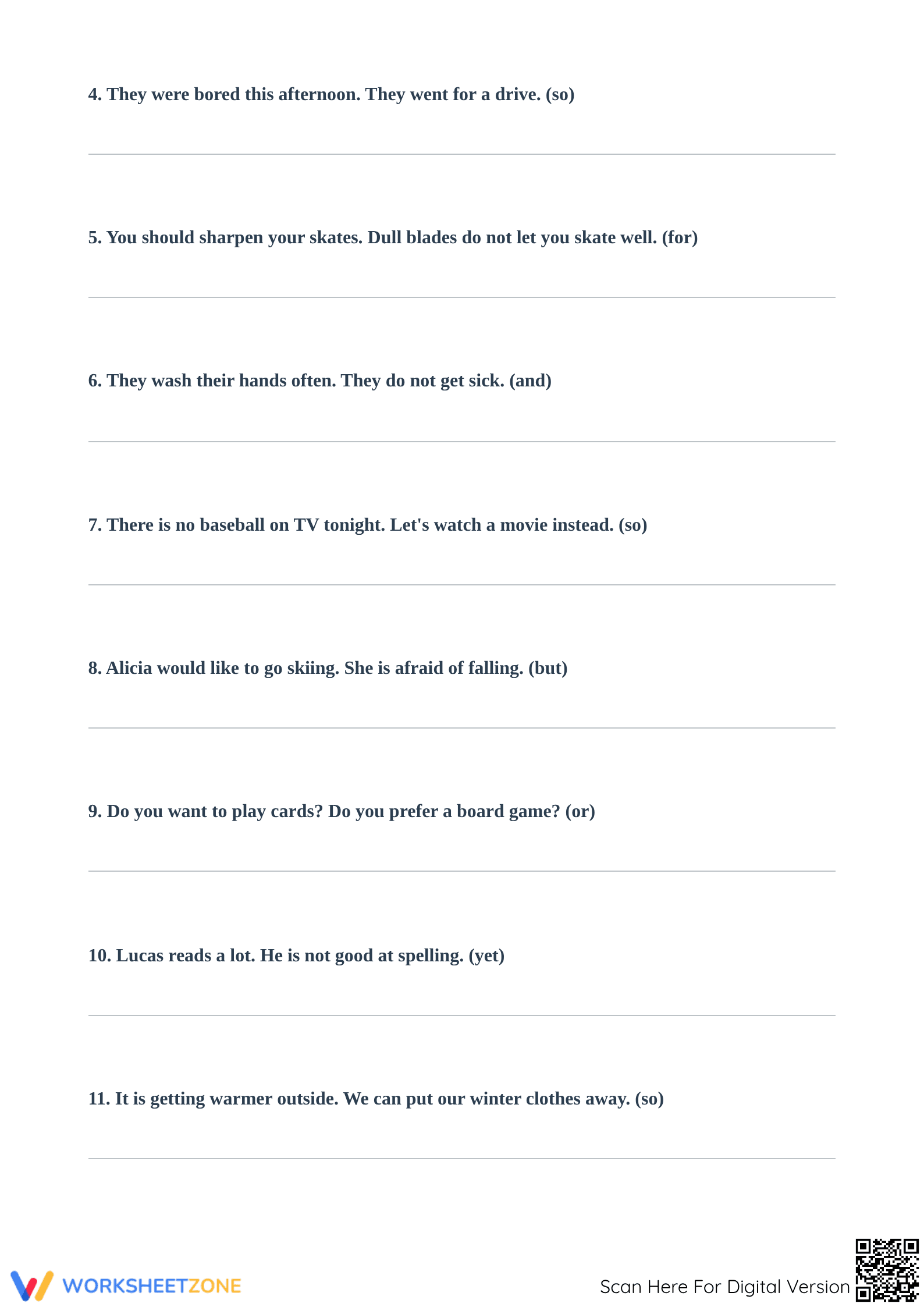
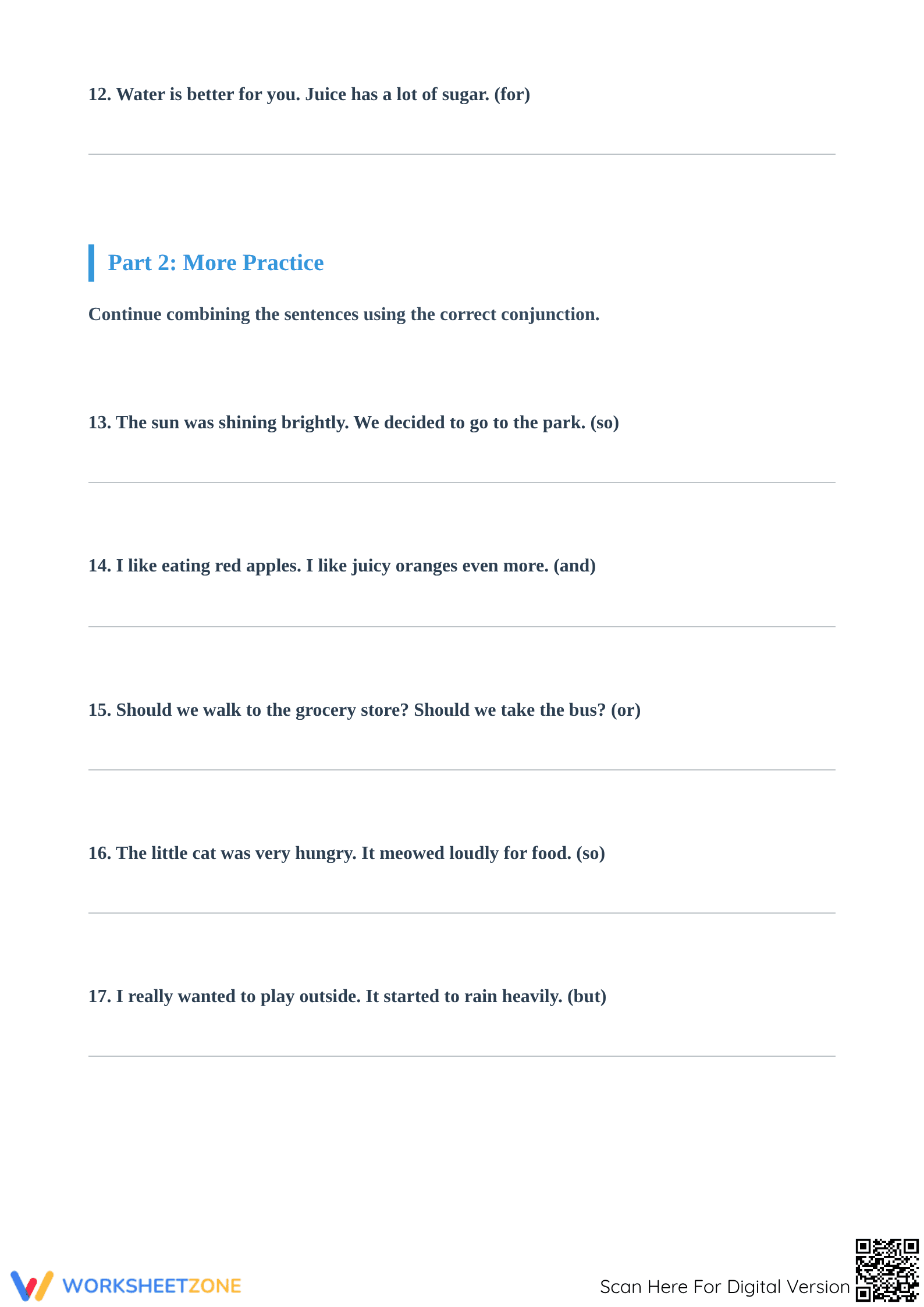
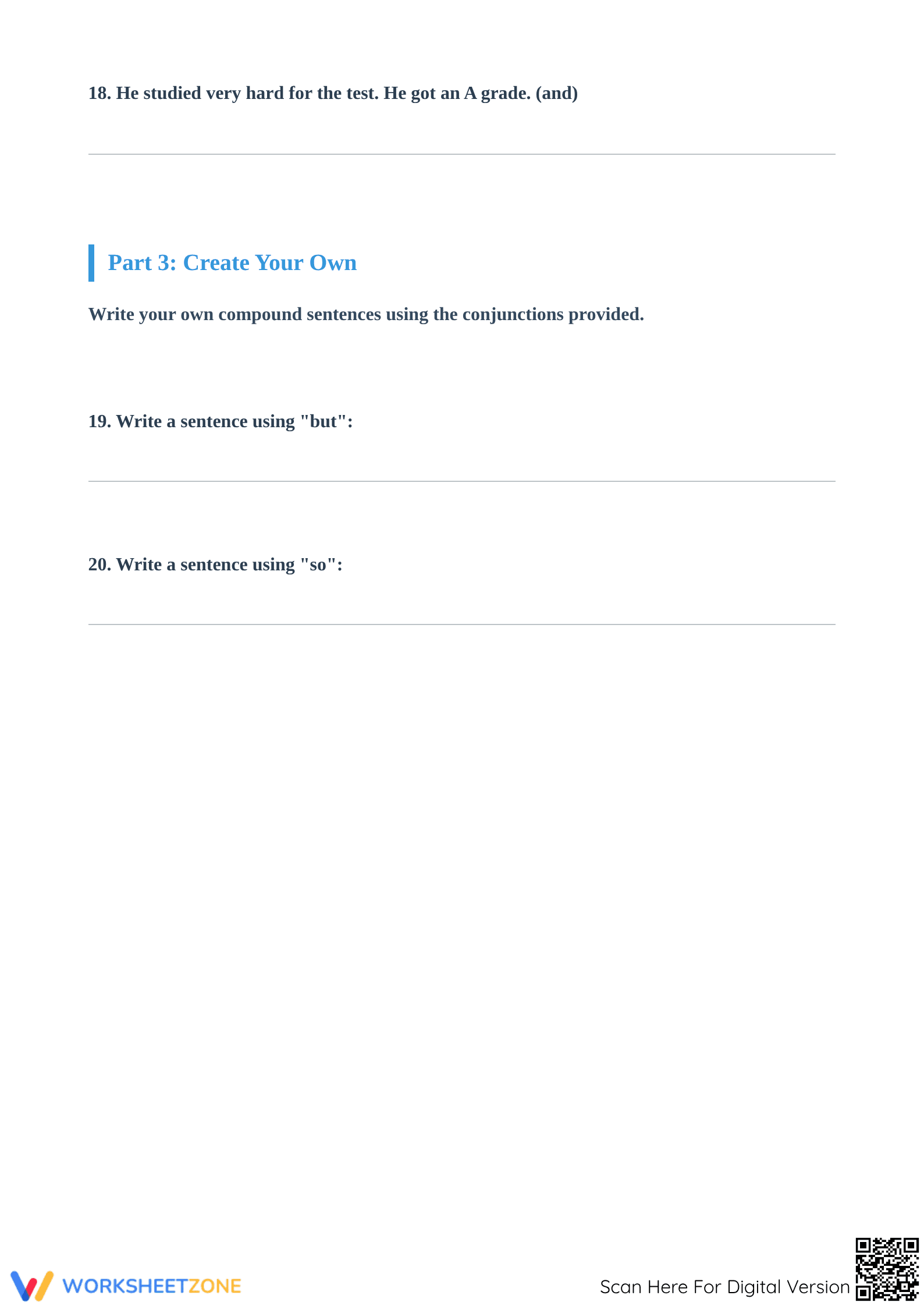
This comprehensive four-page resource features 20 targeted problems divided into three distinct sections. Students begin with a clear worked example showing how to use a comma and a conjunction. The worksheet includes 18 sentence-combining tasks using provided conjunctions in brackets, followed by two open-ended prompts where students create their own compound sentences. A complete answer key is provided for quick grading.
- Guided practice: The worksheet opens with a clear example demonstrating how to combine two simple sentences using a comma and the conjunction "but."
- Supported practice: Parts 1 and 2 provide 18 structured problems where students combine given sentence pairs using specific target conjunctions like "and," "or," "so," "yet," and "for."
- Independent practice: Part 3 challenges students with two open-ended prompts, requiring them to generate their own original compound sentences from scratch using assigned conjunctions.
This gradual-release approach ensures students internalize the mechanics before applying them independently.
This resource is directly aligned to CCSS.ELA-LITERACY.L.2.1.F: Produce, expand, and rearrange complete simple and compound sentences. It specifically targets the use of coordinating conjunctions to join independent clauses. Both standard codes can be copied directly into lesson plans, IEP goals, or district curriculum mapping tools.
Deploy this worksheet during independent practice after direct instruction on coordinating conjunctions. It serves as an excellent follow-up activity to solidify the concept of joining two complete thoughts. Alternatively, use it as a formative assessment tool at the end of a grammar unit. While students work, observe whether they remember to place the comma before the conjunction—a common stumbling block for second graders. Expected completion time is 15 to 20 minutes.
This resource is designed for second-grade general education students, but it also serves as an effective intervention tool for third graders needing foundational grammar review. The clear formatting and explicit examples make it accessible for diverse learners. Pair this worksheet with an anchor chart displaying common coordinating conjunctions to provide additional visual support during the lesson.
Mastering sentence variety is a critical milestone in early elementary writing development. According to Fisher & Frey (2014), providing students with explicit instruction and structured practice in sentence combining significantly improves their overall writing quality and reading comprehension. This resource supports that evidence-based practice by targeting CCSS.ELA-LITERACY.L.2.1.F, requiring students to produce and expand complete simple and compound sentences. By moving from supported combining tasks to independent sentence generation, learners develop the syntactic flexibility necessary for more advanced composition. The targeted use of coordinating conjunctions helps students transition away from choppy, simple sentences toward more fluid and expressive writing. Regular practice with these specific grammatical structures ensures that students can communicate their ideas clearly and effectively across all academic subjects, building a strong foundation for future literacy success.


