


























Views
Downloads
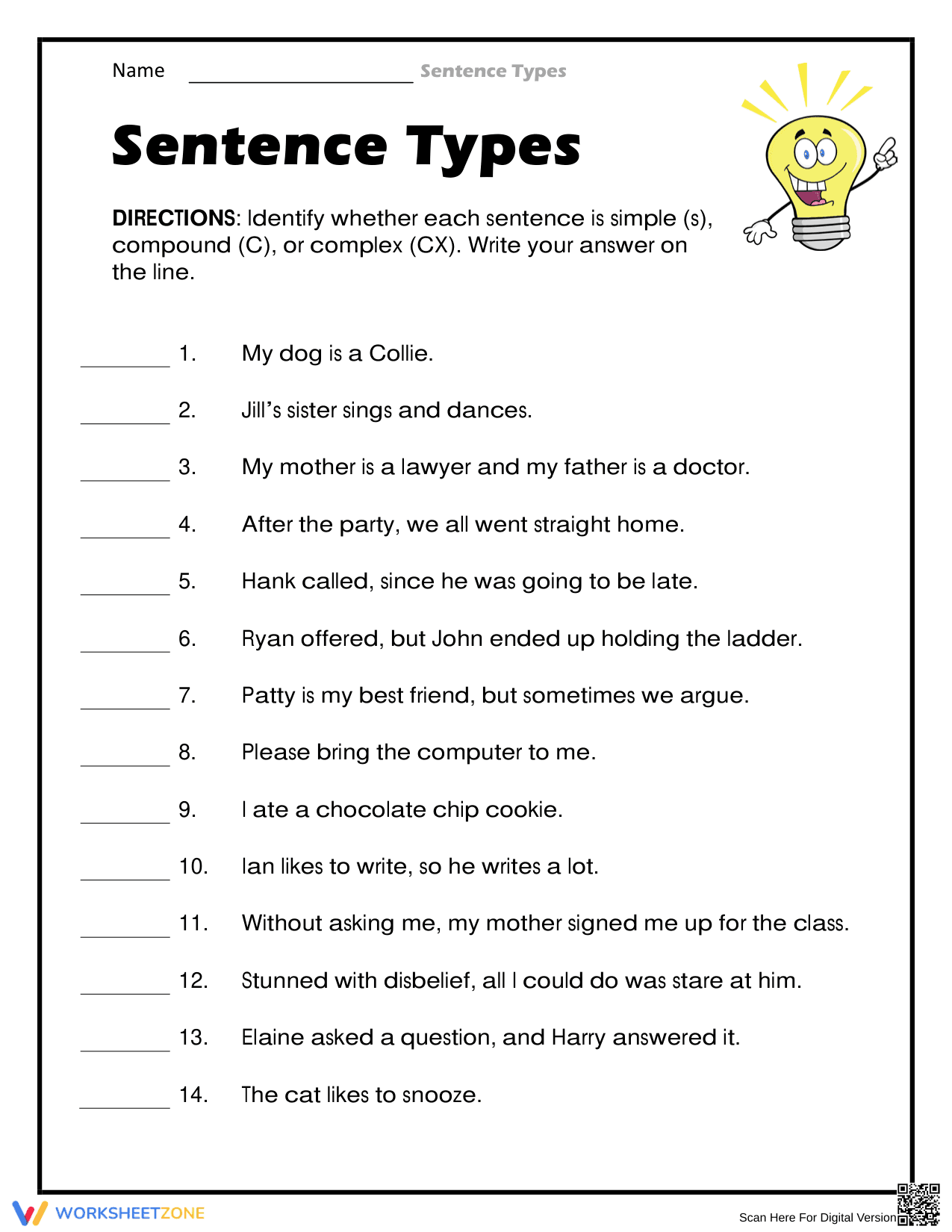

Essential Grade 3 Sentence Types | No-Prep Worksheet
Paste this activity's link or code into your existing LMS (Google Classroom, Canvas, Teams, Schoology, Moodle, etc.).
Students can open and work on the activity right away, with no student login required.
You'll still be able to track student progress and results from your teacher account.
This Grade 3 Sentence Types worksheet provides an essential framework for students to practice classifying syntactic structures. By identifying simple, compound, and complex sentences, learners build the foundational skills necessary for advanced grammar and analytical writing. This exercise focuses on recognizing independent and dependent clauses while improving overall reading comprehension and syntactic awareness.
At a Glance
- Grade: 3 · Subject: ELA
- Standard:
CCSS.ELA-LITERACY.L.3.1.i— Identify and categorize simple, compound, and complex sentence structures- Skill Focus: Sentence Classification
- Format: 1 page · 14 problems · Answer key included · PDF
- Best For: Homework or quick formative assessment
- Time: 15–20 minutes
This single-page resource features 14 diverse sentence examples that challenge students to apply their knowledge of grammar rules. Each item requires the student to write a specific code—S, C, or CX—next to the sentence. The layout is clean and distraction-free, including a helpful word-count equivalent task load that fits perfectly into a single instructional block or quick review session without overwhelming the learner.
Educators can implement this worksheet with minimal effort to maximize instructional time. First, print the single-page PDF. Second, distribute to students for independent practice or a timed quiz. Finally, review as a group to address misconceptions regarding subordinating conjunctions. Total prep time is under two minutes, making it ideal for substitute plans or emergency sub folders during the ELA block.
This resource is directly aligned to CCSS.ELA-LITERACY.L.3.1.i, which requires students to produce and identify simple, compound, and complex sentences. It also supports related standards in language acquisition and conventions of standard English. This standard code can be copied directly into lesson plans, IEP goals, or district curriculum mapping tools to ensure compliance with state frameworks and school-wide literacy initiatives.
Use this worksheet as a formative assessment after introducing sentence types with a mentor text. It is highly effective during the independent practice phase of a lesson. Teachers can observe if students confuse compound and complex sentences, using the 14 items to identify specific intervention needs. Completion typically takes 15 minutes, allowing for immediate feedback and classroom review.
This resource is designed for Grade 3 but works well for Grade 4 review or Grade 2 enrichment. It is beneficial for English Language Learners navigating clause structures and coordinating conjunctions. Pair this with a mentor text to find these patterns in real-world writing or use it as a warm-up for a creative writing task to encourage variety in student drafting.
The classification of sentence structures—simple, compound, and complex—is a critical milestone in elementary literacy development, directly influencing a student's ability to interpret nuanced texts and produce sophisticated writing. This Grade 3 worksheet aligns with CCSS.ELA-LITERACY.L.3.1.i, requiring students to identify various syntactic patterns. According to Fisher & Frey (2014), the gradual release of responsibility model is most effective when students engage in repetitive classification tasks before transitioning to independent sentence construction. By isolating 14 distinct examples, students develop the mental schema necessary to recognize coordinating and subordinating conjunctions in context. Research from the NAEP underscores that mastery of complex sentence structures in the early grades is a strong predictor of later reading comprehension success. This resource provides the high-frequency practice needed to bridge the gap between basic fluency and analytical writing, ensuring that learners are prepared for the rigorous demands of upper-elementary standardized assessments and complex narrative tasks.


