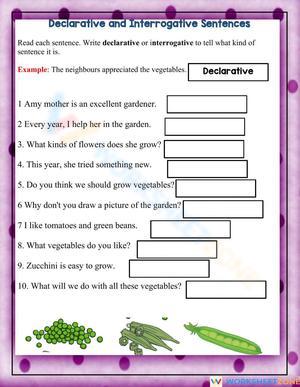
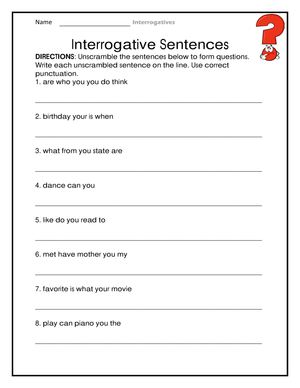
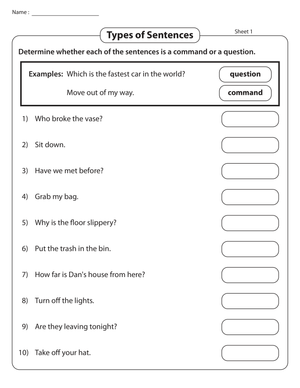
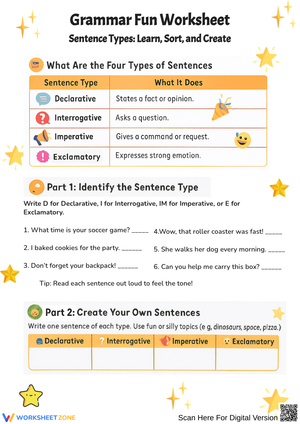
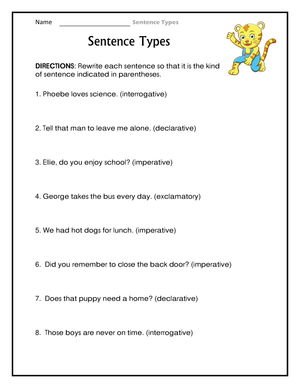
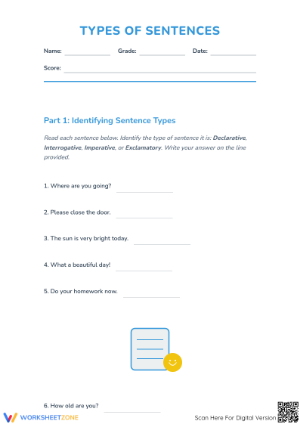
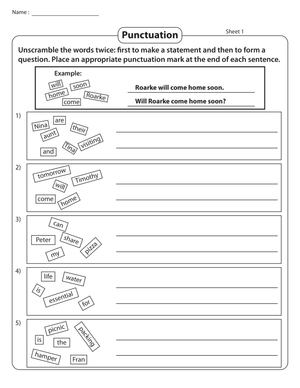
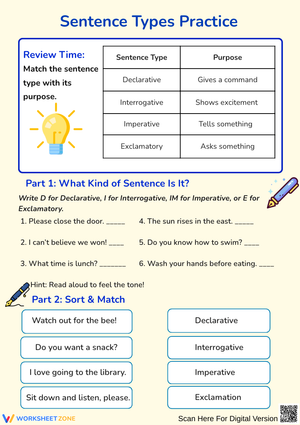
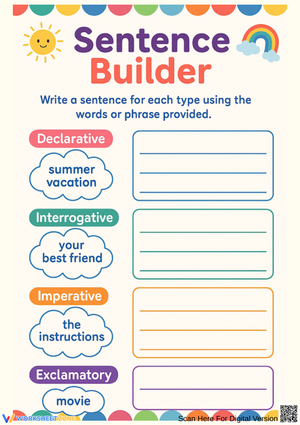
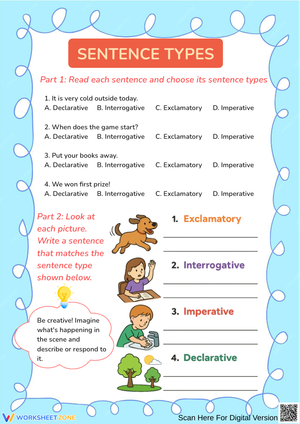
These 3rd grade types of sentences pdf worksheets cover all four sentence types — declarative, interrogative, imperative, and exclamatory — through identification, punctuation practice, and sentence transformation tasks that move students from recognition into actual application. Teachers get a print-ready set that works across multiple lesson formats: direct instruction support, literacy center rotation, or formative check-in. The skills build directly into the sentence-variety work that third-grade writing standards require.
Skills These Worksheets Build
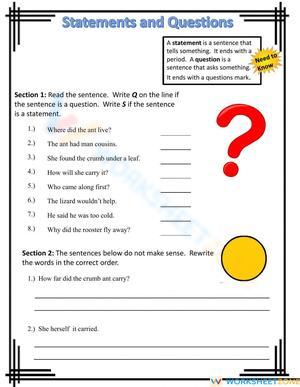
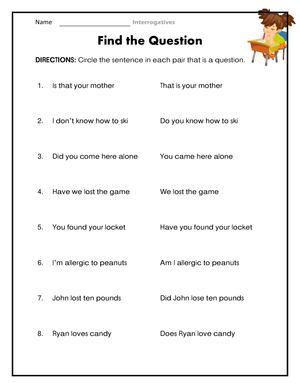
Each worksheet targets a specific task rather than asking students to review all four types at once. Sorting worksheets have students read a set of sentences and classify each one — straightforward when students have the definitions fresh, harder when the sentences involve structural nuances like commands without an explicit subject. Punctuation worksheets present sentences with end marks removed; students add the correct mark and write a short explanation for their choice. That explanation step is what reveals whether a student understands the sentence's function or is just pattern-matching on words like "why" and "how."
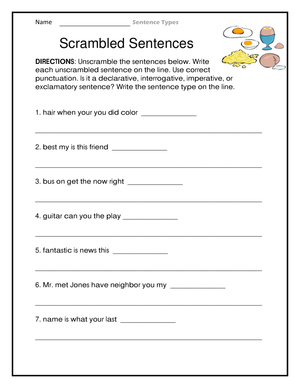
The transformation tasks go a step further. Students take a declarative sentence and rewrite it as a question, a command, or an exclamation — which requires manipulating word order, dropping or adding subjects, and choosing punctuation deliberately. Those tasks belong later in a sentence-type unit, once students have enough command of each type to make meaningful structural changes rather than just swapping the period for a question mark.
Student Errors Worth Anticipating and Addressing
The most consistent confusion at this grade level is between declarative and imperative sentences. Both often end in a period, and students sorting by punctuation alone will lump them together. The deeper issue is the "understood you" — in a sentence like "Feed the cat," the subject is invisible, and nothing in the visible structure cues students that this works differently from "She feeds the cat." Explicit instruction on this concept before assigning imperative-focused worksheets saves a lot of frustration.
Exclamation points create a separate and surprisingly persistent problem. Third graders arrive having learned "use an exclamation point for excitement," and they apply this rule broadly. What they haven't absorbed is that true exclamatory sentences carry a specific structure: they frequently begin with What or How followed by a noun phrase ("What a long race that was!") rather than a standard subject-verb sequence with emphatic punctuation tacked on. A student who writes "I love pizza!" is expressing enthusiasm, but they are writing a declarative sentence. The worksheets surface this distinction directly, which is worth addressing early before students lock in the wrong definition.
Working These Worksheets Into Your Lesson Plans
The most effective sequencing introduces sentence types in pairs rather than all at once. Declarative and interrogative sentences contrast cleanly — one makes a statement, one asks a question — so presenting them together gives students an immediate comparison anchor in the first lesson. Imperative sentences need their own instructional moment because the understood-subject concept requires time to settle. Exclamatory sentences come last, with a deliberate class conversation about when exclamation points reflect grammatical structure versus when they reflect enthusiasm alone. Distribute 3rd grade types of sentences pdf worksheets at each stage so students have focused practice before the next type is introduced.
For the transition window after specials or the last few minutes before dismissal, identification tasks make useful low-stakes review. A worksheet where students read six sentences and write one letter beside each — D, I, Imp, or E — takes three minutes and immediately shows which students are still guessing. The transformation worksheets are better suited to the sustained focus of a grammar block or literacy center, where students have time to work through word-order changes and try more than one version before committing to an answer.
Standard Alignment
This set aligns primarily with CCSS.ELA-LITERACY.L.3.1.I, which requires third graders to produce simple, compound, and complex sentences. Sentence-type practice is the developmental groundwork for that standard: students need a working understanding of what sentences do before they can consciously combine and expand them. The punctuation work across the set also connects to CCSS.ELA-LITERACY.L.3.2, the conventions standard covering capitalization, punctuation, and spelling. In classroom terms, the skills practiced here feed directly into the editing phase of the writing process — students who can identify an imperative sentence on a worksheet are better positioned to recognize when they've accidentally dropped the subject in their own writing.
Adjusting the Set for a Range of Learners
Students who need more support do best starting with sorting and identification tasks. Give them a reference card that lists each sentence type, its function, and its end punctuation — not as a permanent aid but as a working memory support while the underlying concepts are still taking hold. The 3rd grade types of sentences pdf worksheets that focus on labeling and sorting are the right entry point; hold the transformation tasks until a student can classify sentences reliably without the card.
For students who move through identification quickly, sentence transformation becomes a meaningful challenge. Ask them to write a four-sentence paragraph using exactly one of each sentence type, then underline and label each sentence. The constraint forces deliberate structural thinking rather than default writing habits. Students ready for a further stretch can examine sentences that carry structural ambiguity: "Stay here." reads as imperative when addressed to a person but as declarative on a posted sign. That kind of discussion sits outside the standard scope, but it's a natural extension for students who have genuinely mastered the four types and need somewhere to go.
Frequently Asked Questions
Do all the worksheets cover all four sentence types together, or does each worksheet focus on one type at a time?
Both kinds are in the set. Some worksheets isolate a single type — these work well during the introduction phase when students are building familiarity with one concept before moving to the next. Others ask students to identify and sort sentences across all four types, which is more appropriate once instruction on the full set is complete. Teachers can sequence the worksheets according to where their class is in the unit rather than working through them in a fixed order.
How do the worksheets address the difference between a true exclamatory sentence and a declarative sentence that ends with an exclamation point?
Several worksheets include this comparison directly because the distinction matters for both grammar accuracy and writing quality. Students examine sentence pairs and explain in writing why one is exclamatory and the other is not. The written explanation is deliberate — labeling alone doesn't reveal whether a student understands the grammatical structure or is simply reacting to the punctuation mark at the end.
Are these worksheets usable in a pull-out or resource room setting?
The 3rd grade types of sentences pdf worksheets work well in those settings because each one stands alone — a specialist teacher can assign a single worksheet based on the exact skill a student needs without building on prior work in the set. There is no running context or narrative that carries from one worksheet to the next, which makes them practical for targeted intervention sessions as well as take-home reinforcement after a pull-out lesson.












 Interactive Worksheet Maker
 Quiz Maker
 Word Search Maker
 Crossword Puzzle Maker
 Word Scramble Generator
 Sentence Scramble Generator
 Handwriting Worksheet Generator
 Name Tracing Generator
 Fill In The Blank Generator