


























Views
Downloads
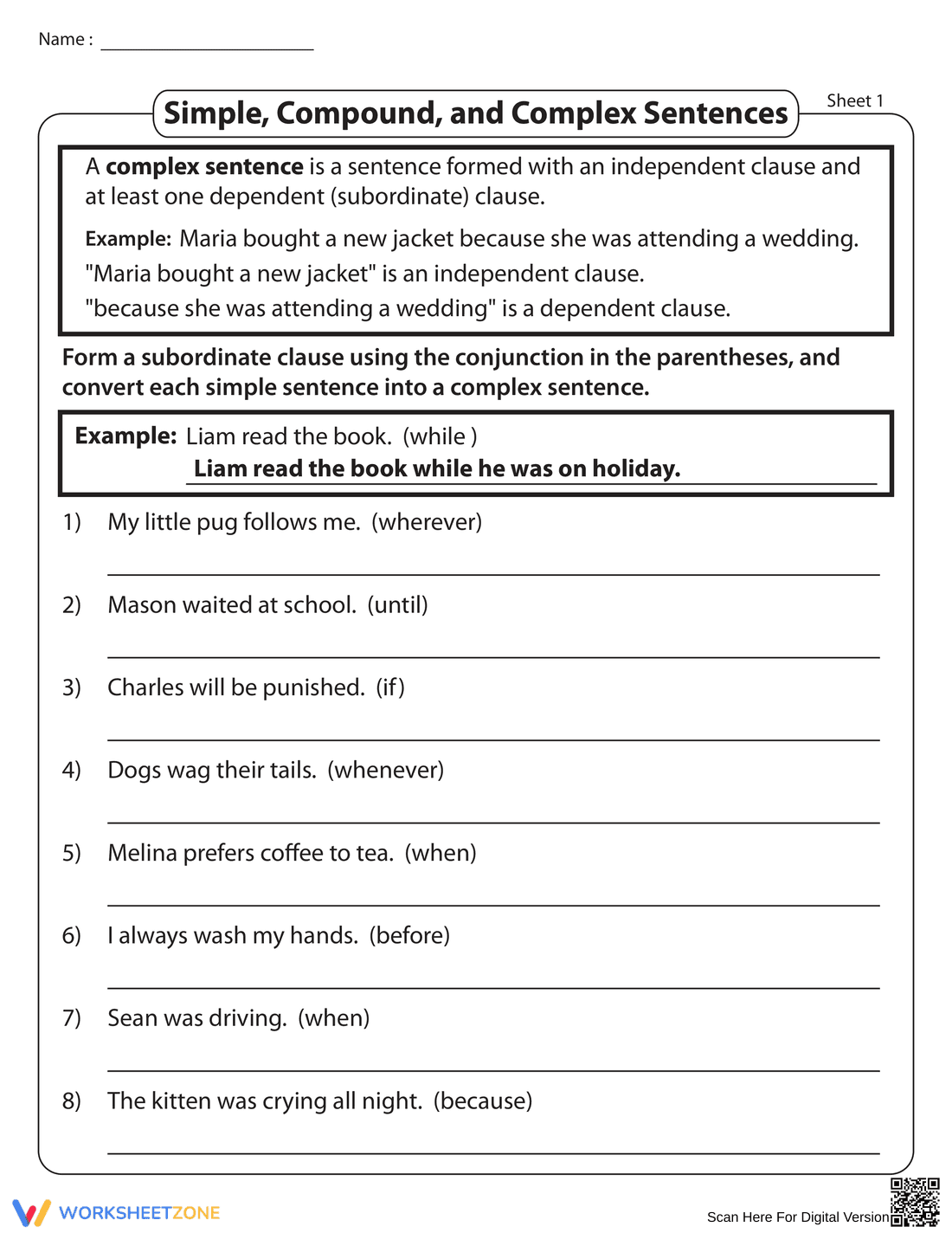

Essential Complex Sentences Worksheet | Grades 3-5 Aligned
Paste this activity's link or code into your existing LMS (Google Classroom, Canvas, Teams, Schoology, Moodle, etc.).
Students can open and work on the activity right away, with no student login required.
You'll still be able to track student progress and results from your teacher account.
This printable complex sentences worksheet empowers students in Grades 3-5 to master advanced sentence structures. By adding dependent clauses to simple sentences using subordinating conjunctions, learners develop the ability to express complex relationships between ideas. This focused practice ensures students can transform basic writing into sophisticated, varied prose while meeting core language standards.
At a Glance
- Grade: 3-5 · Subject: ELA
- Standard:
CCSS.ELA-LITERACY.L.3.1.I— Produce simple, compound, and complex sentences to express varied ideas- Skill Focus: Subordinate Clause Formation
- Format: 1 page · 8 problems · Answer key included · PDF
- Best For: Independent writing practice or sub plan
- Time: 15–20 minutes
This resource contains a comprehensive one-page practice sheet designed for immediate classroom use. It begins with a clear, student-friendly definition of a complex sentence, distinguishing between independent and subordinate clauses with a worked example. The primary task requires students to convert eight simple sentences into complex ones using specific conjunctions provided in parentheses, such as "wherever," "until," and "because."
The zero-prep design of this worksheet makes it an ideal choice for busy educators or emergency sub plans. To implement, follow these three steps: Print (1 minute), Distribute (1 minute), and Review (5 minutes). With a total teacher prep time of under 2 minutes, this resource allows you to provide high-quality grammar instruction without any additional material gathering or complex setup.
This worksheet is primarily aligned with CCSS.ELA-LITERACY.L.3.1.I, which requires students to produce simple, compound, and complex sentences. It also supports Grade 4 and 5 standards regarding sentence fluency and command of standard English grammar. By focusing on the mechanics of subordinate clauses, students build the foundational skills necessary for more advanced writing. Both standard codes can be copied directly into lesson plans, IEP goals, or district curriculum mapping tools.
Utilize this worksheet as a formative assessment after an initial lesson on subordinating conjunctions. As students work, circulate to observe if they are correctly placing commas before or after clauses depending on the sentence structure. It also serves as an excellent "do now" activity or a quiet choice for early finishers, typically taking about 15 to 20 minutes to complete with high accuracy.
This resource is designed for Grade 3, 4, and 5 students who are ready to move beyond simple sentence construction. It is particularly helpful for English Language Learners (ELLs) who benefit from the scaffolded approach of using provided conjunctions. Pair this worksheet with a short reading passage, asking students to identify complex sentences in the text before creating their own on this sheet.
Aligned with CCSS.ELA-LITERACY.L.3.1.I, this complex sentences worksheet focuses on the critical skill of producing varied sentence structures through subordinate clause formation. Research from Fisher & Frey (2014) emphasizes that the gradual release of responsibility—moving from worked examples to independent practice—is essential for students to master linguistic complexity. By providing 8 structured opportunities to combine ideas, this resource directly supports the development of syntactic maturity. Syntactic variety is a key indicator of writing proficiency in Grades 3-5, as students shift from "learning to write" to "writing to communicate" nuanced information. This worksheet provides the specific, measurable practice required to meet CCSS goals for language conventions. Educators can reliably use this tool to track student progress in sentence-level composition, ensuring they are prepared for the more demanding writing tasks found in middle school curricula.


