




























Views
Downloads
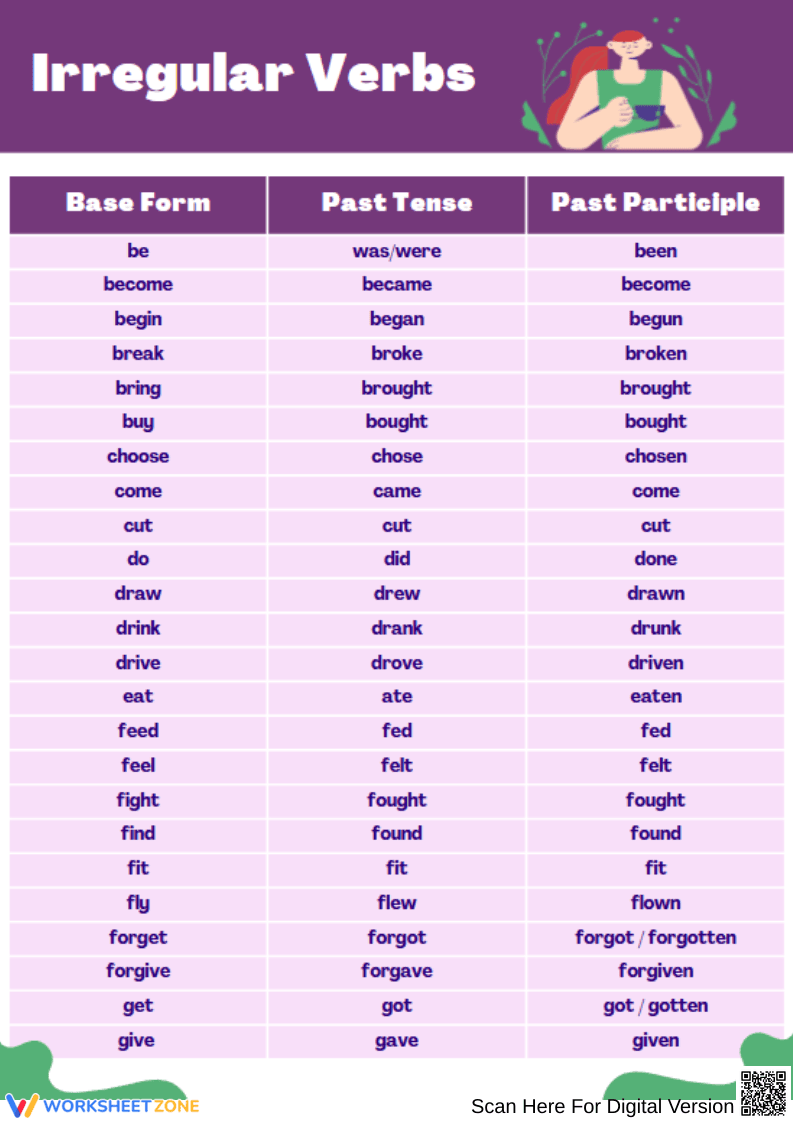


Irregular Verbs List Worksheet | Grade 4 Printable

Paste this activity's link or code into your existing LMS (Google Classroom, Canvas, Teams, Schoology, Moodle, etc.).
Students can open and work on the activity right away, with no student login required.
You'll still be able to track student progress and results from your teacher account.
This printable irregular verbs reference chart builds Grade 3–5 students' command of base forms, past tense, and past participles for 50 high-frequency irregular verbs. Students study and apply three principal parts per verb, building the automaticity needed for accurate writing and editing aligned to CCSS.ELA-LITERACY.L.4.1.B.
At a Glance
- Grade: 3–5 · Subject: ELA — Grammar
- Standard:
CCSS.ELA-LITERACY.L.4.1.B— Form and use the progressive verb tenses and irregular past forms correctly- Skill Focus: Irregular verb principal parts: base, past tense, past participle
- Format: 2 pages · 50 verb entries · Answer key included · PDF
- Best For: Grammar reference, writing workshop anchor
- Time: 15–25 minutes
The worksheet spans 2 pages and presents 50 irregular verbs in a three-column chart: base form, simple past, and past participle. The clean tabular layout doubles as a study reference and a fill-in practice tool. An answer key is included so students can self-check or teachers can use it for quick scoring.
Skill Progression
- Guided practice: Teacher models 5–8 high-frequency verbs (go/went/gone, do/did/done) using the chart as a visual anchor before students work independently.
- Supported practice: Students complete partially filled rows (base form given; past and participle blank) for 20 mid-frequency verbs with a word bank on the reverse.
- Independent practice: Students recall all three principal parts for 22 less common verbs (e.g., shrink/shrank/shrunk) without scaffolding, demonstrating internalized knowledge.
This gradual-release structure mirrors the I Do, We Do, You Do model, moving students from observation to application to independent recall across a single sitting.
Standards Alignment
Primary standard: CCSS.ELA-LITERACY.L.4.1.B — students form and use the progressive verb tenses and correctly produce irregular past-tense and past-participle forms in writing. Supporting standard CCSS.ELA-LITERACY.L.3.1.E addresses forming and using simple verb tenses, making this chart equally valid for Grade 3 instruction. Both standard codes can be copied directly into lesson plans, IEP goals, or district curriculum mapping tools.
How to Use It
Use the chart before direct instruction as a pre-assessment: ask students to fill in as many past and participle forms as they can in 5 minutes, then review gaps whole-class. Use it after instruction as a timed fluency drill — students who complete all 50 rows in under 20 minutes demonstrate solid automaticity. Formative tip: scan column 3 (past participle) first; errors there signal students conflating simple past with participle, a common Grade 4 misconception. Expected completion: 15–25 minutes.
Who It's For
Primary audience: Grade 3–5 students building verb fluency for narrative and informational writing. Strong fit for English learners who benefit from explicit principal-parts instruction. Pairs naturally with a mentor-text passage that uses irregular verbs in context (e.g., a historical narrative) or an irregular-verb anchor chart posted during writing workshop.
Irregular verb mastery is a documented predictor of writing accuracy in upper elementary grades. CCSS.ELA-LITERACY.L.4.1.B requires students to form and use irregular verb principal parts — base, past, and past participle — correctly in writing. NAEP 2022 data show that fewer than 40% of Grade 4 students score at or above Proficient in writing conventions, with verb-form errors among the most frequent surface-level mistakes flagged by scorers. Fisher & Frey (2014) identify explicit, repeated exposure to high-frequency irregular forms as a high-leverage grammar routine when embedded in authentic writing contexts. This 2-page, 50-verb chart provides that structured exposure in a format teachers can deploy as a reference tool, a fill-in drill, or a timed fluency check — making it a practical, research-grounded addition to any Grade 3–5 grammar sequence.


