




























Views
Downloads
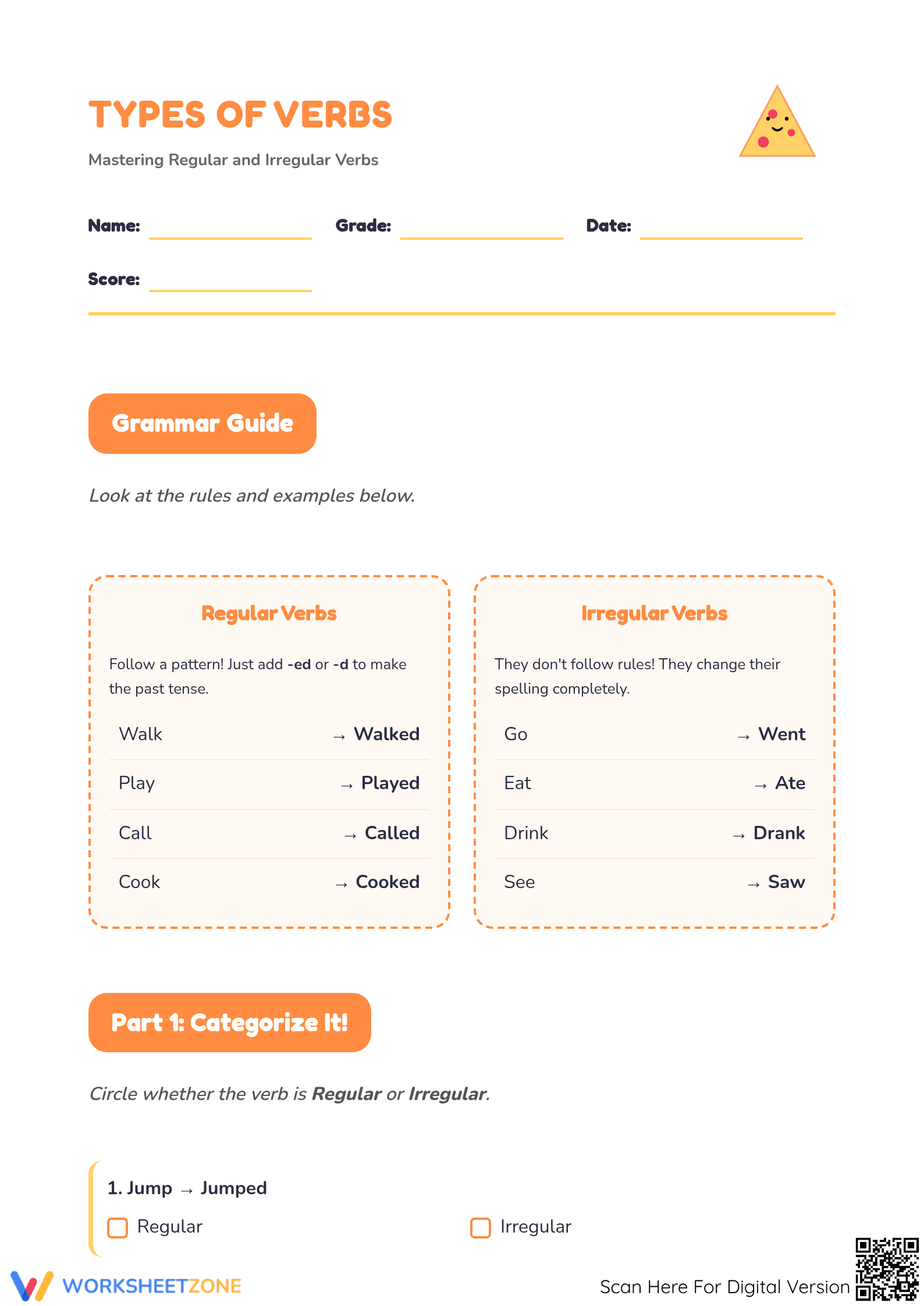



Regular vs. Irregular Verbs Printable Worksheet | Grade 3

Paste this activity's link or code into your existing LMS (Google Classroom, Canvas, Teams, Schoology, Moodle, etc.).
Students can open and work on the activity right away, with no student login required.
You'll still be able to track student progress and results from your teacher account.
This comprehensive regular and irregular verbs worksheet helps third and fourth-grade students master past tense verb forms. By transitioning from basic categorization to sentence writing, learners build the foundational grammar skills necessary for clear, effective communication and accurate narrative writing.
At a Glance
- Grade: 3 · Subject: ELA
- Standard:
CCSS.ELA-LITERACY.L.3.1.D— Form and use regular and irregular verbs- Skill Focus: Regular vs. Irregular Verbs
- Format: 5 pages · 22 problems · Answer key included · PDF
- Best For: Independent grammar practice
- Time: 25–35 minutes
This five-page packet features a built-in grammar guide that reviews the rules for forming past tense verbs, making it highly self-directed. Students will work through 22 distinct tasks divided into four parts: categorizing verbs, completing a past tense table, filling in sentence blanks, and writing a mini-story. A complete answer key is included to ensure quick and accurate grading.
- Guided practice: The worksheet opens with a clear reference guide and a simple categorization task (5 problems) where students identify verbs as regular or irregular.
- Supported practice: Students then complete a past tense table (8 problems) and fill in sentence blanks (8 problems), applying the rules with clear structural support.
- Independent practice: The final "Mini Story" challenge requires students to generate their own sentence using both a regular and an irregular verb in context.
This gradual-release approach ensures students build confidence before applying the grammar rules independently.
This resource is directly aligned to CCSS.ELA-LITERACY.L.3.1.D, requiring students to form and use regular and irregular verbs. It also supports broader writing standards by encouraging accurate sentence construction. Both standard codes can be copied directly into lesson plans, IEP goals, or district curriculum mapping tools.
Deploy this packet during your primary grammar block after a brief direct instruction lesson on verb tenses. It also functions perfectly as a standalone homework assignment or a reliable activity for a substitute teacher, thanks to the included reference guide. As students work through the sentence challenge, observe whether they overgeneralize the "-ed" rule to irregular verbs—this provides excellent formative assessment data. Expect students to complete the entire packet in 25 to 35 minutes.
This worksheet is designed for third and fourth-grade students developing their foundational language skills. The built-in grammar guide provides essential scaffolding for English Language Learners (ELLs) and students who need visual reminders of spelling changes. Pair this resource with a short narrative reading passage so students can hunt for irregular verbs in published texts.
Mastering the distinction between regular and irregular verbs is a critical milestone in early elementary language development. According to Fisher & Frey (2014), providing students with structured, gradual-release grammar practice significantly improves their ability to transfer these skills into independent writing. This resource targets CCSS.ELA-LITERACY.L.3.1.D, ensuring students can accurately form and use regular and irregular verbs in context. By moving learners from basic identification to applied sentence generation, the worksheet prevents common morphological errors, such as over-applying the "-ed" suffix. Consistent practice with these verb forms reduces cognitive load during composition, allowing young writers to focus on meaning and narrative structure rather than basic mechanics. This targeted approach builds the automaticity required for reading comprehension and fluent, effective communication across all academic subjects.


