




























Views
Downloads
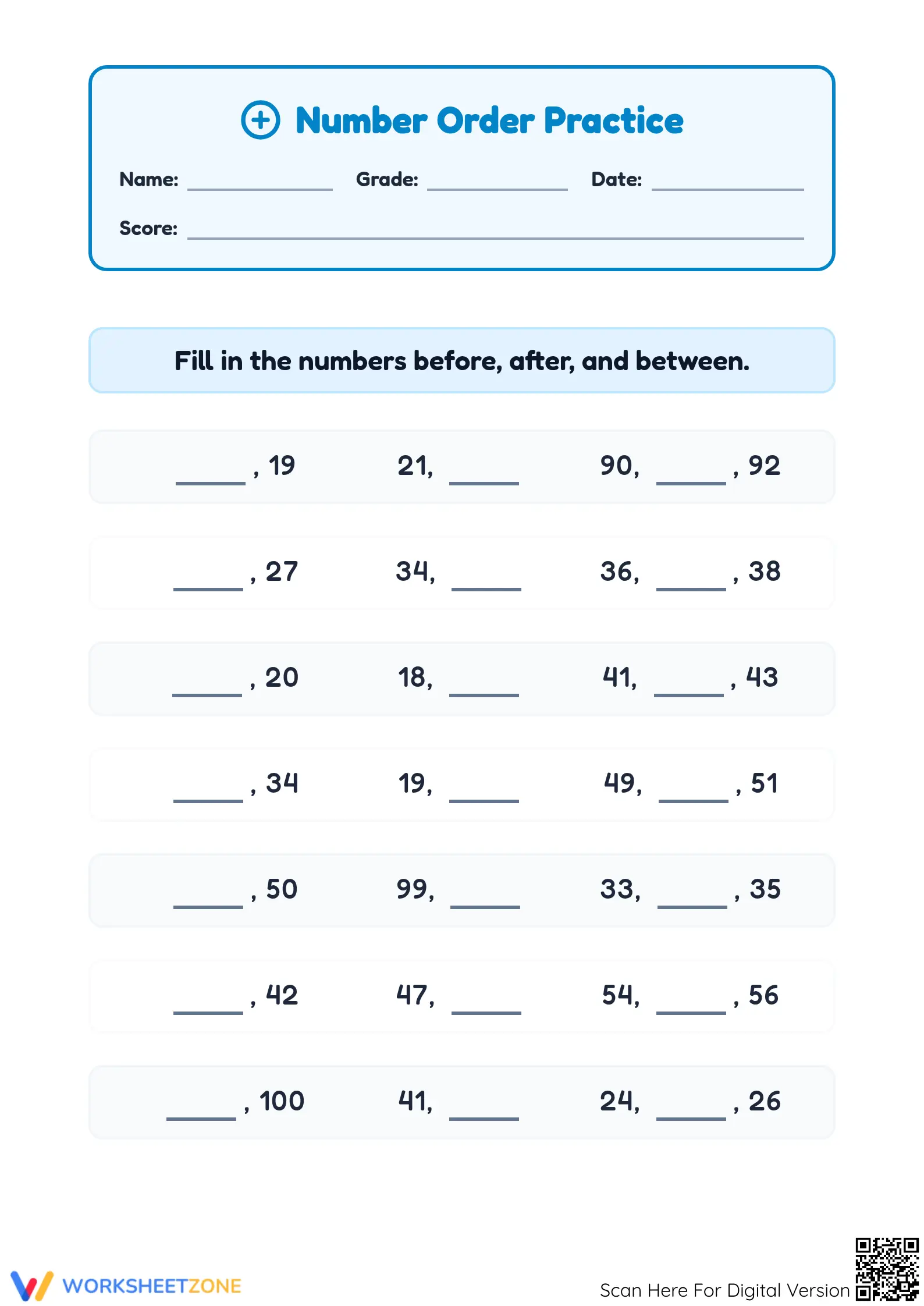
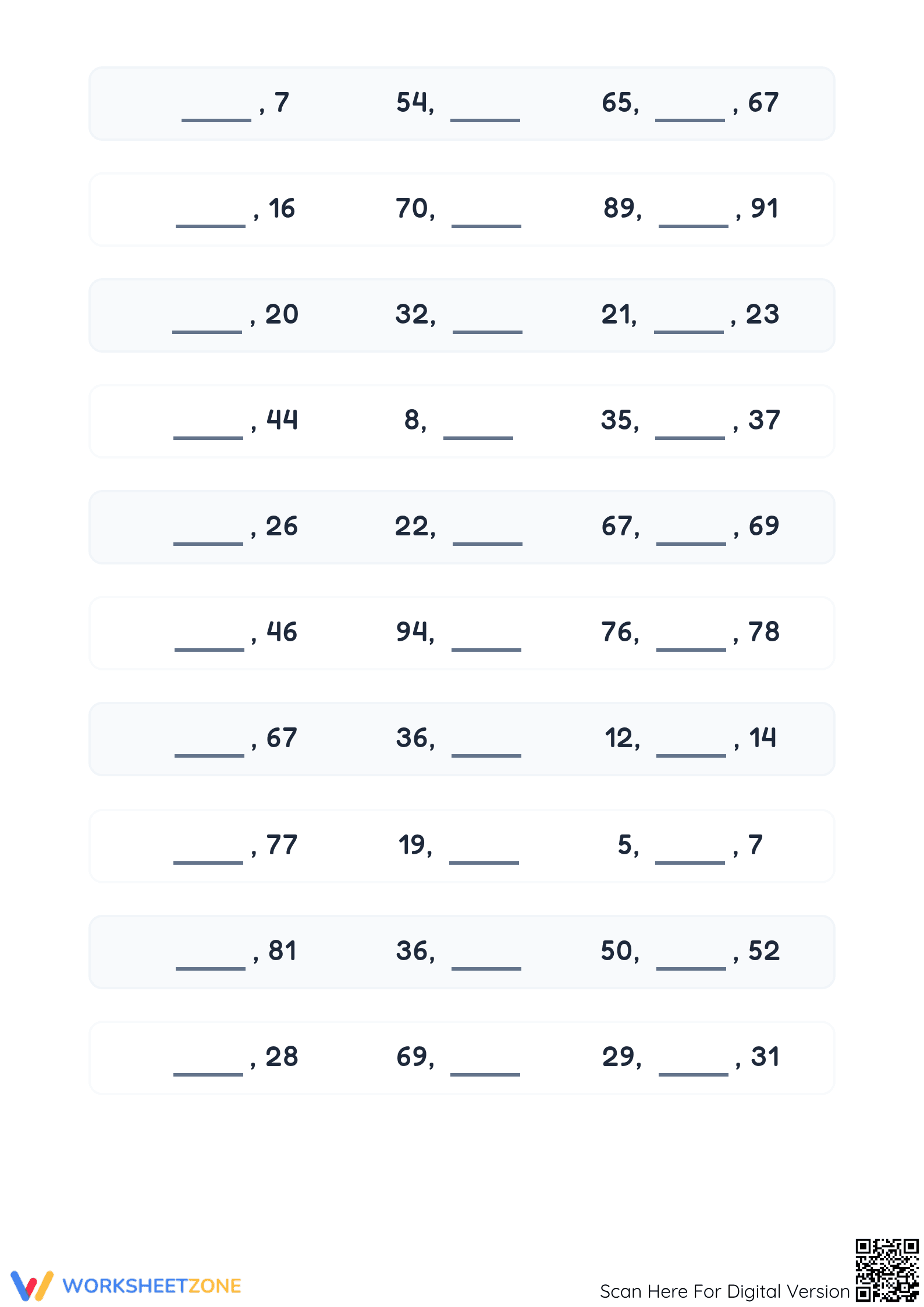


Printable Number Order Practice: Before, After, Between

Paste this activity's link or code into your existing LMS (Google Classroom, Canvas, Teams, Schoology, Moodle, etc.).
Students can open and work on the activity right away, with no student login required.
You'll still be able to track student progress and results from your teacher account.
This comprehensive Grade 2 math worksheet helps students master number sequencing and positional value for numerals up to 100. By identifying numbers that come before, after, and between given values, learners build a strong mental number line and improve their numerical fluency. This essential practice ensures students can confidently navigate the base-ten system and prepare for more complex operations.
At a Glance
- Grade: 2 · Subject: Math
- Standard:
1.NBT.A.1— Count to 120, starting at any number less than 120- Skill Focus: Number Sequencing and Position
- Format: 3 pages · 57 problems · Answer key included · PDF
- Best For: Daily morning work or remedial review
- Time: 15–25 minutes
What's Inside
This three-page PDF collection features 57 individual practice problems organized into a clean, repetitive layout designed to reduce cognitive load and focus on the core task. Each page presents three columns of horizontal number strings where students fill in the missing numeral. The booklet includes a complete answer key for rapid grading and covers numbers from 1 through 100, providing a thorough review of the first century of counting.
Skill Progression
- Guided Practice: The worksheet begins with identifying immediate successors and predecessors for single-digit and low double-digit numbers, establishing the basic pattern of increments.
- Supported Practice: Students move into mid-range numbers between 30 and 70, focusing on identifying "between" values and managing tricky transitions between tens.
- Independent Practice: The final sections involve numbers approaching 100, reinforcing the gradual-release model of instruction as students apply their knowledge to larger values.
This sequence supports the "I Do, We Do, You Do" instructional framework by slowly increasing the numerical complexity while maintaining the same familiar task structure.
Standards Alignment
The primary standard for this resource is 1.NBT.A.1, which requires students to count to 120 starting at any number. It also provides prerequisite support for CCSS.MATH.CONTENT.2.NBT.A.2 by reinforcing skip-counting foundations and general counting within 1000. Both standard codes can be copied directly into lesson plans, IEP goals, or district curriculum mapping tools to ensure instructional coherence across the primary mathematics sequence.
How to Use It
Use this resource as a formative assessment after introducing the number line or as a high-frequency morning work activity to build automaticity. One effective tip for teachers is to observe if students struggle more with "numbers before" versus "numbers after," as backward counting often indicates a need for more concrete number line support. The expected completion time for all three pages is approximately 20 minutes for a Grade 2 student working independently.
Who It's For
This set is designed for Grade 2 students but is also appropriate for Grade 1 students ready for enrichment or Grade 3 students requiring foundational review. It pairs naturally with a hundreds chart anchor chart or a physical classroom number line, allowing students to self-correct and visualize the spatial relationship between numbers as they work through the 57 included problems.
This Grade 2 math resource addresses critical gaps in numerical sequencing, a foundational skill for later algebraic thinking and multi-digit operations. Students who demonstrate proficiency in identifying "before, after, and between" relationships exhibit higher accuracy in mental addition and subtraction. The worksheet provides 57 targeted tasks aligned to CCSS standard 1.NBT.A.1, helping students internalize the structure of the base-ten number system through repetitive, low-stakes practice. By isolating the sequencing skill without the distraction of word problems, learners focus purely on the positional value and order of numerals 1–100. This deliberate practice is essential for building mathematical automaticity. Teachers can use the included answer keys to provide immediate feedback, a key component of effective gradual-release instruction.


