


























Views
Downloads

Essential Number Order Practice | Grade 2 Math
Paste this activity's link or code into your existing LMS (Google Classroom, Canvas, Teams, Schoology, Moodle, etc.).
Students can open and work on the activity right away, with no student login required.
You'll still be able to track student progress and results from your teacher account.
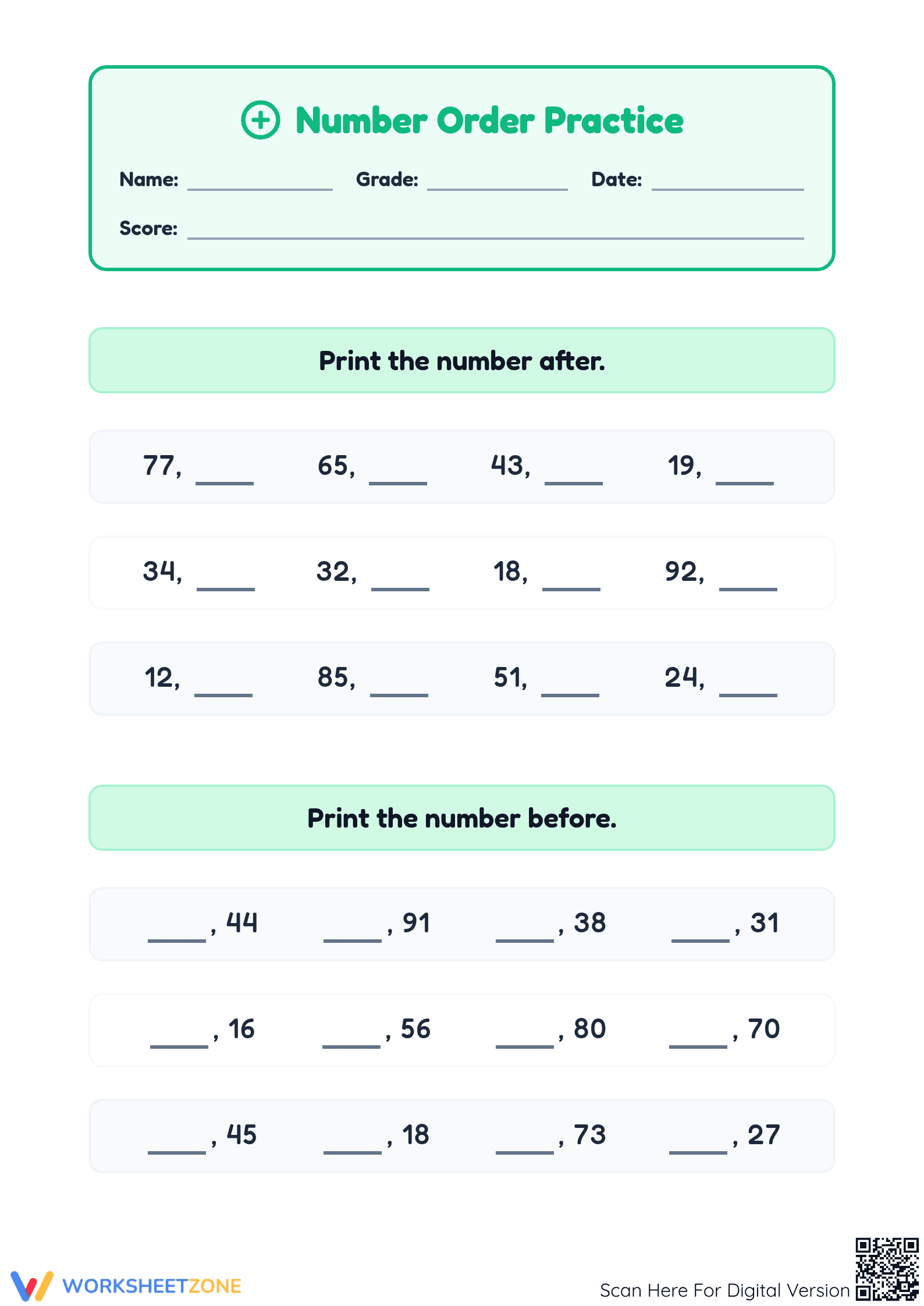
This Essential Number Order Practice worksheet provides Grade 2 students with comprehensive practice in identifying numbers that come before, after, and between values up to 100. By focusing on numerical sequence and position, students solidify their mental number line and transition from simple counting to fluid place value comprehension and comparison skills.
At a Glance
- Grade: Grade 2 · Subject: Math
- Standard:
CCSS.MATH.CONTENT.2.NBT.A.2— Count within 1000 and identify number sequences up to 100- Skill Focus: Number Sequencing (Before/After/Between)
- Format: 2 pages · 33 problems · Answer key included · PDF
- Best For: Independent practice or bell-ringer activity
- Time: 15–20 minutes
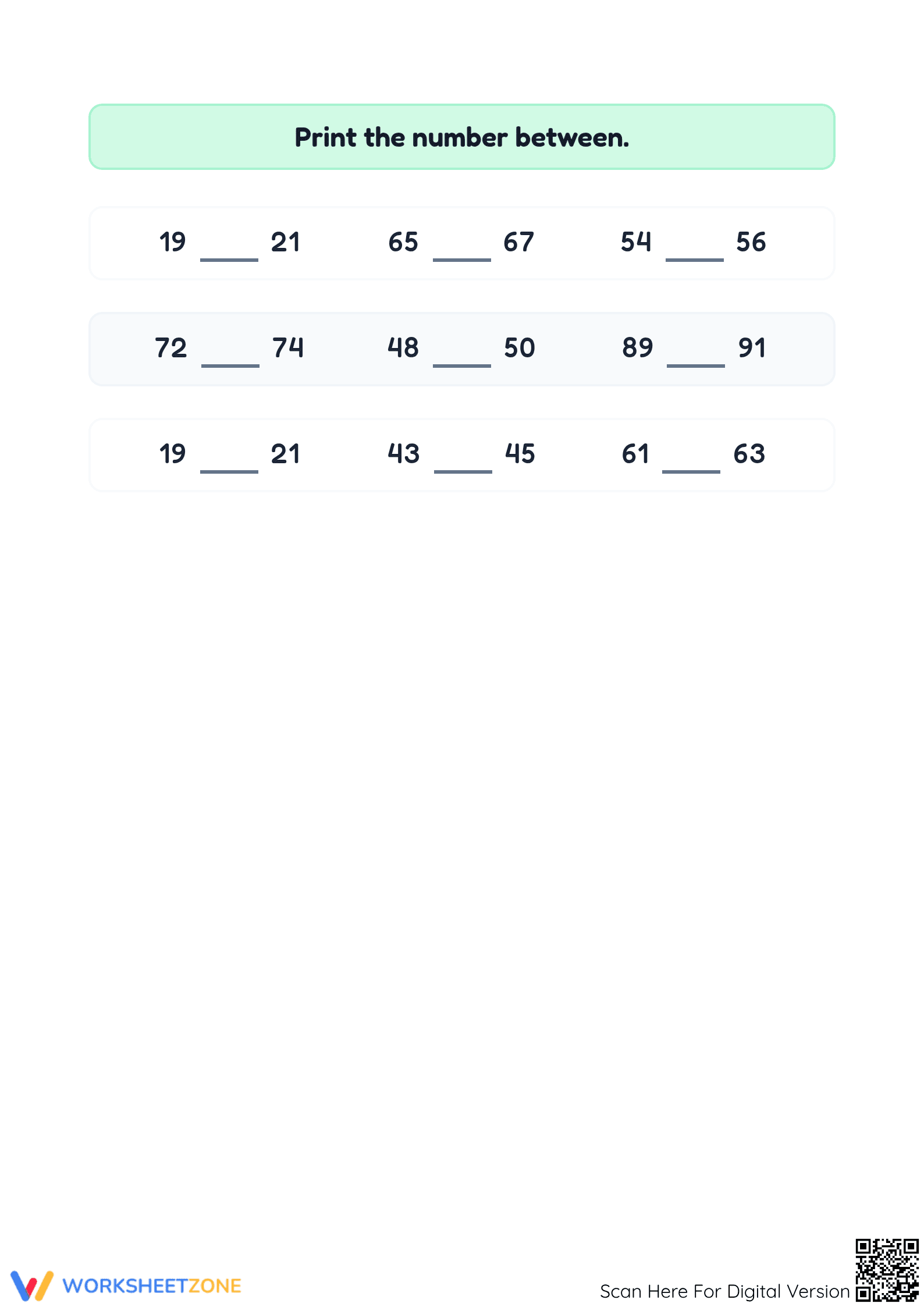
This 2-page PDF collection features 33 distinct problems organized into three logical sections: 12 "after" tasks, 12 "before" tasks, and 9 "between" tasks. The layout is clean and distraction-free, providing ample space for students to write clearly. A full answer key is provided to facilitate rapid grading or student self-correction during independent work periods.
Zero-Prep Workflow
- Print: Output the 2-page document for your entire class in under 30 seconds.
- Distribute: Hand out during independent practice, as a quick quiz, or as a portable homework assignment.
- Review: Utilize the provided answer key to provide immediate feedback or enable student self-checking.
Total teacher preparation time remains under two minutes, making this an ideal solution for emergency sub plans or last-minute instructional transitions.
Standards Alignment
Aligned to CCSS.MATH.CONTENT.2.NBT.A.2, which requires students to count within 1000 and understand number relationships. While focused on the 1-100 range, it serves as a critical prerequisite for skip-counting and larger value comparisons. This standard code can be copied directly into lesson plans, IEP goals, or district curriculum mapping tools.
How to Use It
Use this as a formative assessment after introducing the 100-chart to check for gaps in number-line visualization. Alternatively, assign it as a morning work activity to reinforce sequence automaticity. Observe if students struggle more with the "before" section, which indicates a need for more backward-counting practice. Expected completion time is 15-20 minutes.
Who It's For
This resource is designed for Grade 2 students but is equally effective for Grade 1 learners ready for a challenge or Grade 3 students requiring remedial review. It pairs naturally with a physical hundreds chart or number line anchor chart to support students who are still developing their fluency with two-digit numbers.
According to the ScienceDirect TpT Analysis, repetitive practice in basic number sequencing is a significant predictor of later success in multi-digit addition and subtraction. This worksheet targets CCSS.MATH.CONTENT.2.NBT.A.2 by requiring students to accurately identify the relative positions of numbers within the 100-base system. By isolating the "before," "after," and "between" logic, the resource forces students to move beyond rote counting and instead apply structural logic to the base-ten system. Research indicates that students who master these positional relationships early demonstrate higher confidence when introduced to more complex place value concepts in subsequent units. The 33-task count provides sufficient data points for educators to identify specific misconceptions regarding number magnitude or sequence reversals. This focused practice ensures that the foundational mental number line is robust before students encounter the increased cognitive load of three-digit number operations or regrouping.


