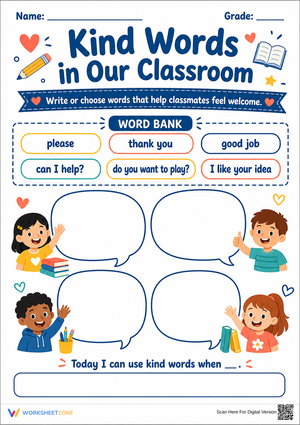
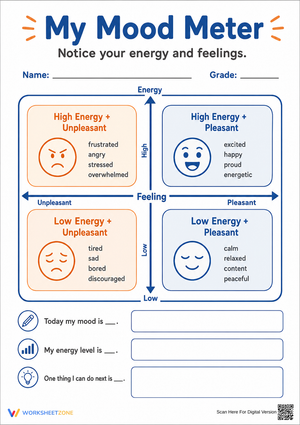
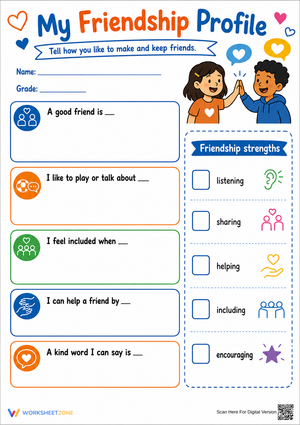
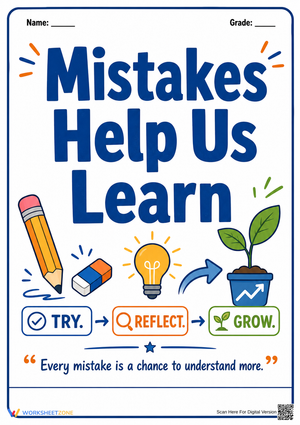
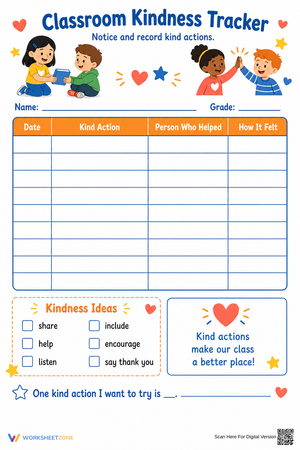
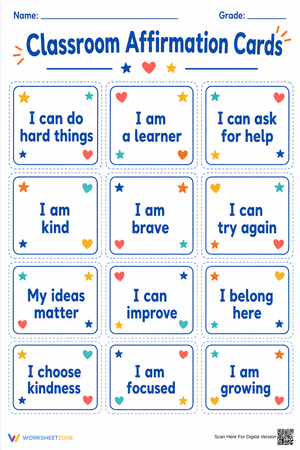
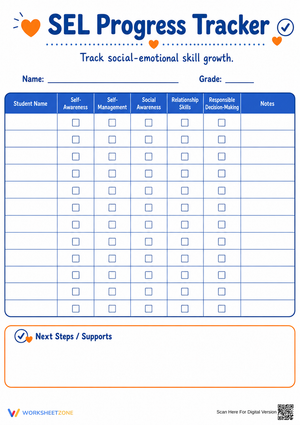
These 2nd grade behavior pdf worksheets give teachers a concrete entry point for the social-emotional instruction that the 7-to-8-year-old window actually calls for — not broad reminders to be kind, but structured practice with naming emotions at their precise intensity, pausing before reacting, and working through how the same situation looks from two different perspectives. What teachers get is a set of standalone worksheets they can drop into morning meeting, pull out after a rough recess, or integrate into a dedicated SEL block.
The Specific Skills These Worksheets Target
The set addresses six skill areas, each with its own worksheet dedicated to one bounded competency:
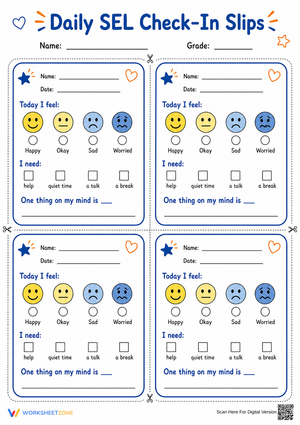
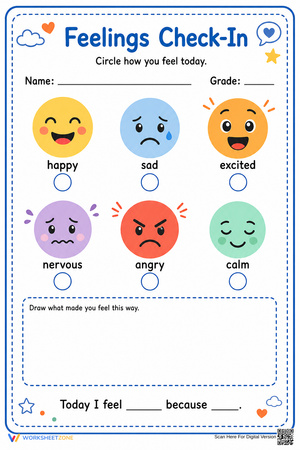
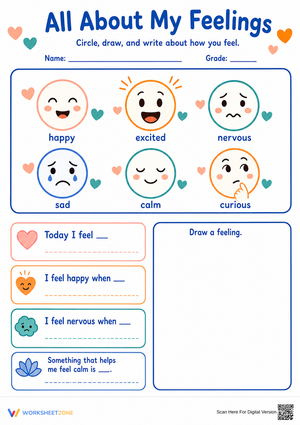
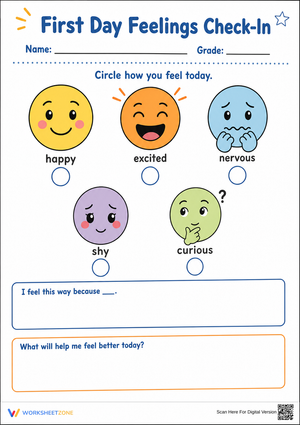
- Emotion identification and intensity labeling
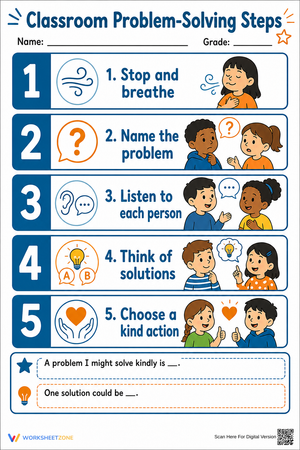
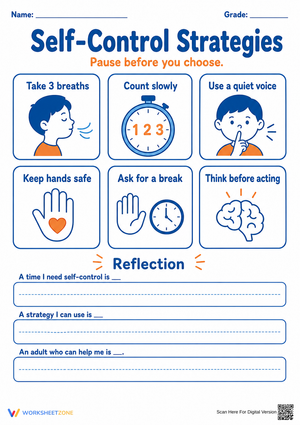
- Impulse control using Stop-Think-Act sequences
- Perspective-taking through two-character viewpoint writing
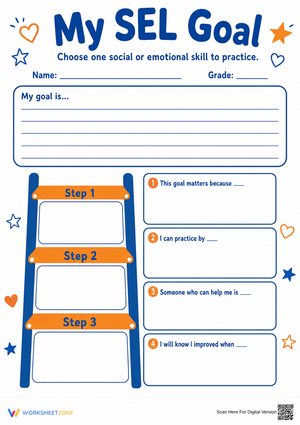
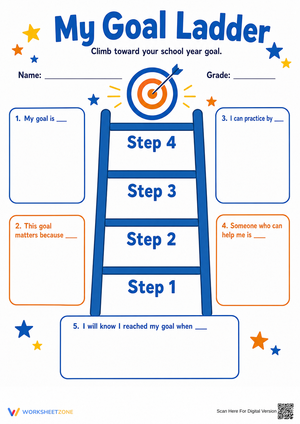
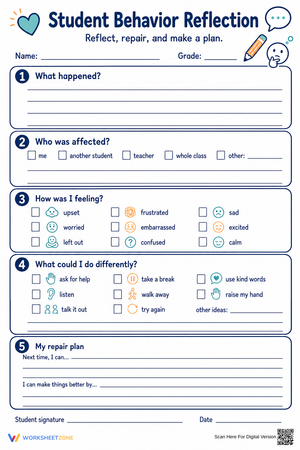
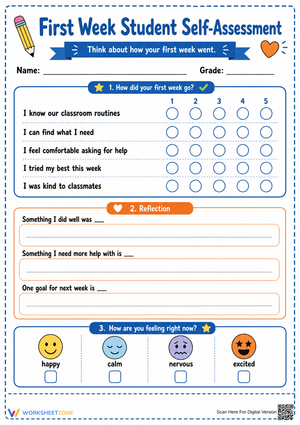
- Self-reflection with guided question prompts
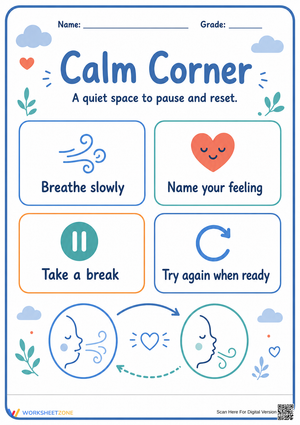
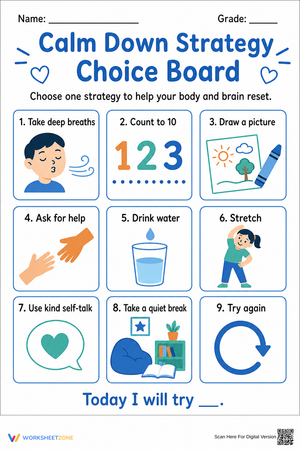
- Calming strategy selection and matching
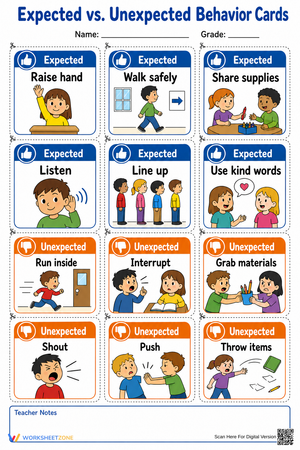
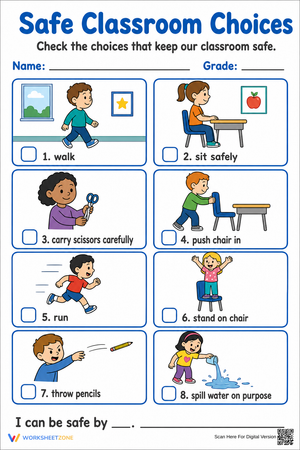
- Classroom rules and logical consequences
The impulse control worksheets present situations drawn from ordinary school moments — someone cuts in line, a partner ruins a shared project, a game ends in a dispute. Students write or draw multiple possible responses and then mark which one they'd actually want a friend to choose. Perspective-taking worksheets ask students to retell the same incident from two characters' points of view. This format lands well at this developmental stage because 7-year-olds are crossing into the ability to hold two viewpoints simultaneously — earlier grades can recite rules, but second graders are beginning to understand why those rules feel different depending on where you're standing.
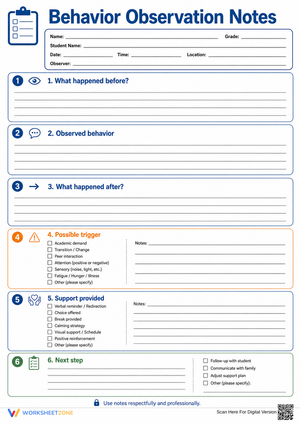
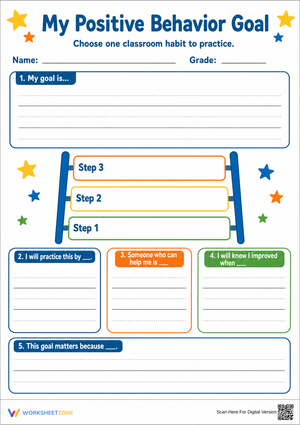
Self-reflection worksheets use specific guiding questions — "What happened?", "What was I thinking at that moment?", "What would I do differently?" — rather than open-ended prompts. Open-ended prompts tend to produce one-sentence responses from most second graders and don't push the thinking far enough. The structured question format moves students through a sequence that mirrors what a teacher-guided debrief would sound like.
Student Errors and Misconceptions to Watch For
The gap that shows up most often: students who complete a worksheet accurately but treat it as a performance task rather than a rehearsal. A student will circle "I would take a deep breath" on the calming strategies worksheet and then, twenty minutes later at center time, throw his pencil when his partner takes his eraser. The worksheet showed comprehension, not internalization. Pairing the written work with a short verbal debrief — "Tell me what you'd actually say to Marcus when that happens" — moves the response out of a multiple-choice format and closer to real application.
Perspective-taking worksheets reveal a different pattern: students understand that the other person "was sad," but they write it as an observed fact rather than something felt. "She was sad because her drawing got ripped" is not the same cognitive work as "If my drawing got ripped, I would feel like no one cared about my work." The shift from observational to empathetic language is visible in student writing, and it tells you where the skill actually sits for that child.
On self-reflection worksheets, most students can answer "What happened?" and "What will I do next time?" without much trouble. The middle question — "What was I thinking at that moment?" — almost always produces a shrug or a brief deflection. For many second graders, accessing the mid-incident mental state in retrospect is genuinely hard. That question is worth slowing down on rather than accepting a non-answer. It's usually where the most useful information lives.
Fitting These Worksheets Into the School Day
The most consistent use pattern is the Monday morning anchor — 10 minutes after morning meeting when the schedule has some breathing room and students are still settling into the week. Introducing one worksheet at the start of the week, then referencing it by name when the skill appears naturally later, creates the repetition that moves a concept from a classroom activity into actual behavior. "Remember what we talked about on Monday — what would you do right now?" is a faster, lower-escalation move than a longer verbal correction in the middle of a conflict.
Reflection worksheets work best when they're not framed as punishment. If a student encounters a reflection worksheet only after misbehaving, the association turns negative and the thinking becomes defensive. Using them proactively — asking a well-regulated student to walk through a situation she handled well — builds the habit of looking inward without a disciplinary moment attached to it.
The emotion identification and calming strategies worksheets also hold up well in the last 8 minutes before dismissal on a high-friction afternoon — brief enough to finish, focused enough to help the group re-center before the rush to backpacks and buses. Keeping a small stack accessible as a predictable cool-down tool, rather than pulling them out only in a crisis, normalizes the practice across the week.
Adjusting the Set for a Range of Learners
For students still developing writing fluency, the drawing-response options on several worksheets carry the full instructional weight. Those worksheets lose nothing by being completed entirely through illustration — the cognitive work of identifying an emotion or planning a response doesn't depend on written language. For students with stronger written fluency, adding the instruction "Write what you would actually say out loud" turns a reflection exercise into something more demanding: verbal language requires more retrieval and specificity than selecting from provided options.
Students farther ahead in social awareness can use the perspective-taking worksheets in pairs — one partner writes one character's account, they trade papers, and the second writes the other. This forces genuine negotiation about what the shared event actually looked like, a more demanding task than writing both viewpoints alone. For students with limited emotional vocabulary, keeping a class emotions word wall visible during worksheet time is a straightforward support structure that doesn't require a separate accommodation plan.
Standard Alignment
These worksheets align to the CASEL framework's five core competency areas: self-awareness, self-management, social awareness, relationship skills, and responsible decision-making. Most state SEL standards reference CASEL directly or use its competencies as the organizational backbone for their grade-band descriptors. For states using the Illinois Social Emotional Learning Standards as a model — a common reference point across districts — second-grade benchmarks under Goal 1 (develop self-awareness and self-management skills) and Goal 2 (use social-awareness and interpersonal skills to establish positive relationships) map directly to the emotion identification, impulse control, and perspective-taking worksheets in this set. Teachers who want to map 2nd grade behavior pdf worksheets to their own state's performance indicators can use CASEL's grade-band alignment documents as the most consistent common thread across state versions.
Frequently Asked Questions
Can these worksheets replace a dedicated SEL curriculum?
The worksheets provide direct instruction in specific skills, but direct instruction is one component of social-emotional development — not the whole structure. Students need repeated opportunities to practice these skills in real social situations, and they need teachers who name and reinforce the skills when they appear organically during the day. The 2nd grade behavior pdf worksheets work well as the explicit-instruction anchor of an SEL approach, paired with real-time coaching and classroom community routines that give students a chance to apply what they've practiced on paper.
How do I handle a student who refuses to complete a reflection worksheet?
Refusal usually signals one of two things: the student is still too activated emotionally to think clearly, or the worksheet has already become associated with punishment. In the first case, give the student 10 to 15 minutes to regulate before starting — answers produced from an escalated state are mostly defensive and not particularly useful. In the second case, use reflection worksheets proactively with the whole class, not only with students who misbehave, so the format carries a neutral association.
When in the school year should I introduce these worksheets?
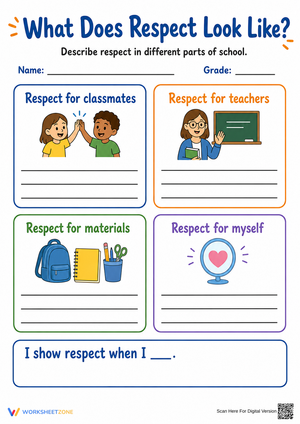
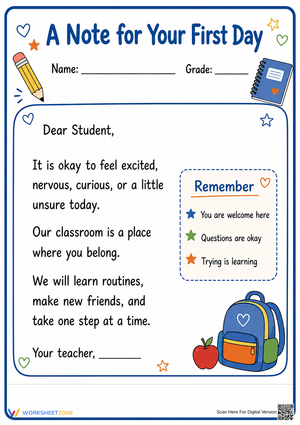
Emotion identification and classroom expectations worksheets make strong opening-week material — they establish shared vocabulary and norms while the class culture is still forming. Hold the self-reflection worksheets until students are comfortable in the classroom environment, typically three to four weeks in, so the first time a student uses one, it doesn't feel like an unfamiliar demand stacked on top of an already stressful moment.
Are these worksheets useful for students on behavioral support plans?
The 2nd grade behavior pdf worksheets serve as useful documentation tools alongside individualized support plans — completed reflection worksheets build a written record of patterns over time that a teacher can bring to a team meeting or a parent conference. A student with significant behavioral needs requires more than structured worksheet practice, though. These resources support the tier-one instruction that benefits all students and can inform tier-two conversations, but they don't replace a counselor or behavior specialist's involvement.
Do these worksheets work for English Language Learners?
Worksheets that rely primarily on drawing, sorting, or visual matching — the emotion thermometer activities, the calming strategies sort — transfer well for ELL students with minimal modification. For worksheets requiring written responses, pairing the activity with oral discussion in the student's home language, when a bilingual paraprofessional or peer is available, preserves the cognitive work of the skill while reducing the language barrier. Pre-teaching the emotional vocabulary before the lesson helps significantly, especially for students at early stages of language production.