


























Views
Downloads
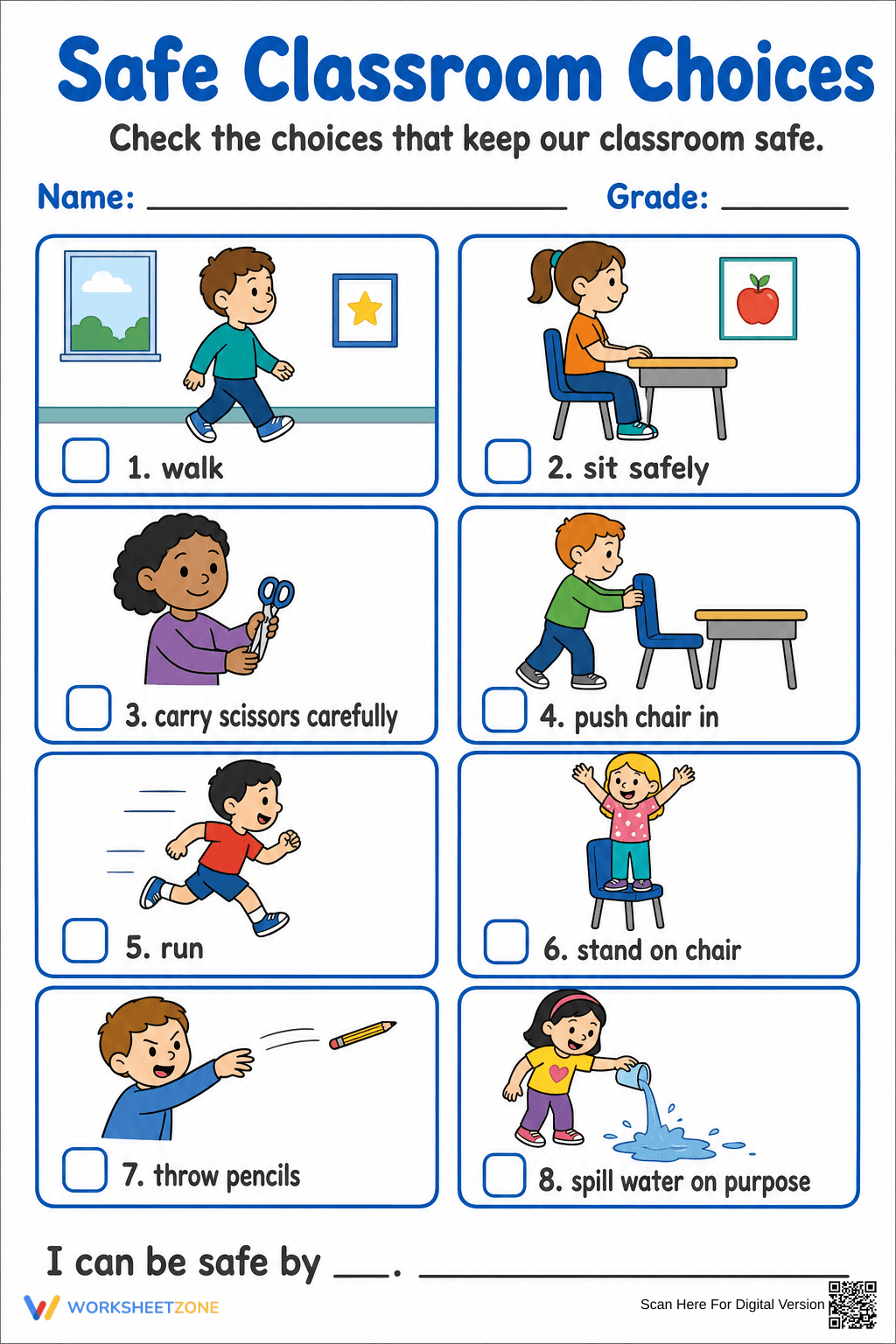

Safe Classroom Choices Worksheet | Grade 1 Printable
Paste this activity's link or code into your existing LMS (Google Classroom, Canvas, Teams, Schoology, Moodle, etc.).
Students can open and work on the activity right away, with no student login required.
You'll still be able to track student progress and results from your teacher account.
This Grade 1 safe classroom choices worksheet helps students identify and reinforce positive behaviors for a secure learning environment. By evaluating eight common classroom scenarios, young learners distinguish between safe and unsafe actions, building foundational social-emotional skills and personal responsibility.
At a Glance
- Grade: 1 · Subject: SEL
- Standard:
CCSS.ELA-LITERACY.RI.1.7— Use illustrations to describe key ideas- Skill Focus: Identifying safe behaviors
- Format: 1 page · 9 problems · Answer key included · PDF
- Best For: Beginning of year routines
- Time: 10–15 minutes
This single-page activity features eight distinct behavioral scenarios. Each scenario includes a clear illustration and a short descriptive label, such as "walk" or "stand on chair." Students use rounded checkboxes to select only the choices that promote safety. The page concludes with a sentence completion task where students write one way they can personally contribute to a secure classroom. A complete answer key is provided for quick reference.
This worksheet offers a streamlined workflow:
- Print (1 minute): The black-and-white friendly design prints quickly and clearly, requiring no special formatting or color ink.
- Distribute (1 minute): Hand out the single page to students during morning work or a dedicated social-emotional learning block.
- Review (3 minutes): Use the included answer key to quickly check student responses or project the page on a smartboard for whole-class discussion.
With under two minutes of total teacher prep time, this resource is an excellent addition to emergency sub plans or spontaneous review sessions.
This activity aligns with CCSS.ELA-LITERACY.RI.1.7, requiring students to use the illustrations and details in a text to describe its key ideas. By analyzing the visual cues in each picture card, students practice critical comprehension skills while internalizing classroom expectations. Both standard codes can be copied directly into lesson plans, IEP goals, or district curriculum mapping tools.
Teachers can deploy this worksheet during the first weeks of school to establish routines, or as a mid-year refresher after a long break. It works exceptionally well immediately following direct instruction on classroom rules. As students complete the nine tasks, teachers can circulate and use the activity as a formative assessment, noting which children struggle to differentiate between safe and unsafe impulses. The activity takes 10 to 15 minutes.
This resource is primarily designed for first-grade students, though it serves as an excellent review for second graders or a guided activity for kindergarteners. The heavy reliance on visual supports makes it highly accessible for English Language Learners and students requiring behavioral accommodations. It pairs perfectly with a whole-group anchor chart detailing classroom expectations or a read-aloud book about school safety.
Explicit instruction in classroom routines is a fundamental component of effective classroom management and long-term student success. When students actively engage with materials that require them to evaluate peer behaviors, they develop stronger self-regulation and decision-making skills. This worksheet directly supports CCSS.ELA-LITERACY.RI.1.7 by asking students to use illustrations to describe key ideas, specifically focusing on safe versus unsafe choices in a school setting. According to a comprehensive RAND AIRS 2024 report, early elementary students receiving consistent, visual reinforcement of behavioral expectations show significantly decreased disruptions and increased active instructional time. By integrating visual discrimination tasks with core social-emotional learning objectives, educators can foster a more secure, inclusive, and highly productive learning environment. This targeted practice ensures that foundational safety concepts are not merely heard during lectures, but actively processed, evaluated, and understood by young learners.


