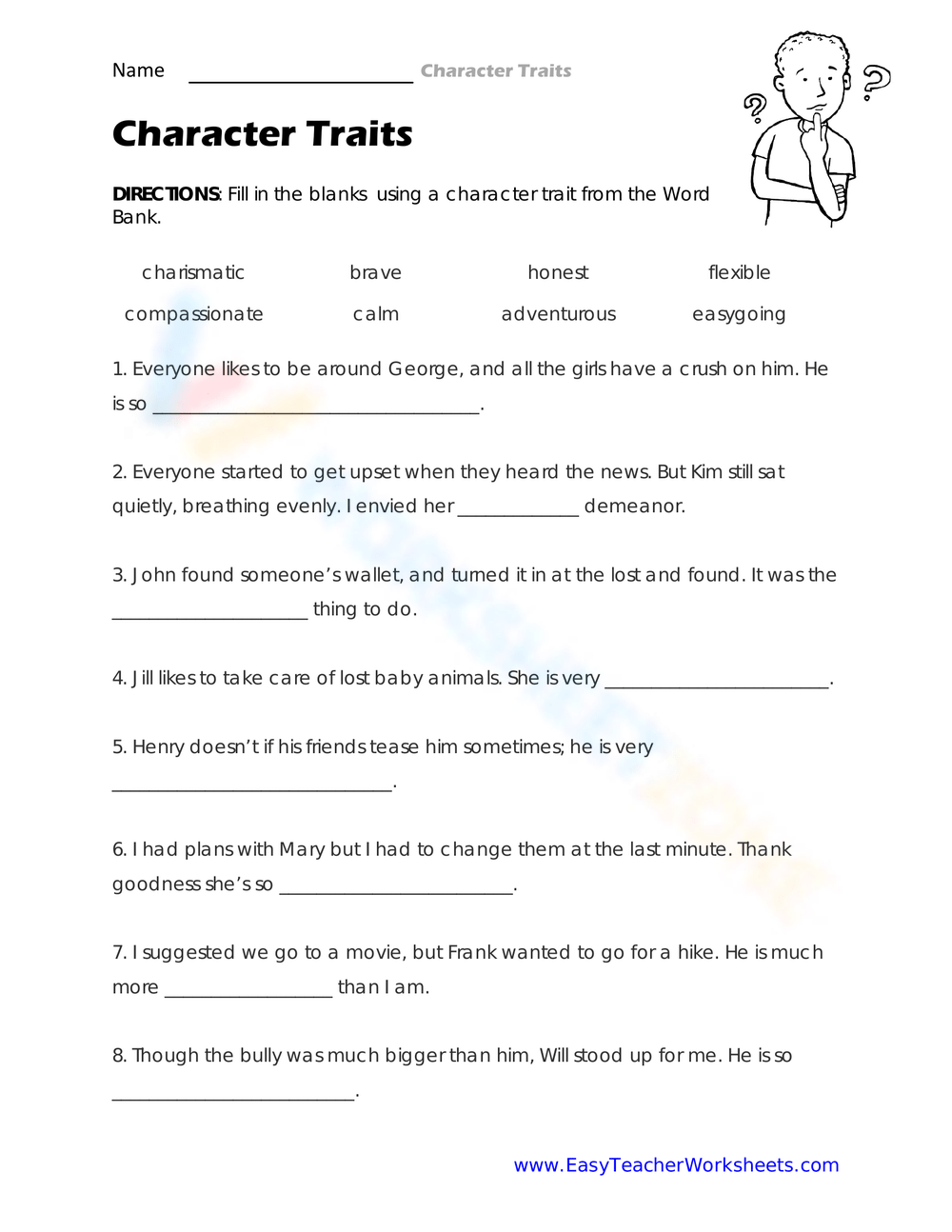
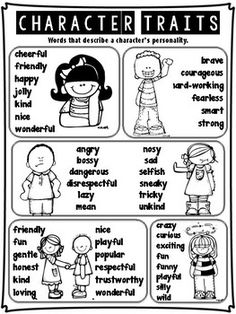
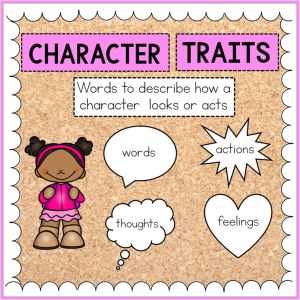
These character traits worksheets printable for 2nd grade give teachers a focused set of resources for building the vocabulary and analytical thinking students need to discuss internal qualities — in book characters, in classmates, and in themselves. Seven- and eight-year-olds are at a specific developmental window: they're beginning to understand that people have stable internal qualities that shape behavior across situations, not just temporary moods tied to a single moment. The worksheets are built around that understanding.
What Students Practice Across the Set
Each worksheet targets a distinct layer of character trait literacy rather than repeating the same format with different vocabulary words. The skills students work through include:
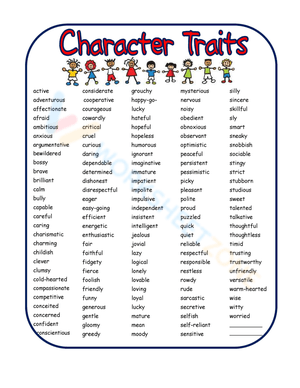
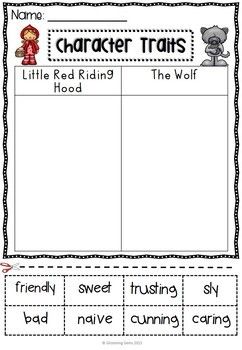
- Inside vs. outside sorting: Students categorize words and phrases — hair color, height, generosity, patience — into physical descriptions and internal qualities. This is usually the activity where the distinction clicks for students who have been treating the two as interchangeable.
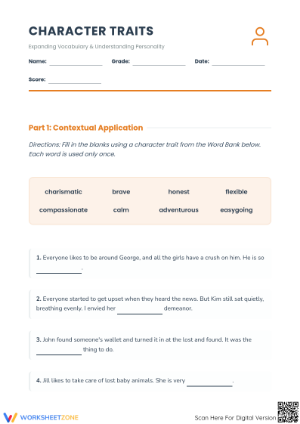
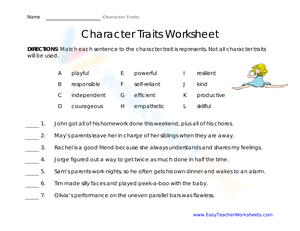
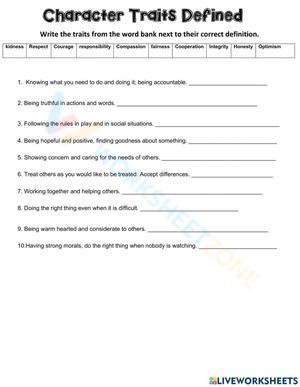
- Vocabulary matching and sentence writing: Students match trait words to definitions, then write an original sentence using the term. The word list includes familiar terms like honest and kind alongside less common ones like perseverance and integrity.
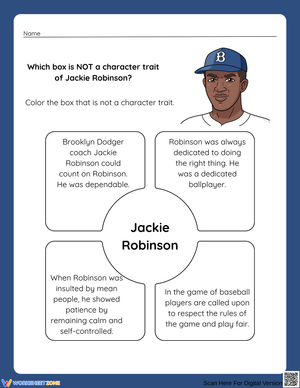
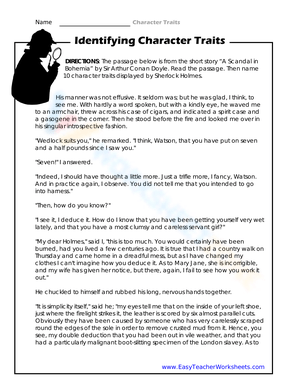
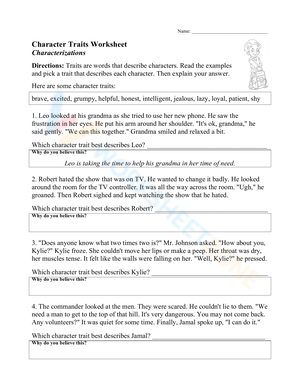
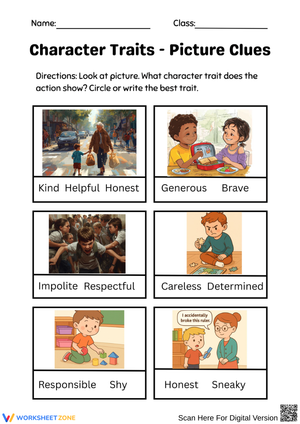
- Scenario analysis: Short passages end with a question asking students to name the trait demonstrated and explain their reasoning in one or two sentences — the same cognitive move required by 3rd-grade reading standards.
- Self-reflection prompts: Students identify a trait they want to practice and describe a situation where they could apply it. These are low-stakes writing tasks, not performance assessments.
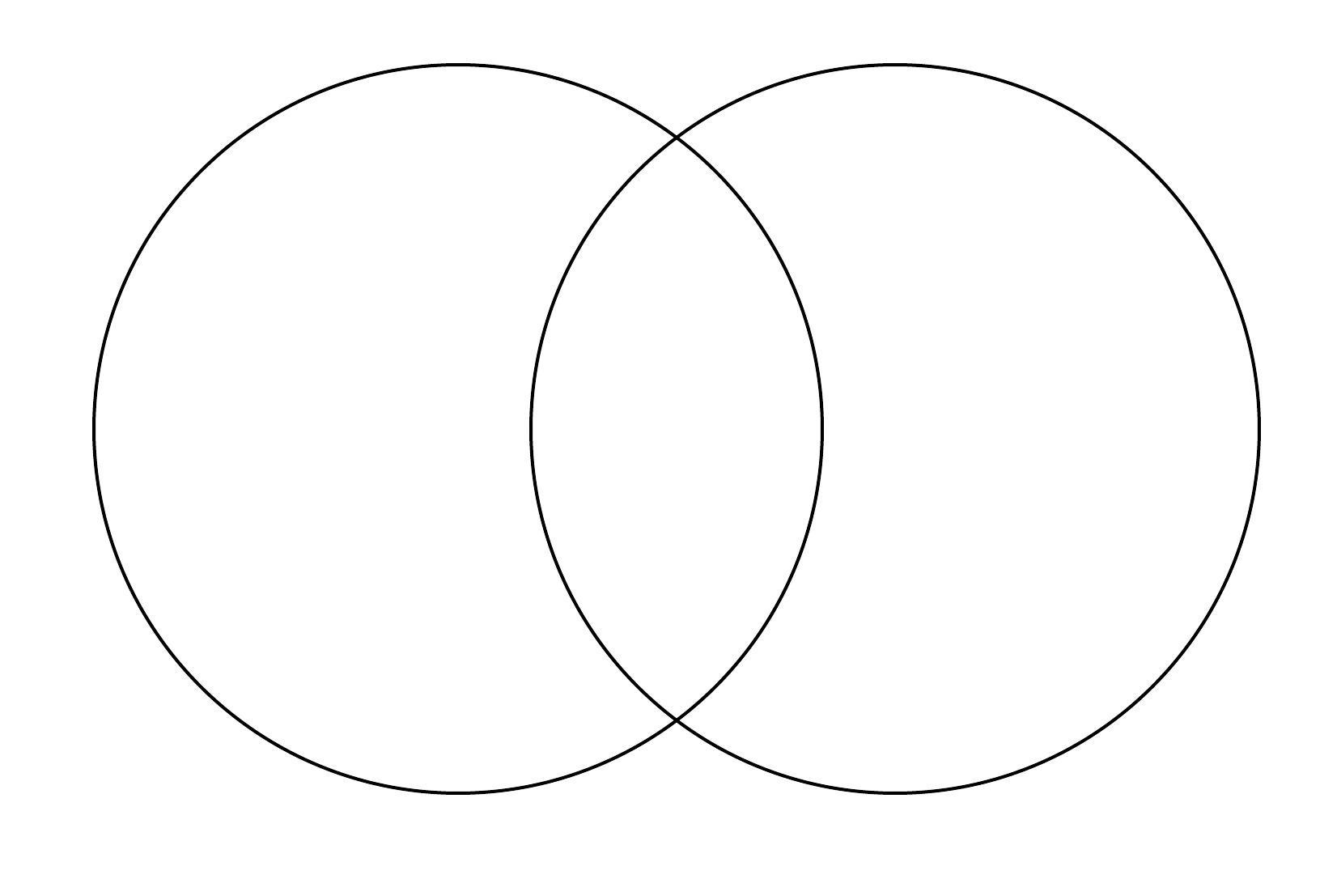
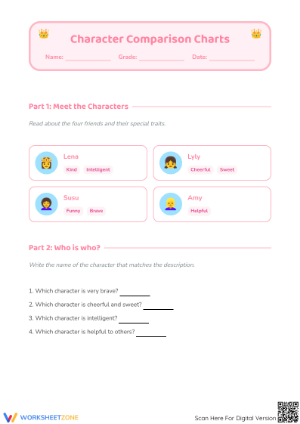
- Character comparison: Students mark which traits two characters from a short passage each demonstrate, building the comparative reading skills they'll need as texts grow more complex.
How to Build These Worksheets Into Your Lesson Plans
The most reliable structure teachers use for character traits worksheets printable for 2nd grade is a trait-of-the-week format. Introduce the vocabulary word on Monday with a brief class discussion and post it somewhere visible. Use the matching or definition worksheet mid-week — Tuesday or Wednesday — as a short independent task. Save scenario analysis for Thursday or Friday, after students have encountered the trait in a read-aloud or morning discussion. That sequencing matters: students who attempt scenario work before building vocabulary tend to guess rather than reason from a definition, and the results show it.
Before distributing a scenario worksheet, consider having partners act out the situation first and then write. When a student physically acts out the moment a character decides to tell the truth about a broken crayon rather than blame a classmate, "honesty" stops being a vocabulary word and becomes something they've experienced. The written answers that follow are almost always more specific and better reasoned. Eight-minute morning meeting tasks also work well — a self-reflection prompt done before the academic day begins gives teachers information worth having. A student who writes "I want to work on patience today because I get mad when I have to wait" is telling you something you'll want to know by first recess.
Student Errors Worth Anticipating Before You Distribute
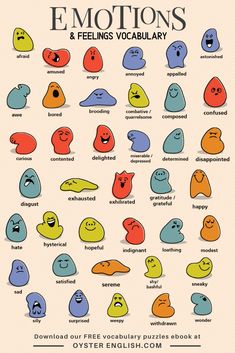
The most persistent confusion at this grade is between feelings and traits. A student who writes "happy" as a character trait isn't entirely wrong to associate it with a person, but they're naming a mood, not a stable quality. The distinction is the conceptual foundation of the whole unit. The clearest correction: ask aloud, "Would this person have that quality even on a hard day?" A child who is kind is still kind when they're tired; a child who feels happy is only happy when things are going well. Running that question with the class before the sorting worksheet prevents a lot of re-dos and frustration.
A second pattern worth watching: students who apply traits freely to book characters but go vague when asked about themselves. On self-reflection prompts, this shows up as "I don't know" or a single-word answer with no situation attached. It's not avoidance — it's that mapping abstract qualities onto oneself requires a level of self-awareness that some second graders haven't developed yet. A sentence frame ("I show _____ when I _____") on those specific worksheets closes the gap for most students without reducing the cognitive demand of the task.
Standard Alignment
The scenario analysis and character comparison worksheets connect directly to CCSS.ELA-LITERACY.RL.2.3, which asks students to describe how characters respond to major events and challenges. Explaining why a character acts a certain way — and naming the internal quality behind the action — is exactly what that standard requires. The vocabulary work also supports CCSS.ELA-LITERACY.L.2.5b, which asks students to distinguish shades of meaning among related words. Sorting terms like brave, courageous, and bold builds precisely that nuance.
On the SEL side, the set aligns with the CASEL framework's self-awareness and social awareness competencies. Most district SEL scope-and-sequence documents for 2nd grade reference these competencies by name, and the trait-of-the-week format maps cleanly onto weekly SEL blocks already built into many school schedules.
Adjusting the Set for a Range of Learners
For students reading below grade level, the vocabulary matching worksheets become more accessible when teachers preview the word list aloud and invite students to draw a quick sketch next to each definition before they begin writing. The sketch gives lower readers an anchor to return to during independent work. Sentence frames on self-reflection prompts serve the same function — they remove the burden of generating sentence structure from scratch without reducing what the student is actually being asked to think through.
Advanced students typically move through scenario analysis quickly and accurately, which means extension needs to be built in. Asking them to write a second scenario of their own — a different situation that shows the same trait — requires generating context rather than analyzing a given one, which is a genuine step up in abstraction. Some teachers pair character traits worksheets printable for 2nd grade with longer read-alouds or independent chapter books at higher Lexile levels, giving strong readers the opportunity to track how a single character's traits develop across a full text rather than a paragraph.
Frequently Asked Questions
How do I explain the difference between a feeling and a character trait to a second grader?
The framing that holds up at this age: feelings pass, traits stay. You can feel sad about something that happened at lunch and still be a generous person. You can feel annoyed with your brother and still be a patient friend. Traits are what someone keeps coming back to, even after the feeling fades. A sorting worksheet that puts "sad," "angry," and "excited" in one column and "honest," "responsible," and "caring" in another makes the distinction visible before you ask students to explain it in words.
Are these worksheets useful for strong readers who struggle with self-reflection?
Strong decoding skills don't predict strong self-reflection — that's worth naming explicitly. Some of the most capable readers in a 2nd-grade class write the vaguest answers on self-reflection prompts, because the skill required is introspection, not reading. For those students, scenario analysis is usually the better entry point. Analyzing someone else's behavior is cognitively easier than examining one's own, and over time the habit of asking "what trait does this character show?" tends to transfer inward.
How many worksheets should I plan for a focused character education unit?
A two-to-three week unit typically uses eight to twelve worksheets — roughly one vocabulary worksheet and one application task per trait introduced. That pace leaves room for discussion and real-world connection between sessions without overwhelming students with written tasks. Teachers using character traits worksheets printable for 2nd grade as part of a yearlong trait-of-the-week structure spread the set across the calendar instead, which is the more common pattern and keeps the vocabulary active across the full school year rather than concentrated in a single stretch.












 Interactive Worksheet Maker
 Quiz Maker
 Word Search Maker
 Crossword Puzzle Maker
 Word Scramble Generator
 Sentence Scramble Generator
 Handwriting Worksheet Generator
 Name Tracing Generator
 Fill In The Blank Generator