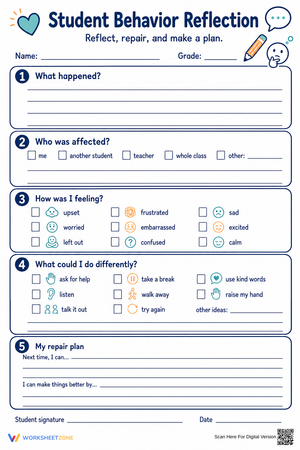
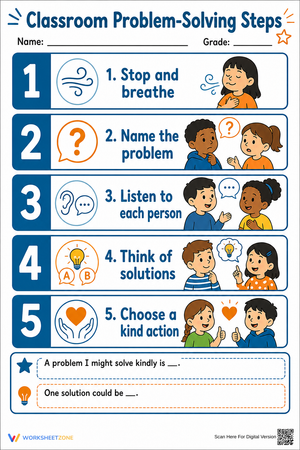
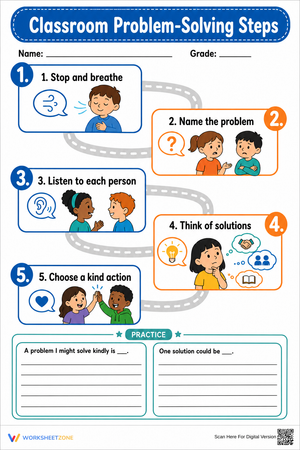
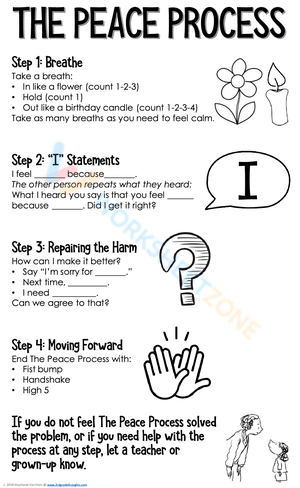
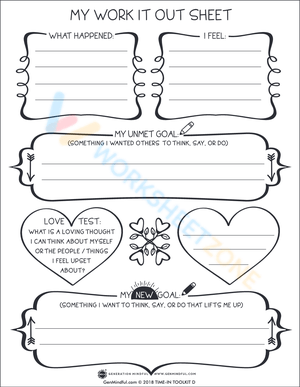
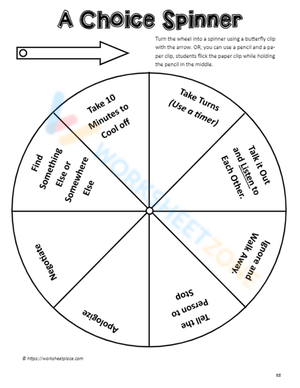
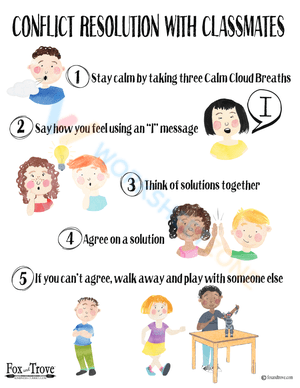
These conflict resolution worksheets pdf for 2nd grade give teachers a structured, printable way to address peer disagreements at exactly the developmental moment when they matter most. Seven- and eight-year-olds are consumed by fairness — when a classmate skips in line or grabs the only red marker, the perceived injustice registers as enormous — but the cognitive flexibility to consider what that classmate was actually thinking is still months from being automatic. The set sits at that intersection, turning abstract social concepts into concrete, repeatable steps students can apply by Friday recess.
The Skills Covered Across the Set
Each worksheet isolates one targeted area of conflict resolution rather than asking students to move through a multi-step process all at once. Second graders retain isolated skills better before they integrate them, so the set is intentionally narrow per worksheet and broad across the whole collection.
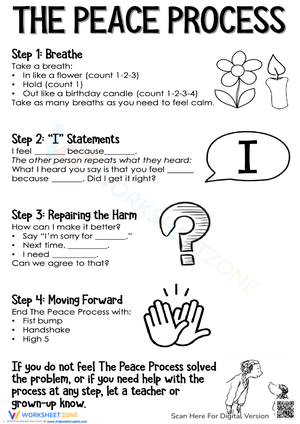
- I-statement construction. Students fill in a sentence frame — "I felt ___ when ___ because ___" — applied to a drawn or described scenario. Having the frame on the worksheet means students don't have to recall its structure while emotionally activated; they follow the prompt instead.
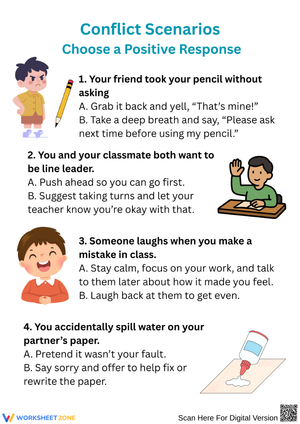
- Big problem vs. small problem sorting. Students read short scenarios and decide: handle it yourself, or get a teacher? This single distinction does more to reduce unnecessary tattling than almost any amount of classroom discussion about it.
- Perspective-taking prompts. Students answer for both characters in a scenario — what did each want, and what might each have felt? Writing both sides forces the cognitive switch to happen slowly and visibly instead of being skipped entirely.
- Win-win brainstorming. Students generate two or three possible compromises and select the one that leaves both characters feeling okay — not necessarily happy, but okay. That distinction matters at this age and is worth naming explicitly.
- Active listening checks. After a role-play or partner conversation, students write what their partner said before writing their own response. The prompt "My partner said..." appears on the worksheet to cue the sequence.
The vocabulary across the set stays close to what second graders actually use. Words like "frustrated," "left out," and "fair" appear throughout — not "disrespected" or "undermined," which are adult framings students often repeat without understanding.
Building These Worksheets Into Your Week
Morning meeting is the natural entry point. Working through one worksheet together as a class — projected on the board, scenario read aloud, responses collected from volunteers — takes about twelve minutes and fits cleanly before the first transition of the day. Introducing one skill per week, in the same order across the set, keeps cognitive load manageable and gives students several days to try the new skill before the next one is introduced.
Keeping a folder of conflict resolution worksheets pdf for 2nd grade in a designated calm-down corner changes the dynamic of post-recess conflicts considerably. When two students come inside still upset, handing each one the relevant worksheet and asking them to fill it out independently before they talk — not instead of talking, but before — almost always produces a calmer conversation. Writing "I felt left out when you picked teams without asking me" does work that telling the teacher the same story does not.
One honest limitation: these worksheets are least effective when handed to a student who is still dysregulated. They work best after two or three minutes of cool-down, once the student can read the prompt without it feeling punitive. Teachers who try to use them as a real-time regulation tool during an active meltdown usually end up setting the worksheet aside — which is the right call, but the worksheet serves a different purpose than regulation.
Mistakes Students Make That These Worksheets Help Surface
I-statement work trips students up in a predictable way. Most second graders write "I feel mad when you are mean" and consider the task complete. The word "mean" is a judgment, not a behavior, and students need to hear that distinction named directly. The redirect that works best: "What exactly did they do? Can you describe it without using the word 'mean'?" Asking that same question consistently over several weeks produces noticeably more specific language in later worksheets — the shift from "being mean" to "took my pencil without asking" represents real conceptual growth, and you can see it accumulating in the writing.
Win-win brainstorming produces a reliable shortcut: "just share" appears as the solution for nearly every scenario a student hasn't thought through carefully. It sounds cooperative, which is probably why students reach for it, but it usually means they haven't considered the specifics of the situation. The worksheets that include a second solution line — "What else could they do?" — break this pattern more reliably than additional instruction about it.
The big-vs.-small sorting task surfaces useful information beyond the skill itself. Students who feel genuinely unsafe tend to categorize almost everything as a big problem requiring adult help. Students eager to appear capable tend to underreport, marking things like being shoved as small problems they'll handle themselves. Both patterns show up regularly in second-grade classrooms, and seeing them in writing is easier to act on than inferring them from behavior alone.
Adjusting the Set for a Range of Learners
For students still building reading fluency, the scenario text on each worksheet can be read aloud while the student follows along, then the student responds verbally while a partner or aide records the answer. The sentence frames stay identical; only the input method changes. This keeps the social learning intact without turning the exercise into a decoding task.
Students who move through the basic frames quickly benefit from an additional layer built into the perspective-taking worksheets: after filling in their own I-statement, they write one for the other character in the scenario. Holding two perspectives simultaneously is a real cognitive stretch at this age, and the worksheet format supports that extension without requiring separate materials.
For students with IEPs that include social-emotional goals, many of these worksheets produce documented, measurable artifacts. A student who correctly identifies the other character's perspective on four out of five scenarios has produced something that can be referenced at a progress-monitoring meeting — more useful than a general note about "improved conflict resolution" when it's time to discuss goal mastery.
Standard Alignment
These worksheets align with CASEL's Relationship Skills domain, specifically the competency of resolving conflicts constructively. In ELA terms, the perspective-taking and active listening worksheets connect to CCSS.ELA-LITERACY.SL.2.1, which asks second graders to build on others' ideas and express their own clearly during collaborative conversations. The I-statement and brainstorming worksheets support CCSS.ELA-LITERACY.W.2.1, where students introduce a topic and supply reasons — the same underlying logic students use when explaining why one compromise works better than another. That ELA connection makes it straightforward to carve out instructional time for these worksheets during the literacy or writing block rather than treating them as an add-on to an already full day.
Frequently Asked Questions
Can students use these worksheets independently, or do they need teacher guidance each time?
Once the routine is established — usually after three or four weeks of whole-class practice — most second graders use the I-statement and big-vs.-small worksheets without direct support during a designated calm-down time. The perspective-taking and brainstorming worksheets need more guided practice until mid-year, because generating multiple solutions and holding another person's viewpoint simultaneously take longer to internalize at this developmental stage.
How does this set fit alongside an existing SEL curriculum?
The conflict resolution worksheets pdf for 2nd grade in this set work well alongside Second Step, Responsive Classroom, and similar programs rather than replacing them. Most structured SEL curricula build shared vocabulary and classroom norms; these printables give students a place to practice applying those concepts to specific scenarios. Teachers using Second Step often pull the perspective-taking worksheets to extend the empathy units and the big-vs.-small sorting worksheets to reinforce the lesson on when to ask for adult help.
What should I do if a student refuses to fill out a worksheet during a conflict?
Refusal usually signals the student is still activated. These worksheets are reflection and communication tools — not regulation tools — and requiring one too soon turns the resource into a consequence. Let the student calm down first, then offer the worksheet as a way to explain their side of what happened. Framing it as "this helps me understand your perspective" rather than "you need to complete this" changes the dynamic in a way that's immediately noticeable.
Is there a recommended order for introducing the different worksheet types across the year?
The conflict resolution worksheets pdf for 2nd grade in this set work best when introduced in this sequence: big-vs.-small sorting first (establishes when to seek help versus handle it independently), then I-statements (gives students language for their own feelings), then perspective-taking (extends that language to someone else's experience), then win-win brainstorming (builds on all the prior work). Active listening worksheets fit well alongside either the I-statement or perspective-taking phase, depending on where your class shows the most difficulty.












 Interactive Worksheet Maker
 Quiz Maker
 Word Search Maker
 Crossword Puzzle Maker
 Word Scramble Generator
 Sentence Scramble Generator
 Handwriting Worksheet Generator
 Name Tracing Generator
 Fill In The Blank Generator